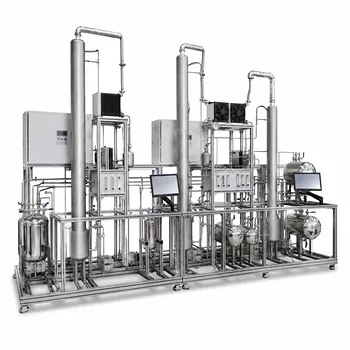
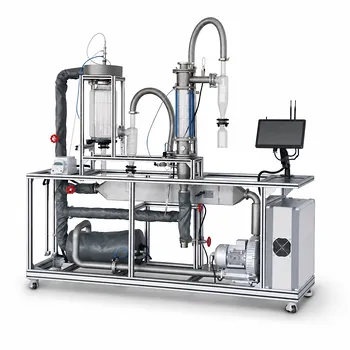
Here’s the short answer: Performing a shortcut fractionation simulation first gives you the reliable initial estimates that a rigorous tray-to-tray simulator absolutely needs to converge. Without those pre-calculated values—like stage counts, reflux ratios, and temperature profiles—the complex non-linear solvers in rigorous models will frequently fail, wasting hours of lab time and obscuring the real physics of the pilot plant.
A shortcut simulation is not a simplified toy; it is the strategic prerequisite that transforms a rigorous distillation model from a black-box guessing game into a trustworthy, physics-based tool. By providing accurate initial guesses, it prevents numerical convergence failure and creates a clear theoretical baseline against which you can critically evaluate real pilot-plant data.
The Practical Necessity: Preventing Convergence Failure
Why Rigorous Solvers Demand a Good Starting Point
Rigorous tray-to-tray simulations solve coupled mass, equilibrium, summation, and enthalpy (MESH) equations for every stage simultaneously. These equations are highly non-linear and sensitive to initial conditions.
Modern algorithms, often using the Soave-Redlich-Kwong equation of state with inside-out convergence loops, will simply not converge if fed arbitrary guesses. The mathematical path to a solution depends on landing in the right basin of attraction from the very first iteration.
How Shortcut Results Feed the Solver
Shortcut methods like Fenske-Underwood-Gilliland yield logical, physically grounded estimates for minimum stages, minimum reflux, and optimal feed location. When these numbers are seeded into the rigorous model, the solver starts near the true solution.
This eliminates the most common source of frustration in distillation simulation: a model that runs endlessly without converging, or converges to a physically meaningless result. The shortcut output gives the rigorous simulation a map before it starts walking.
Direct Impact on Pilot-Plant Comparisons
If a rigorous simulation fails to converge, you cannot compare its predictions against the real column. By ensuring convergence, the shortcut step enables the core educational loop: comparing theoretical predictions (from both shortcut and rigorous models) with measured temperature profiles, purities, and duties from the physical unit.
Building a Theoretical Baseline for the Pilot Plant
Transforming Column Setup into a Calculated Decision
Shortcut calculations directly inform how you physically configure the distillation pilot plant. You determine the required number of theoretical stages, choose the actual number of trays or packing height, and locate feed ports accordingly.
For an educational lab, this turns "assembly by guesswork" into a deliberate design process. Students learn that the hardware setup follows from a verifiable theoretical foundation, not just a standard operating procedure.
Establishing Performance Expectations Before Startup
Running the shortcut model sets clear, quantifiable expectations. You know the minimum reflux ratio you must exceed, the approximate top and bottom temperatures, and the expected distillate purity at a given boil-up.
This baseline serves as a reference point when you later observe the real column. Deviations become opportunities for learning: they highlight heat loss, tray inefficiency, or non-ideal mixture effects that the shortcut assumptions ignore.
Creating a Safe Operating Envelope
Operating a distillation column far from its calculated limits can waste energy or overload the condenser and reboiler. Shortcut estimates of reboiler duty and condenser cooling load prevent you from selecting a reflux ratio that would thermally stress the pilot plant. The shortcut step becomes a safety and efficiency checkpoint before you ever turn on the heating medium.
Bridging Theory and Physical Reality
The Two-Model Comparison as a Learning Engine
A well-designed unit operations lab does not stop at one model. When students compare shortcut predictions, rigorous simulation outputs, and actual pilot-plant data, they see exactly where idealized assumptions break down.
The shortcut assumes constant molal overflow and constant relative volatility. When the real column shows a notably different temperature profile or lower separation, students must diagnose why—perhaps azeotropic behavior, heat loss, or tray weeping. This comparison embeds deep understanding of thermodynamic non-idealities.
Why the Rigorous Model Alone Is Not Enough
A rigorous simulation can perfectly converge and still give numbers that disagree with the plant. Without the shortcut baseline, students might not know whether the deviation comes from poor simulation setup or real physical phenomena.
Shortcut results provide a low-fidelity but zero-ambiguity anchor. The gap between shortcut and rigorous simulation highlights model fidelity; the gap between rigorous simulation and pilot plant highlights physical reality. Both gaps are essential for developing engineering judgment.
Understanding the Trade-offs and Limitations
What Shortcut Methods Deliberately Ignore
Shortcut calculations assume constant relative volatility and constant molal overflow—conditions that rarely hold in non-ideal mixtures or systems with significant heat effects. They also typically handle only two key components and struggle with complex column configurations like side draws or multiple feeds.
If you naively trust shortcut predictions without a rigorous follow-up, you risk designing a column that can never meet purity specs for a highly non-ideal mixture. The shortcut is a starting point, not the final answer.
The Risk of Premature Automation
Modern simulators can automatically generate initial estimates. However, bypassing the deliberate, manual shortcut step deprives students of the chance to internalize the Fenske-Underwood-Gilliland logic. They lose the intuition for how changing relative volatility or recovery changes column size, which is critical for troubleshooting real columns later.
The educational value lies not just in getting the numbers, but in deriving them yourself and understanding their origin.
When Shortcut Results Can Mislead
For a strongly non-ideal system—like ethanol-water—a shortcut model based on constant relative volatility may suggest a feasible separation that the rigorous model and pilot plant will reveal as impossible below the azeotrope. The correction comes from the rigorous simulation, but the student must be taught to anticipate this failure. That anticipation is built by doing the shortcut first and then seeing the discrepancy.
How to Apply This to Your Lab or Design Project
After grasping the “why,” the practical application boils down to aligning the two-step approach with your specific goal.
- If your primary focus is educating students on distillation fundamentals: Have them manually perform the shortcut calculation (Fenske-Underwood-Gilliland) before touching any simulator. Then require them to import these values into the rigorous tool and explain every discrepancy against the pilot-plant data.
- If your primary focus is rapid process screening for a pilot-plant design: Use a shortcut tool to quickly bracket the feasible range of stages and reflux. Only then move to rigorous simulation for the few promising configurations, saving significant computation and set-up time.
- If your primary focus is safe and efficient pilot-plant operation: Never start the column without shortcut-derived estimates for heat duties, temperatures, and reflux. These numbers become your operating limits and alert you to sensor drift or incipient flooding during the run.
This single habit—shortcut first, rigorous second, pilot plant third—turns distillation from a recipe-following exercise into a true engineering investigation.
Summary Table:
| Feature | Shortcut Simulation | Rigorous Simulation |
|---|---|---|
| Key Equations | Fenske-Underwood-Gilliland | MESH (Mass, Equilibrium, Sum, Enthalpy) |
| Convergence | Always converges (algebraic) | Highly sensitive; requires precise initial guesses |
| Assumptions | Constant relative volatility & molal overflow | Real thermodynamic properties & non-idealities |
| Primary Role | Provides baseline estimates (reflux, stages) | Validates final design & matches pilot plant data |
Bring Industry-Grade Unit Operations to Your Institution
To truly master distillation and process design, students and researchers must compare theoretical models with physical systems. LABPARK provides premium Educational and Vocational Unit Operations Pilot Plants in chemical engineering, bioprocess & biotech, and environmental & water treatment.
Tailored for universities, research institutes, and enterprises, our advanced pilot plants turn complex thermodynamic equations into hands-on learning engines and reliable research platforms.
Contact LABPARK today to find the perfect pilot plant solution for your lab!
Related Products
- Continuous Sieve-Plate Distillation Pilot Plant for Unit Operations Laboratory Education
- Multi-Modal Distillation Unit Operations Training Pilot Plant
- Green Anhydrous Ethanol Purification Extractive Distillation Unit Operations Training Pilot Plant
- Dual-Mode Rectification Pilot Plant for Practical Training Unit Operations
- Ethyl Acetate Synthesis Unit Operations Pilot Plant for Practical Training
People Also Ask
- Why is vacuum operation capability an essential feature for a distillation unit operations pilot plant? Unlock Efficiency
- How does catalyst water concentration affect distillation pilot plant design? Key separation train choices.
- What are the primary reflux ratio control strategies? Master Distillation Unit Operations
- How to select the right activity coefficient model (Wilson, NRTL, UNIQUAC) for distillation pilot plants?
- How can real-time carbon number prediction improve distillation pilot plants? Optimize control.