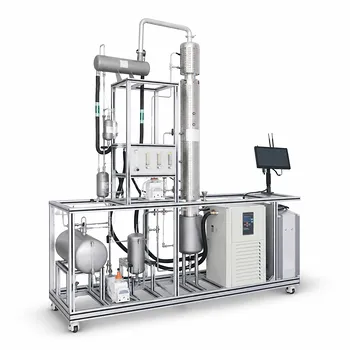
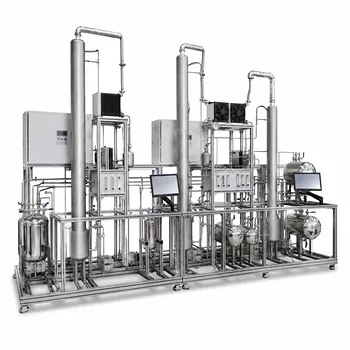
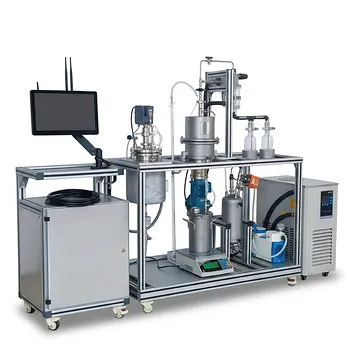
The pilot plant is your laboratory for mastering the central tension of industrial distillation. At their core, educational distillation units demonstrate two fundamental reflux control strategies: constant reflux ratio and constant distillate composition. A constant reflux ratio simplifies operation, keeping the return flow to the column fixed relative to the distillate take-off, making it a perfect tool for teaching steady-state theory. In contrast, constant distillate composition mode demands dynamic adjustment of the reflux ratio to maintain product purity as the still pot depletes, providing a live-fire exercise in closed-loop process control and automation.
While constant reflux ratio mode teaches foundational theory through stable analysis, constant distillate composition mode forces students to confront the dynamic, real-world reality of process control. The true training benefit emerges when students navigate the trade-offs between these strategies, learning when simplicity yields to the necessity of automation for maintaining product quality.
Laying the Foundation: The Baseline State
Before exploring dynamic control strategies, students must establish a baseline for their column's maximum potential. This is where theoretical and practical training intersect.
The Pedagogical Power of Total Reflux
Operating at total reflux means no product is withdrawn; all condensate returns to the column.
This creates an infinite reflux ratio. It's the simplest state to achieve experimentally because you eliminate the need to balance continuous feed and product flows. As a training tool, it allows students to establish steady-state conditions effortlessly and measure the column's absolute separating capability, as described by the Fenske equation.
This baseline run determines the minimum number of theoretical stages for a given separation. Students can then compare this ideal performance against data gathered during normal production runs, directly visualizing the efficiency penalty of drawing off product.
Strategy One: The Constant Reflux Ratio
This is often the first operational mode students encounter. Its value lies not in its industrial ubiquity, but in its analytical clarity.
A Window into McCabe-Thiele Analysis
In constant reflux ratio mode, a fixed portion of the overhead condensate is sent back to the column. This stability creates a fixed operating line slope, making the process perfectly suited for graphical analysis using the McCabe-Thiele method on an x-y diagram.
Students can physically "step off" theoretical stages from their collected data, which cements a visceral understanding of mass balance concepts. This strategy excels at answering fundamental questions: given this fixed ratio and our column's number of stages, what purity can we expect?
Teaching the Core Cost Trade-off
This mode provides a controlled environment to explore the relationship between energy input and separation quality. By manually changing the ratio and allowing the column to reach a new steady state, the operational cost equation becomes tangible.
Increasing the reflux ratio demonstrably improves product purity, but students can read the increased energy consumption directly from the reboiler heater and condenser cooling water flow meters. This makes the abstract trade-off between capital cost (number of trays) and operating cost (energy) a measurable reality.
Strategy Two: Constant Distillate Composition
This strategy shifts the learning objective from steady-state theory to dynamic control. The product's purity is the target, and the reflux ratio becomes the weapon.
Mastering the Dynamic Control Loop
Here, the reflux ratio is not a set-point but a manipulated variable. As the lighter components boil off, the still pot becomes heavier, and the column's natural tendency is to produce a less pure distillate.
To hold the constant distillate composition, the control system must continuously increase the reflux ratio. This forces the student to engineer a control loop using temperature sensors, automated valves, and a PID controller or PLC.
From Theory to Industrial Reality
This mode is a crucible for teaching automation. A student learns that a fixed input does not guarantee a fixed output in a batch or transient condition. They gain hands-on experience in tuning a controller's response to a drifting process variable, a core competency for any process engineer.
The lesson is profound: this strategy maintains product quality but at the cost of a climbing energy bill and decreasing product flow rate as the batch progresses. It’s a direct experience with the operational sacrifices required for consistent quality.
Understanding the Trade-offs and Operational Limits
A complete training module must also expose the physical and theoretical constraints that bound these strategies.
The Energy-Separation Dilemma
Every control decision is a compromise. Operating at a fixed, low constant reflux ratio saves energy but may fail to meet purity specifications if the column lacks sufficient physical stages. Conversely, a high reflux ratio brings operational risks beyond just energy cost. Students must learn to identify the chosen ratio in context, typically framed as a multiple of the minimum reflux ratio (R_min), often within a practical range of $1.1$ to $1.5$ times $R_{min}$.
Physical Constraints: Flooding and Material Balance
The column's internal plumbing imposes physical limits. A very high reflux ratio can overwhelm the column's internal capacity, leading to flooding, a dramatic failure mode students can safely witness in a pilot environment. Furthermore, theory sets ultimate boundaries. Even at infinite reflux, the separation is capped by the physical number of stages, and the maximum possible product rate is governed by the overall material balance, specifically the ratio $F x_F / D$.
The Complexity Cue: Reactive Distillation
A pilot plant can also offer a glimpse into advanced topics like reactive distillation. Here, the simple compensatory relationship between reflux ratio and stages breaks down entirely. The ratio affects catalyst contact time and reaction kinetics, creating a non-linear system where a simple R_min may not exist. Instead, there is a specific optimal reflux ratio for peak conversion, highlighting that distillation control strategies are highly dependent on the underlying chemistry.
How to Apply This to Your Training Program
The choice between emphasizing constant reflux ratio or constant composition control in a curriculum depends on your primary training objective. The pilot plant itself must be equipped with automated valves, flow meters, and a flexible data acquisition system to toggle between these modes.
- If your primary focus is teaching fundamental thermodynamics and column design: Start with the constant reflux ratio mode. Use it to teach McCabe-Thiele stepping and the Fenske equation baseline, ensuring students intuitively grasp the relationship between operating lines and theoretical stages.
- If your primary focus is developing practical process control and automation skills: Design exercises around the constant distillate composition mode. Challenge students to write and tune the control logic that automatically increases the reflux ratio to maintain purity during a batch run.
- If your primary focus is optimizing for energy efficiency and cost analysis: Create an experiment where students must find the lowest possible constant reflux ratio that still meets a purity target, then compare those energy costs directly with a run in constant composition mode.
The most valuable training a pilot plant provides is not the answer but the earned intuition for navigating the permanent tension between product quality, energy consumption, and operational stability.
Summary Table:
| Control Strategy | Core Concept | Key Training Benefit | Operational Focus |
|---|---|---|---|
| Total Reflux | Infinite reflux; all condensate returns to the column | Establishes baseline separation capability via the Fenske equation | Determining minimum theoretical stages |
| Constant Reflux Ratio | Fixed return flow relative to distillate take-off | Simplifies McCabe-Thiele analysis and demonstrates steady-state energy trade-offs | Foundational design and cost-to-purity analysis |
| Constant Distillate Composition | Dynamic adjustment of reflux ratio to maintain product purity | Provides hands-on PID/PLC loop tuning and automation troubleshooting | Real-world process control and transient operations |
Elevate Your Chemical Engineering Lab with LABPARK
Are you looking to provide your students or researchers with hands-on experience in distillation control strategies?
LABPARK designs and manufactures high-quality Educational and Vocational Unit Operations Pilot Plants in chemical engineering, bioprocess & biotech, and environmental & water treatment. Our custom pilot units empower universities, research institutes, and enterprises to bridge the gap between classroom theory and industrial process control.
Ready to upgrade your training curriculum? Contact LABPARK today to discuss your laboratory's custom requirements!
Related Products
- Continuous Sieve-Plate Distillation Pilot Plant for Unit Operations Laboratory Education
- Multi-Modal Distillation Unit Operations Training Pilot Plant
- Green Anhydrous Ethanol Purification Extractive Distillation Unit Operations Training Pilot Plant
- Dual-Mode Rectification Pilot Plant for Practical Training Unit Operations
- Ethyl Acetate Synthesis Unit Operations Pilot Plant for Practical Training
People Also Ask
- How to select the right activity coefficient model (Wilson, NRTL, UNIQUAC) for distillation pilot plants?
- Why is vacuum operation capability an essential feature for a distillation unit operations pilot plant? Unlock Efficiency
- How does catalyst water concentration affect distillation pilot plant design? Key separation train choices.
- How can real-time carbon number prediction improve distillation pilot plants? Optimize control.
- Why run shortcut fractionation before rigorous distillation calculations? Optimize your pilot plant.