The reason vacuum operation is a non-negotiable feature for a distillation pilot plant boils down to a single thermodynamic advantage: it artificially manipulates relative volatility. By lowering the system's operating pressure, you reduce the boiling points of the mixture’s components, which increases their relative volatility ((\alpha)) and makes the separation thermodynamically easier to achieve. Without vacuum capability, a pilot plant cannot accurately analyze the behavior of high-boiling or heat-sensitive mixtures, fundamentally limiting its usefulness for research and process development.
To analyze true separation efficiency, a pilot plant must isolate the variables of mass transfer and hydraulics. Vacuum operation is the primary tool for lowering the required energy input by increasing relative volatility. This capability alone dictates whether a researcher can study optimal column design, prevent product degradation, and gather scalable data for high-purity separations.
The Thermodynamic Imperative: Relative Volatility as the Master Variable
Separation efficiency isn't just about having enough trays or packing height. The fundamental limit is governed by vapor-liquid equilibrium (VLE), and the key controlling variable is temperature.
How Vacuum Directly Enhances Separation
As the equilibrium temperature of a system increases, the relative volatility ((\alpha)) of the components generally decreases. This makes separation inherently more difficult.
By utilizing a vacuum system, you reduce the operating pressure. This correspondingly lowers the boiling points of every component in the mixture.
This temperature reduction directly increases the relative volatility between the components. This single thermodynamic shift is the difference between a sharp, economically viable separation and a theoretical impossibility.
Demonstrating the Energy-Separation Nexus
The relationship between pressure, temperature, and volatility is a foundational concept that a pilot plant is designed to teach. Running under vacuum allows researchers to physically observe how separation efficiency improves as the reboiler duty decreases due to the lower boiling points.
You generate the same molar flow of vapor with significantly less heat input. This is the direct link that proves how vacuum operation improves overall process economics at an industrial scale.
Beyond Thermodynamics: Protecting the Product and the Process
Analyzing separation efficiency isn't just about hitting a purity target; it’s about doing it without destroying the very molecules you’re trying to separate. Atmospheric pressure often creates a thermal ceiling that makes efficient separation impossible.
Preventing Thermal Degradation
Atmospheric distillation is strictly limited by the thermal stability of the feed. Exceeding roughly 630 K triggers thermal decomposition, or pyrolysis, which deposits coke on hot surfaces.
This contamination invalidates separation efficiency data and damages the unit. For heavy residues and heat-sensitive compounds like monomers, vacuum distillation is essential.
It lowers the operating pressure well below 0.1 bar, suppressing the boiling point and allowing fractionation to occur in a safe temperature zone far from the degradation threshold. A pilot plant that can’t do this can’t analyze the separation of an entire class of critical industrial materials.
Optimizing Pilot Plant Hardware Design
The shift to vacuum conditions introduces a physical trade-off that a pilot plant must help researchers solve. The lower operating pressure reduces vapor density, which dramatically increases the volumetric flow rate of the vapor.
To analyze separation efficiency accurately, you must manage this increased volume. This often means the pilot plant data will show that a larger column diameter is required for a given throughput.
Furthermore, to maintain the vacuum profile, the column internals are critical. Packed columns are strongly preferred over tray columns in vacuum service because they offer a significantly lower pressure drop per theoretical stage, preserving a high vacuum at the column bottom and preventing a debilitating pressure gradient.
Understanding the Trade-offs
A complete technical analysis of separation efficiency requires acknowledging the downsides and dangers introduced by vacuum operation. True understanding comes from navigating these constraints.
The Vapor Density and Diameter Trade-off
The core physical challenge is managing the increased vapor volume. While vacuum increases relative volatility, the resulting low vapor density is a hydraulic penalty.
The data from a pilot plant allows you to model this exact trade-off. You can determine the economic break-even point between energy saved (from easier separation) and capital cost added (from a wider column shell).
The Constant Threat of Implosion
Vacuum operation turns the entire distillation unit into a pressure vessel working in reverse. Even a tiny negative pressure differential of 10 mbar can exert massive, destructive loads on flat tank roofs or unreinforced vessel walls due to a large surface area.
Analyzing separation efficiency becomes irrelevant if the equipment has collapsed. The pilot plant architecture itself teaches essential safety design: columns must have sufficiently thick walls to withstand external atmospheric pressure, and all glass components must be flawless.
Storage and surge tanks require vacuum breakers or vent valves that automatically open to the atmosphere, preventing collapse from pump suction or cooling steam. A pilot plant demonstrates that process performance is inseparable from mechanical integrity.
Making the Right Choice for Your Project
To leverage vacuum operation for meaningful separation analysis, your focus should be aligned with your primary research or demonstration goal.
- If your primary focus is protecting heat-sensitive compounds: Prioritize a deep vacuum system with a packed column. The low pressure drop is essential to achieve the low bottom temperature needed to prevent product degradation, which is the primary metric of a successful separation.
- If your primary focus is studying fundamental VLE and energy optimization: Use the vacuum to generate a range of pressure curves for the same mixture. The data will clearly map the relationship between relative volatility and reboiler energy consumption, directly showing the path to process economics.
- If your primary focus is safe equipment design and operation: Treat the vacuum system itself as the subject of study, including the protective absorption towers and cold traps before the pump. The key lesson is that a proper startup, leak-check, and cooldown procedure that prevents air ingress and oil backflow is just as vital to success as the distillation theory.
A pilot plant’s vacuum capability ultimately transforms separation analysis from a simple binary distillation into a precise, multi-variable exploration of the thermodynamic and mechanical limits of the process.
Summary Table:
| Key Aspect | Vacuum Operation Effect | Main Benefit & Challenge |
|---|---|---|
| Relative Volatility | Lowers system pressure and boiling points | Enhances separation efficiency with lower heat input |
| Thermal Sensitivity | Reduces operating temperature requirements | Prevents product degradation and coke formation |
| Column Hydraulics | Decreases vapor density, increasing volume | Requires larger column diameters and packed internals |
| Safety & Mechanics | Creates external atmospheric pressure loads | Demands robust vessel walls and vacuum safety valves |
Advance Your Chemical Engineering Research & Education with LABPARK
To accurately analyze separation efficiency and master real-world thermodynamic challenges, your laboratory needs reliable, industrial-grade equipment.
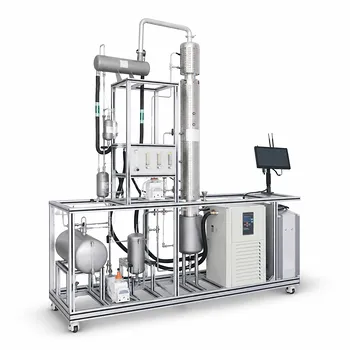
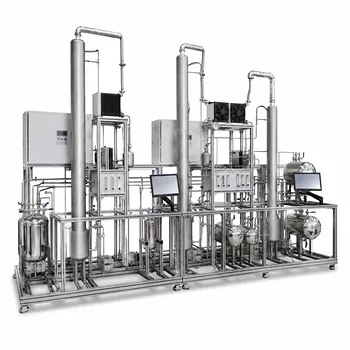
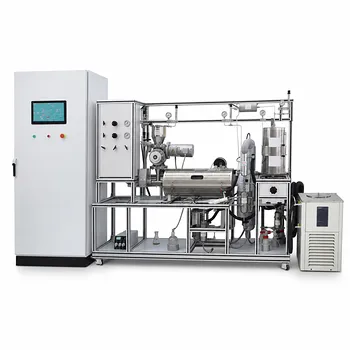
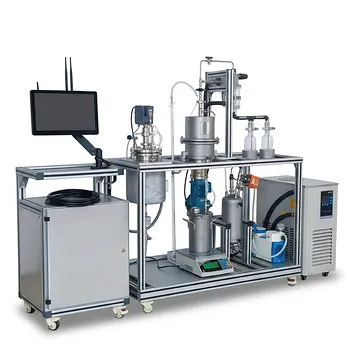
LABPARK provides state-of-the-art Educational and Vocational Unit Operations Pilot Plants in chemical engineering, bioprocess & biotech, and environmental & water treatment. Designed specifically for universities, research institutes, and enterprises, our pilot plants feature precise vacuum control systems to help you safely study relative volatility, prevent thermal degradation, and gather scalable process data.
Take your chemical engineering curriculum and research capabilities to the next level. Contact LABPARK Today to receive a custom solution tailored to your project requirements!
Related Products
- Continuous Sieve-Plate Distillation Pilot Plant for Unit Operations Laboratory Education
- Multi-Modal Distillation Unit Operations Training Pilot Plant
- Green Anhydrous Ethanol Purification Extractive Distillation Unit Operations Training Pilot Plant
- Dual-Mode Rectification Pilot Plant for Practical Training Unit Operations
- Ethyl Acetate Synthesis Unit Operations Pilot Plant for Practical Training
People Also Ask
- How to select the right activity coefficient model (Wilson, NRTL, UNIQUAC) for distillation pilot plants?
- What are the primary reflux ratio control strategies? Master Distillation Unit Operations
- How can real-time carbon number prediction improve distillation pilot plants? Optimize control.
- How does catalyst water concentration affect distillation pilot plant design? Key separation train choices.
- Why run shortcut fractionation before rigorous distillation calculations? Optimize your pilot plant.