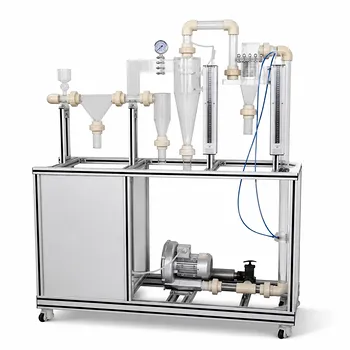
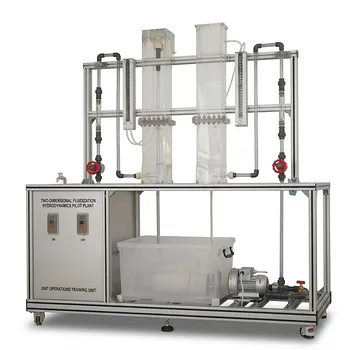
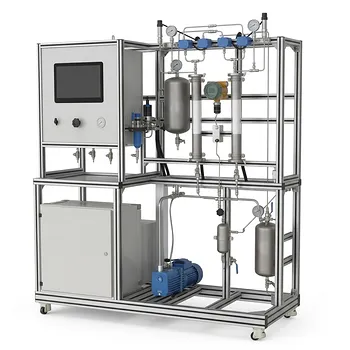
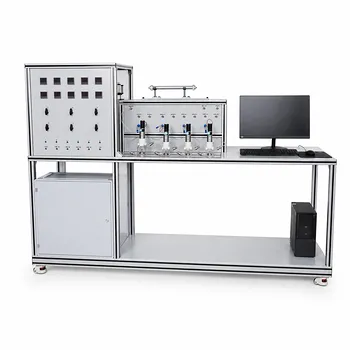
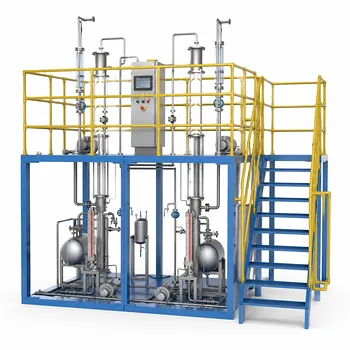
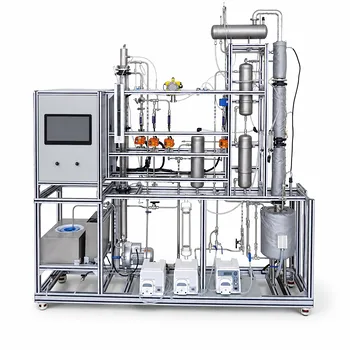
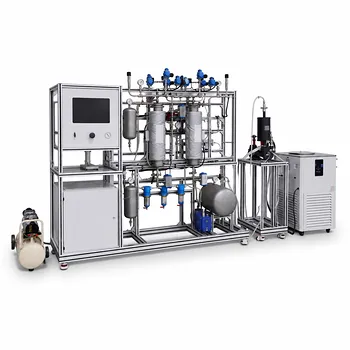
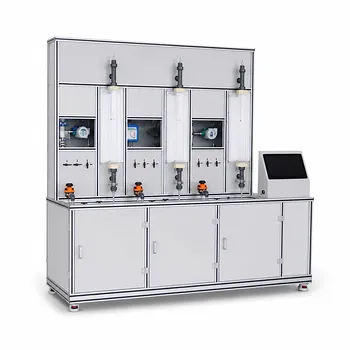
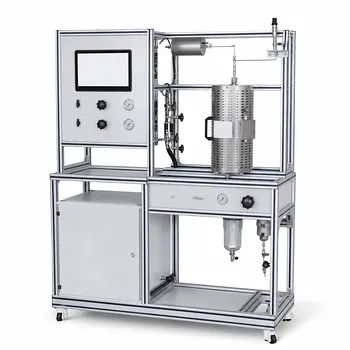
Your ability to see inside a reactor and track every shrinking particle is what a gas-solid reaction pilot plant provides. It transforms theoretical equations for particle size change and elutriation into tangible, measurable reality. By running continuous experiments, students execute material balances on feed, exit, and elutriated fines streams, and then directly compare their data against rate laws for particle shrinkage. This closes the loop between textbook kinetics and the real behavior of solids in a fluidized bed, making complex concepts like residence time distribution and conversion efficiency immediately understandable.
The core challenge is that particle size is not static in gas-solid reactions—it changes constantly, altering fluidization and elutriation. A well-instrumented pilot plant lets students measure this dynamic instead of guessing. It becomes a laboratory where they can isolate variables, quantify the loss of fines via elutriation, and verify how particle size distribution governs reactor performance, thus building intuition for design and scale-up.
The Core Challenge: Why Particle Size and Elutriation Matter in a Continuous Reactor
In a noncatalytic gas-solid reaction, the solid reactant is consumed. Particles either shrink or grow, and that changes everything about how the reactor behaves. If you can’t account for the evolving size distribution, your predictions for conversion, heat transfer, and even whether the bed will fluidize properly fall apart.
Elutriation is the selective loss of fine particles from the bed by the uplifting gas stream. This process removes material early, altering the average residence time and often carrying away unreacted solids. Understanding the interplay between size change and elutriation is not an academic exercise—it is essential for designing industrial units like calciners, combustors, or ore roasters.
The Two Problems Are Inseparable
You cannot study shrinking particles without simultaneously studying elutriation. As fines are generated (for example, by surface abrasion or progressive shrinkage), they become eligible for entrainment. A pilot plant captures this coupled behavior, giving students a complete picture of how solids actually leave the reactor: either through the bottom discharge or the top gas stream.
How the Pilot Plant Makes Analysis Tangible: Material Balances and Rate Laws
The primary reference states that pilot plants enable students to “perform material balances that account for feed rate, exit stream distribution, and elutriation.” This is the heart of the learning experience. You weigh what goes in, what comes out at the bottom, and what fines are collected in the cyclone or elutriator column.
Using Shrinkage Rate Laws Directly
For a gas-film-controlled reaction, particles might shrink at a linear rate (dR/dt = -k) or follow an inverse shrinkage model. In a lab, you measure size distributions over time and compare them against these laws. The pilot plant turns an abstract differential equation into a tangible dataset—you can calculate the quantity of material lost to elutriation vs. discharge and see whether the linear model holds.
Bridging Batch Theory and Continuous Reality
Most textbook kinetics are derived for a single batch particle. In a continuous unit, particles have a distribution of residence times. The pilot plant lets students feed solids with a known size distribution, operate under steady-state backmixing conditions, and then collect exit streams to experimentally determine the average solids residence time. You can even verify residence-time distribution models (E(t) curves) by running tracer studies, something impossible to grasp deeply from a book alone.
Quantifying Elutriation: From Empirical Correlations to Design Parameters
The supplementary references highlight how pilot plants use cyclones or elutriator columns to physically capture entrained fines. This hardware is not just a separation device—it’s a measurement tool. By collecting the elutriated material, students can apply correlations like Wen and Hashinger to calculate the specific elutriation constant ($E^*_s$).
The Elutriation Constant in Practice
The Wen and Hashinger correlation ties together gas velocity, terminal velocity of particles, gas/solid density difference, and particle diameter. With a pilot plant, you vary the fluidizing gas velocity and measure the change in fines carryover rate. You can then plot data points against the model, critically assess its accuracy, and learn why empirical constants have limitations. This is experiential learning at its best—you don’t just trust the correlation; you test it.
Linking Elutriation to Particle Size Distribution
Because you can size the captured fines, you see exactly which particle fractions are most susceptible to entrainment. This drives home a key point: a uniform particle size in the feed is a myth once reaction starts. The pilot plant shows how attrition and reaction create a dynamic distribution that shifts the elutriation rate nonlinearly, forcing you to consider population balances rather than average diameters.
Particle Size Changes Dictate Reactor Performance and Rate Control
The pilot plant does more than just count fines. It lets students diagnose why the reaction behaves as it does. By varying particle radius (R) and observing conversion time, they can apply the Sharp Interface Model to identify the rate-controlling step.
Identifying the Controlling Regime Through Size-Dependent Experiments
If the characteristic conversion time ($\tau$) scales with R¹, the reaction is surface-reaction controlled. If it scales with R², ash diffusion dominates. Gas-film control often shows a 1.5–2 order dependency. In a pilot plant, you prepare batches of different mean particle sizes and measure conversion times under identical fluidization conditions. Plotting $\tau$ vs. R reveals the mechanism directly. This is a powerful demonstration of how a structural change (size) is intimately linked to chemical kinetics.
Manipulating Hydrodynamics vs. Temperature
Interlocking experiments clarify the picture further. Changing agitation speed or gas velocity will only shift the rate significantly if mass transfer controls the process. If a temperature jump causes a sharp rate increase while hydrodynamics do nothing, chemical kinetics is the bottleneck. A pilot plant with precise control over flow and temperature enables students to decouple these factors, reinforcing transport phenomena concepts in a concrete way.
Understanding the Trade-offs
Pilot plants are not perfect mirrors of industrial reality. Recognizing their limitations is essential for honest analysis.
Sampling and Measurement Artifacts
Collecting fines non-isokinetically or allowing fines to stick to walls skews elutriation measurements. The very act of extracting solids can disturb the bed’s fluidization. Students learn the hard way that good data hygiene is as important as the theory itself, and that material balance closures of ±5% are often an achievement.
Ideal Flow Assumptions vs. Real Backmixing
Many simple models assume perfect mixing or plug flow of solids. In a small pilot plant, inlet/outlet effects and gas bypassing can cause deviations. The student’s job is to determine whether the observed elutriation rate still follows the trend predicted by the Wen and Hashinger correlation, or if a more sophisticated mixing model (like a two-phase model) is required. Overfitting an ideal model to noisy data is a classic trap.
The Scale-up Dilemma
Elutriation rates are notoriously scale-dependent. Wall effects and slugging in small-diameter columns can exaggerate entrainment. The pilot plant teaches this by forcing comparison with larger-scale correlations. Students discover that a rate constant derived on a 100-mm column may not directly apply to a 1-meter industrial unit, underscoring the need for careful piloting strategy.
Making the Right Choice for Your Learning or Design Goal
Use the pilot plant’s capabilities selectively, based on what you most need to understand about the gas-solid system.
- If your primary focus is mastering material balance fundamentals: Run the plant at a constant fluidization velocity, change only the feed size distribution, and close balances on all solid streams. Measure elutriation rate constants empirically and compare them to theoretical predictions.
- If your primary focus is diagnosing the rate-controlling mechanism: Prepare size-fractioned batches and conduct conversion-time experiments at the same temperature and gas velocity. Supplement with a second set where you vary temperature significantly while holding particle size constant.
- If your primary focus is predicting reactor performance for scale-up: Avoid over-reliance on bulk-average elutriation constants. Instead, perform a population balance across multiple size bins, verify it against cyclone catch data, and use that data to validate a reactor model that includes hydrodynamics.
- If your primary focus is understanding particle shrinkage kinetics: Operate the unit continuously with a narrow feed size distribution, sample the bed and exit streams at steady state, and measure particle diameters microscopically. Fit the size change data to linear or inverse shrinkage models and compare conversions predicted from those models against outlet gas analysis.
The gas-solid pilot plant is not just equipment; it is your most honest critic and your most capable tutor when you learn to listen to its material balance closures.
Summary Table:
| Analysis Focus | Experimental Method | Key Learning Outcome |
|---|---|---|
| Material Balances | Weigh feed, bottom discharge, and cyclone fines | Verifies conservation of mass and tracks solid loss |
| Shrinkage Kinetics | Compare exit size distributions against $dR/dt$ rate laws | Differentiates linear vs. inverse shrinkage models |
| Elutriation Constant | Measure entrainment rates using Wen and Hashinger correlation | Understands gas velocity and particle size limits |
| Rate Control Diagnosis | Run size-fractioned batch runs to plot conversion time vs. $R$ | Identifies surface-reaction vs. ash-diffusion control |
Bring Hands-On Chemical Engineering to Your Lab
Are you looking to bridge the gap between textbook kinetics and real-world pilot scale operations for your students or researchers?
LABPARK provides premium Educational and Vocational Unit Operations Pilot Plants in chemical engineering, bioprocess & biotech, and environmental & water treatment. Designed specifically for universities, research institutes, and enterprises, our pilot plants deliver the precise control, reliable measurements, and robust safety features needed to study complex dynamics like particle shrinkage, elutriation, and fluidization.
Ready to enhance your teaching and research capabilities? Contact us today to find the perfect pilot plant solution for your institution!
Related Products
- Fixed Bed Gas Solid Catalytic Reaction Educational Pilot Plant
- Fluidized Bed Gas Solid Catalytic Reaction Educational Pilot Plant
- Micro-Scale Gas-Solid Catalytic Reaction Educational Pilot Plant
- Fixed-Bed Chemical Reaction and Gas Dust Tar Removal Unit Operations Pilot Plant
- Educational Unit Operations Pilot Plant for Intraparticle Diffusion Effective Factor Measurement
People Also Ask
- How do reactor pilot plants safely study gas-solid reactions? Master kinetics with thermal & flow control.
- How does the Mears criterion evaluate transport resistance? Key Guide to Intrinsic Kinetics
- Why is a multibed configuration necessary for exothermic reactions? Optimize your pilot plant trajectory.
- Fluidized vs. Fixed Bed Reactors: Comparing Heat & Complexity in Pilot Plants
- What are the differences between pseudohomogeneous and heterogeneous models in pilot plants?