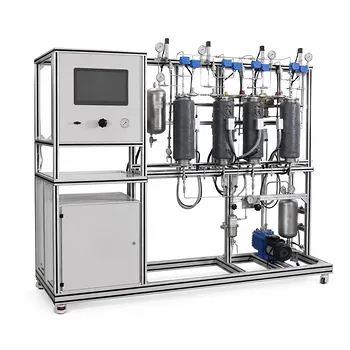
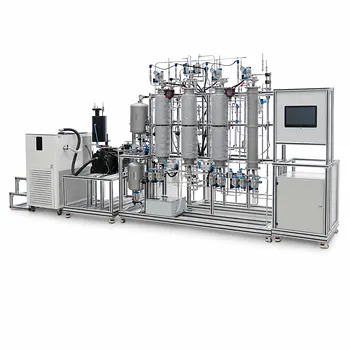
Diffusion and mass transfer coefficients don't just explain a pilot plant's performance—they are the levers you pull to design, operate, and scale it predictably.
In distillation and gas absorption columns, separation happens because molecules diffuse across phase boundaries. The rate at which they move is captured by the mass transfer coefficient (k). This coefficient isn't a fixed number; it changes instantly with temperature, flow turbulence, interfacial area, and fluid properties. In a pilot plant, controlling these variables directly tunes k, which in turn dictates the required column height, the optimal liquid-to-gas flow ratio, and the purity you can achieve at a given throughput. Understanding this cause-and-effect chain is what transforms a lab experiment into a scalable industrial design.
The core takeaway: Pilot plants are not just miniature versions of full-scale columns. They are measurement tools for the underlying mass transfer kinetics. Every design decision—from column packing type to reflux ratio—works by manipulating the effective interfacial area and the driving force for diffusion. Your job as an operator or designer is to keep the mass transfer coefficient as high as practical without triggering flooding, excessive pressure drop, or runaway energy costs.
The Fundamental Role of Diffusion and Mass Transfer
Separation in a column is a race between molecular diffusion and system residence time. Two concepts govern this race.
Diffusion as the Driving Force
At the molecular level, diffusion is the net movement of a species from a region of high concentration to low concentration. Fick’s first law describes this flux, and it is the non-negotiable starting point for any mass transfer operation.
In a pilot plant, the concentration gradient is the engine. A steeper gradient—maintained by continuously removing enriched product or by using a fresh solvent stream—maximizes the driving force. The moment that gradient weakens, the rate of separation drops, and your column becomes less efficient per unit height.
The Mass Transfer Coefficient: The Rate Limiter
While diffusion defines the fundamental driving force, the mass transfer coefficient (k) translates that force into an actual transfer rate across a phase interface.
This coefficient is a lumped parameter that captures everything opposing molecular movement: boundary layer thickness, fluid viscosity, and turbulence. In gas absorption, you deal with distinct gas-phase and liquid-phase mass transfer coefficients; their reciprocal sum gives the overall coefficient. In pilot plant operations, adjusting gas velocity or mechanical agitation directly thins the stagnant boundary layer, increasing k and boosting performance without requiring more column height.
Translating Principles to Pilot Plant Design
Design isn't arbitrary—it's an exercise in managing mass transfer coefficients through physical geometry and flow ratios.
Sizing and Configuration: The Role of HETP and Interfacial Area
The height equivalent to a theoretical plate (HETP) is the most practical output of all this theory. A smaller HETP means each meter of packed height does more separation, translating directly to shorter—and cheaper—columns.
Pilot plants allow you to measure HETP experimentally for your specific mixture. The key to lowering HETP is maximizing the specific interfacial area between phases. This area can vary by orders of magnitude depending on packing type, plate design, or gas sparging rate. More surface area means more sites for diffusion to occur, directly lowering HETP. But it also increases pressure drop and flooding risk—a critical trade-off.
Controlling the Operating Lines: Flow Rates and the Absorption Parameter
In gas absorption, the ratio of liquid to gas flow rates is the master tuning knob. The absorption parameter is expressed as m·G_m / L_m, where m is the equilibrium slope, G_m is the gas molar flow, and L_m is the liquid molar flow.
This ratio dictates the slope of the operating line on a McCabe-Thiele diagram. A value between 0.7 and 0.8 is historically cited as optimal for balancing capital cost against operating cost. At these settings, the required number of transfer units—and thus column height—is minimized for a target solute removal. The pilot plant becomes the place where you experimentally verify this optimal slip between phases, adjusting solvent rate until the trade-off between separation efficiency and pumping cost is clear.
Operational Levers to Control Mass Transfer
Once the column exists, you influence mass transfer every minute through temperature, fluid properties, and pressure.
Temperature, Viscosity, and Concentration Gradients
Temperature is a double-edged lever. Raising it decreases liquid viscosity and increases molecular kinetic energy, both of which raise the liquid diffusion coefficient. This directly increases the mass transfer coefficient. However, it also shifts vapor-liquid equilibrium, which can shrink the driving force if not compensated.
Liquid viscosity has an inverse relationship with diffusion rate. In pilot plants handling viscous solvents or absorption oils, preheating or selecting lower-viscosity alternatives becomes essential to keep k at an acceptable level. Similarly, molecular size matters: larger molecules diffuse more slowly. When scaling up a separation that involves heavy components, the pilot plant must be operated with longer residence times to compensate.
Leveraging Molecular Weight in Gas Separations
For gas-phase operations, Graham’s law states that diffusion rates are inversely proportional to the square root of molecular weight.
This is particularly valuable in pilot-scale membrane filtration or gas separation columns. Lighter molecules effuse and diffuse faster; thus, a mixture containing hydrogen and carbon dioxide will exhibit vastly different mass transfer coefficients for each component. Accurate estimation of gaseous diffusion coefficients—often using the Fuller-Schettler-Giddings method—allows you to model the concentration profiles inside the column and predict which component will break through first at a given pressure gradient.
Understanding the Trade-offs
No lever moves in isolation. Every gain in mass transfer efficiency brings a cost.
Purity vs. Throughput: The Reflux Ratio Dilemma
In distillation, the reflux ratio is the knife edge between product purity and production rate. A higher ratio returns more condensed liquid to the column, creating a larger internal counter-current flow and enriching the top product. But it also reduces the net product withdrawn per hour. Push the ratio too low and separation collapses. The pilot plant teaches you to find the economic optimum where incremental purity gains no longer justify the loss in output.
Liquid Holdup and Pressure Drop
Many strategies that increase interfacial area—finer packing materials, higher gas velocities, mechanical agitation—also increase liquid holdup and gas-phase pressure drop. High holdup provides necessary residence time for slow diffusion but can promote frothing or flooding. In a packed absorption column, optimizing the gas-liquid contactor design is a balance: you want to maximize the volumetric mass transfer coefficient (kLa) without pushing the column into an unstable hydrodynamic regime.
Making the Right Choice for Your Pilot Plant Goal
Your control strategy depends entirely on what problem you’re trying to solve.
- If your primary focus is maximizing separation purity: Prioritize a higher reflux ratio in distillation or a liquid-to-gas ratio in absorption that keeps the operating line well away from the equilibrium curve. Accept slower production rates and higher energy input.
- If your primary focus is rapid process development and scale-up: Use the pilot plant to directly measure HETP and overall mass transfer coefficients under a range of flow regimes. Do not assume literature values—verify k experimentally for your specific mixture and packing.
- If your primary focus is handling viscous or difficult liquids: Leverage temperature to reduce viscosity and increase the liquid diffusion coefficient. Carefully monitor for thermal degradation or vaporization limits.
- If your primary focus is gas separation with sharply differing molecular weights: Design your column and select packing based on the expected differences in gaseous diffusion rates. Use Graham’s law to anticipate that the lighter component will transfer rapidly, potentially dominating early breakthrough curves.
The ultimate goal of any pilot plant is to give you a measurable, defensible basis for scaling up. By linking every operational adjustment back to its effect on the mass transfer coefficient and available interfacial area, you turn a black-box separation into a transparent, controllable process.
Summary Table:
| Parameter | Impact on Mass Transfer | Operational Trade-off / Effect |
|---|---|---|
| Temperature | Increases diffusion coefficient & lowers viscosity | Enhances transfer rate; shifts equilibrium |
| Fluid Velocity | Thins boundary layer & increases turbulence | Boosts coefficient $k$; risks flooding/pressure drop |
| Packing Surface Area | Maximizes specific interfacial area | Lowers HETP; increases column cost and flow resistance |
| Reflux / Flow Ratios | Manipulates concentration gradient driving force | Balances target purity against throughput and energy costs |
Accelerate Your Research & Training with LABPARK Pilot Plants
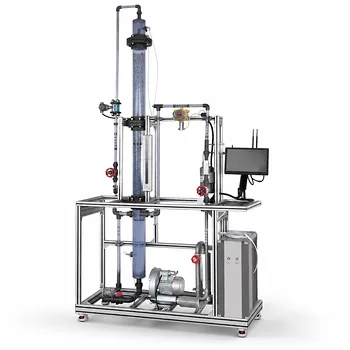
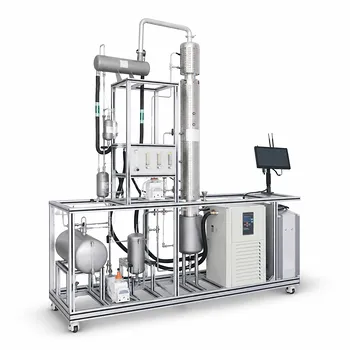
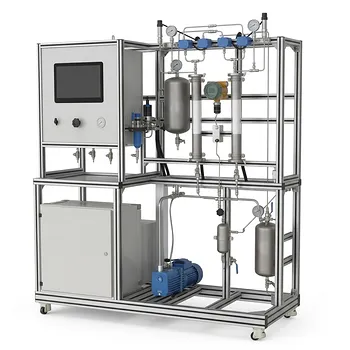
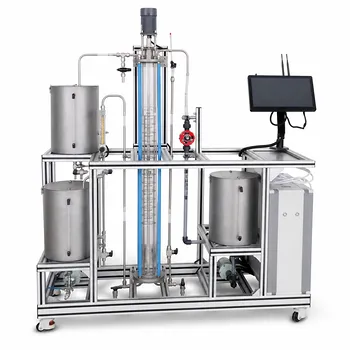
Bridge the gap between mass transfer theory and industrial application. LABPARK provides state-of-the-art Educational and Vocational Unit Operations Pilot Plants in chemical engineering, bioprocess & biotech, and environmental & water treatment.
Whether you are a university, research institute, or enterprise, our pilot systems empower you to:
- Visualize & measure real-time mass transfer kinetics, HETP, and hydrodynamics.
- Prepare students & operators with robust, industry-grade distillation and gas absorption columns.
- Validate scale-up parameters safely with precise instrumentation and control.
Ready to enhance your lab's capabilities? Contact LABPARK today for a custom solution!
Related Products
- Absorption and Desorption Educational Unit Operations Pilot Plant
- Packed Bed Absorption Educational Unit Operations Pilot Plant
- Bench Scale Dual Column Gas Separation and Capture Educational Pilot Plant
- Multi-Functional Special Distillation Educational Pilot Plant
- Continuous Sieve-Plate Distillation Pilot Plant for Unit Operations Laboratory Education
People Also Ask
- How to demonstrate physical vs chemical absorption using a pilot plant? A practical lab guide.
- Why are liquid-phase mass transfer rates in pilot plants comparable to gas-phase rates? Key Insights
- Why is interface composition critical in absorption pilot plants? Bridging Theory & Practice
- How do absorption pilot plants assist students in calculating mass transfer coefficients and sizing column parameters?
- How to Calculate HTU & NTU for Pilot Plant Packing Height: A Complete Guide