The required packing height in an absorption column is simply the product of the Height of a Transfer Unit (HTU) and the Number of Transfer Units (NTU). For gas-film controlling systems, the design equation is (Z = H_{OG} \cdot N_{OG}), where (H_{OG}) captures the mass transfer efficiency of the packing under your operating conditions, and (N_{OG}) quantifies the thermodynamic difficulty of the separation. In an educational pilot plant, you calculate or experimentally determine these two factors, then multiply them to find the minimum packing depth needed.
The HTU/NTU method cleanly separates the equipment’s performance (HTU) from the process’s demand (NTU). NTU is computed from the inlet/outlet concentrations and the equilibrium curve—it tells you how many “transfer units” you must achieve. HTU tells you how many centimeters (or inches) of packing are needed to accomplish one transfer unit, making it the bridge between a conceptual task and a physical column.
The HTU/NTU Framework: A Logical Decomposition
Before worrying about numbers, grasp what these two parameters represent. One is about the column, the other about the chemistry.
What the Height of a Transfer Unit (HTU) Tells You
HTU is the yardstick of mass transfer efficiency for a given packing and set of flow rates.
- For a gas-phase overall driving force, (H_{OG} = \frac{V}{K_Y a , \Omega}), where (V) is the inert gas flow rate, (K_Y a) is the volumetric overall mass transfer coefficient, and (\Omega) is the column cross‑sectional area.
- Small (H_{OG}) values mean rapid mass transfer. That happens when the packing wets well, provides high interfacial area, and operates under conditions that keep resistance low.
- Liquid‑phase overall HTU ((H_{OL} = \frac{L}{K_X a , \Omega})) follows the same logic for liquid‑film controlled systems.
In a pilot plant, you can think of HTU as the “price” you pay per transfer unit. A shorter tower needs a packing that delivers a low HTU under your chosen liquid and gas loads.
What the Number of Transfer Units (NTU) Represents
NTU is a pure measure of separation difficulty, independent of column dimensions.
- For gas‑phase overall analysis: (N_{OG} = \int_{Y_2}^{Y_1} \frac{dY}{Y - Y^*}).
- Here, (Y) is the actual solute mole ratio in the gas, (Y^*) is the value that would be in equilibrium with the bulk liquid, and the integration runs from inlet (bottom) to outlet (top) conditions.
- A large NTU means the solute is hard to remove—either the equilibrium line is unfavorable or you need a big concentration change.
Because NTU comes from thermodynamics and target purity, it is the “distance” your separation must cover. You cannot change it by choosing a better packing; you change it only by altering the process goals or perhaps the solvent.
Calculating (H_{OG}) and (N_{OG}) in a Pilot Plant
In an educational absorption experiment, you rarely calculate HTU purely from first principles. Instead, you measure what you can and deduce the rest.
Determining (N_{OG}) from Measured Concentrations
If your system is dilute and the equilibrium curve is roughly linear, you can avoid numerical integration.
- The log‑mean driving force method gives:
(N_{OG} = \frac{Y_1 - Y_2}{\Delta Y_{lm}}), where (\Delta Y_{lm}) is the log‑mean of the driving forces at the bottom and top of the column. - To find (Y^*) values, you need the equilibrium relationship (often Henry’s law for physical absorption) and the measured temperature.
- Students then integrate this into a spreadsheet, using inlet and outlet gas/liquid concentrations to plot operating and equilibrium lines, and compute NTU directly.
Do not underestimate the leverage of operating line slope. The liquid‑to‑gas ratio ((L/V)) determines the operating line position. A steeper operating line increases the driving force and reduces NTU—but you pay with higher solvent usage.
Experimental Determination of (H_{OG}) and (K_Y a)
Once you have (N_{OG}) and you measure the actual packing height (Z), HTU is the quotient.
- In a pilot column of known effective height (Z): (H_{OG,exp} = Z / N_{OG}).
- With (H_{OG}) in hand and known (V) and (\Omega), you can back‑calculate the volumetric mass transfer coefficient: (K_Y a = \frac{V}{H_{OG,exp} , \Omega}).
- This experimental (K_Y a) is invaluable. It automatically includes the real wetting, liquid distribution, and wall effects present in your pilot rig.
This closes the loop. Students can compare their experimental (H_{OG}) against predictions from textbook correlations for the specific packing type, and see where idealized models fall short.
Understanding the Trade-offs and Practical Limitations
The HTU/NTU method is elegant, but it hides several real‑world difficulties that pilot‑plant training should highlight.
The Hidden Influence of Liquid Distribution
HTU is not just a function of gas and liquid flow rates—it depends critically on how evenly the liquid wets the packing.
- Poor initial distribution or channeling can create dry areas where mass transfer plummets. Your column’s apparent HTU will rise, even if the packing itself is “high‑efficiency.”
- Pilot‑scale columns are especially sensitive to wall flow. Liquid tends to migrate to the wall, bypassing the bulk packing. This wall effect becomes proportionally smaller in industrial‑scale towers.
Thus, a packing’s published HTU data from a large‑scale test bed may not directly translate to your small educational pilot rig. You must interpret results with caution.
Scaling from Pilot to Production
Extrapolating pilot plant HTU data to design a full‑scale absorber is not a simple proportional scale‑up.
- Mass transfer coefficients and effective interfacial area do not scale linearly with column diameter.
- Liquid distribution systems, packing support arrangements, and gas inlet designs all affect the real‑world HTU at large scale.
- Reliable scale‑up often requires a pilot column that is large enough to avoid wall effects, using the exact same packing and operating at similar liquid loads per wetted perimeter.
In an educational context, this teaches a vital lesson: the HTU you measure is specific to your hardware configuration. It’s a performance indicator, not a material constant.
Making the Right Choice for Your Educational Goal
How you use HTU/NTU in a pilot plant depends on what you want the student to learn. Tailor your approach:
- If your primary focus is cementing mass transfer fundamentals: Start with a simple air‑water‑CO₂ system. Have students measure concentrations, calculate (N_{OG}) by the log‑mean method, then determine (H_{OG}) experimentally. Use that to back‑calculate (K_Y a) and compare it to literature values.
- If your primary focus is comparing packing performance: Keep the same gas/liquid loads and test two different packings (e.g., Raschig rings vs. structured packing). Measure (N_{OG}) each time; the packing that gives a smaller (H_{OG}) (for the same (N_{OG})) is the more efficient choice. Discuss why.
- If your primary focus is exploring process variables: Vary the liquid flow rate while holding the gas rate constant, and map how (H_{OG}) changes. The minimum (H_{OG}) often occurs near the onset of flooding, highlighting the trade‑off between capacity and efficiency.
- If your primary focus is preparing for scale‑up: Insist on accurate pressure drop and liquid distribution measurements. Have students calculate HTU only after verifying that the liquid is evenly distributed. Discuss why a measured (H_{OG}) of 0.3 m in a 2‑inch column does not guarantee the same performance in a 2‑meter column.
The HTU/NTU concept is the bridge between chemical thermodynamics and mechanical design. Master it in the pilot plant, and you master a skill that scales across your entire career.
Summary Table:
| Parameter | Full Name | Formula (Gas-Phase Overall) | Key Focus |
|---|---|---|---|
| HTU | Height of a Transfer Unit | $H_{OG} = \frac{V}{K_Y a , \Omega}$ | Mass transfer efficiency of the packing and flow rates |
| NTU | Number of Transfer Units | $N_{OG} = \int \frac{dY}{Y - Y^*}$ | Thermodynamic difficulty of the separation |
| Z | Required Packing Height | $Z = H_{OG} \times N_{OG}$ | Total physical packing depth needed for the column |
Bring Chemical Engineering Theory to Life with LABPARK
Are you looking to provide students and researchers with hands-on training in mass transfer and unit operations? LABPARK designs and manufactures high-quality Educational and Vocational Unit Operations Pilot Plants in chemical engineering, bioprocess & biotech, and environmental & water treatment.
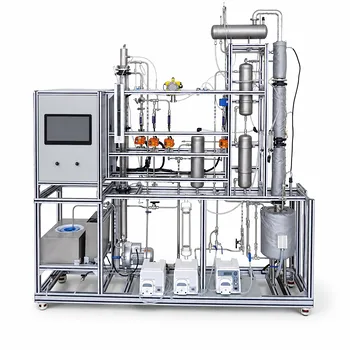
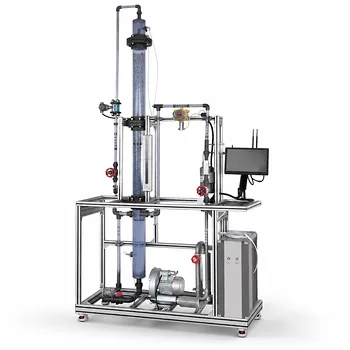
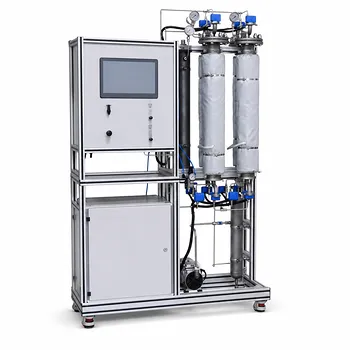
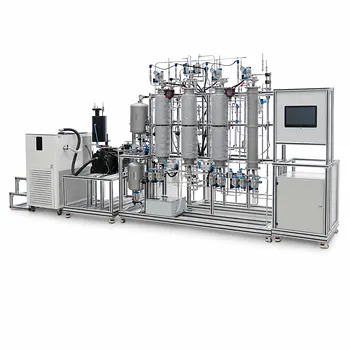
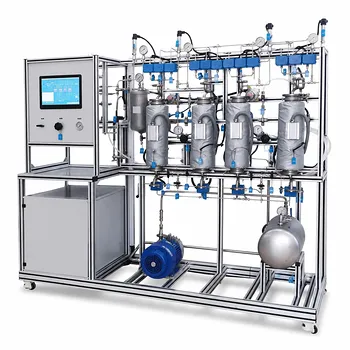
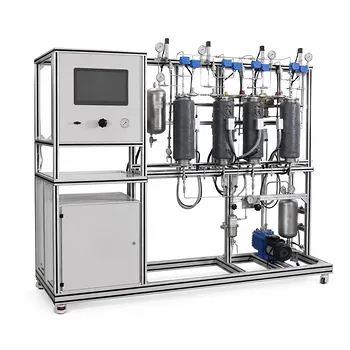
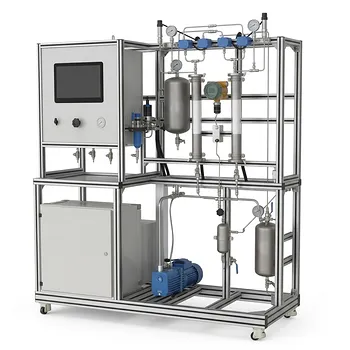
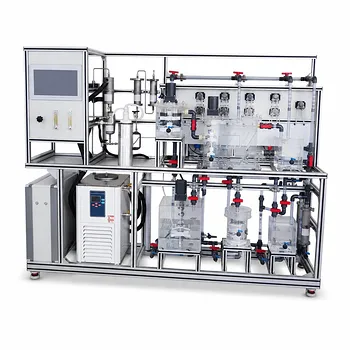
Our absorption pilot plants help universities, research institutes, and enterprises easily bridge the gap between classroom calculations (like HTU/NTU) and industrial-scale operations.
Contact LABPARK today to request a quote and discover how we can customize a pilot plant to fit your educational goals!
Related Products
- Carbon Dioxide Absorption and Desorption Educational Pilot Plant for Carbon Capture Studies
- Absorption and Desorption Educational Unit Operations Pilot Plant
- Packed Bed Absorption Educational Unit Operations Pilot Plant
- Multimodal Absorption and Desorption Pilot Plant for Unit Operations Training
- Dual-Mode Gas Absorption and Desorption Unit Operations Training Pilot Plant
People Also Ask
- How does operating pressure influence the transition between absorption and desorption in a CO2 pilot plant?
- How do temperature variations affect CO2 transport models in pilot plants? Model vs Reality
- What unit operations are critical for CCUS training pilot plants? Build hands-on engineering expertise.
- How do electrolytes affect phase equilibrium in absorption pilot plants, and how to calculate it?
- Why is critical surface tension key in column internals? Optimize gas absorption pilot plant efficiency