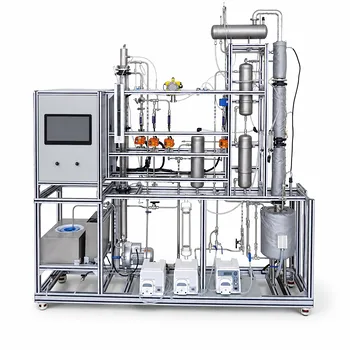
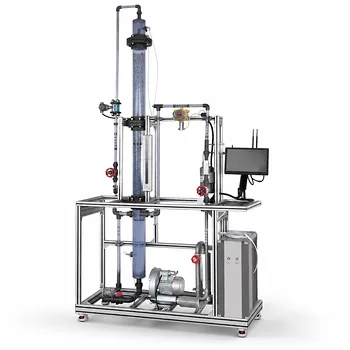
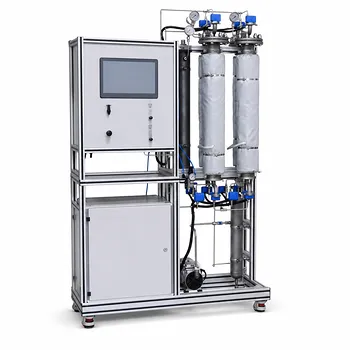
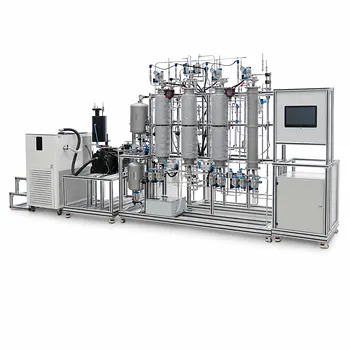
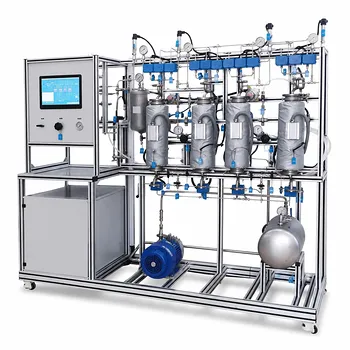
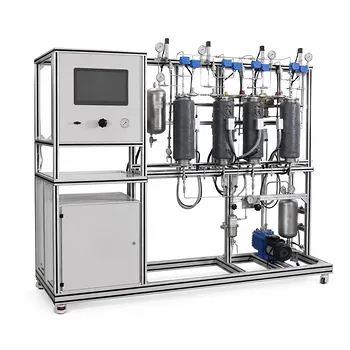
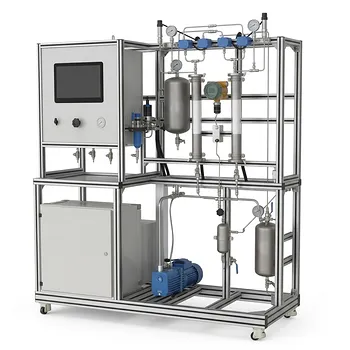
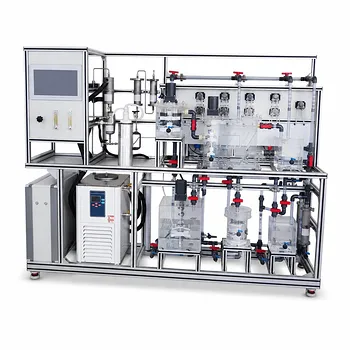
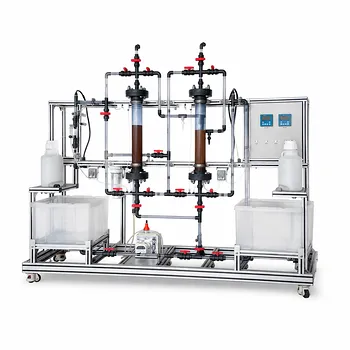
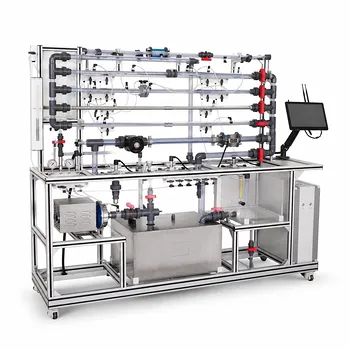
Absorption pilot plants transform abstract mass transfer theories into calculable, observable realities. By measuring gas and liquid flow rates, inlet and outlet solute concentrations, and pressure drops across the column, students can directly compute the overall gas-phase mass transfer coefficient (K_Y a), the Height of a Transfer Unit (HTU), and the Number of Transfer Units (NTU). Simultaneously, witnessing hydrodynamic phenomena like loading and flooding gives them the data needed to size the column diameter and select appropriate packing for industrial-scale designs.
A pilot plant is a miniature chemical engineering laboratory. It bridges the gap between textbook equations and full-scale equipment by allowing students to collect real experimental data, perform material balances, calculate dimensionless numbers, and observe the physical limits that dictate how large a column must be.
Turning Measurements into Mass Transfer Coefficients
The Experimental Data You Collect
The foundation of any coefficient calculation lies in precise, steady‑state measurements. You record the gas and liquid inlet and outlet solute concentrations using online analyzers or titration.
You also log the volumetric flow rates of both phases and the pressure drop across the packed bed. These raw numbers are the sole inputs needed to quantify mass transfer performance.
Calculating the Overall Mass Transfer Coefficient
First, a material balance gives the total solute absorption rate (G_A) from the change in gas‑phase concentration multiplied by the gas molar flow rate. With the liquid‑phase measurements, you can cross‑check the balance.
Next, you determine the log mean average driving force (ΔY_m). Using Henry’s Law or the appropriate equilibrium relationship at the column’s operating temperature and pressure, the inlet and outlet concentration differences are averaged logarithmically.
Finally, knowing the packed bed volume (V_p) from the column’s internal dimensions, the volumetric overall mass transfer coefficient is calculated directly: K_Y a = G_A / (V_p · ΔY_m).
This single number captures the combined effects of the mass transfer coefficient and the effective interfacial area — a parameter that is nearly impossible to predict from theory alone.
Determining HTU and NTU from Pilot Data
The Number of Transfer Units (NTU) represents the difficulty of the separation. It is calculated by integrating the change in gas‑phase concentration over the driving force between the column inlet and outlet.
The Height of a Transfer Unit (HTU) is then simply the packed height divided by the NTU. Since HTU equals the gas superficial velocity divided by K_Y a, you can also validate the consistency of your experimental data.
These twin parameters — HTU and NTU — are the everyday language of column design. Pilot‑plant experiments make them tangible, turning abstract integrals into values you can write in a lab notebook.
Sizing Column Parameters Through Hydrodynamic Observation
Watching Loading and Flooding in Real Time
No equation can fully predict the moment a column floods. In a pilot plant, you gradually increase the liquid or gas flow until you visually see liquid holdup rise sharply, pressure drop skyrockets, and liquid backs up above the packing.
This loading region, followed by the flooding point, is the absolute hydrodynamic limit. Your column diameter must be large enough to keep the design gas velocity safely below this threshold.
Translating Pressure Drop to Column Diameter
Pressure drop data collected at various gas and liquid flow rates are plotted to create a generalized pressure drop correlation for the specific packing being tested. The operating line must stay below the flooding curve.
The pilot plant allows you to measure pressure drop at the design liquid‑to‑gas ratio. From this, you back‑calculate the column cross‑sectional area required to maintain an acceptable pressure drop, which directly fixes the industrial column diameter.
Understanding the Trade‑offs and Limitations
Scale‑Dependent Effects Are Real
Pilot plants typically operate at lower liquid and gas distribution qualities than industrial towers. Mal‑distribution and wall effects can be more pronounced, meaning the HTU you measure may differ from the true large‑scale value.
You must apply engineering judgment — and often design safety factors — when translating pilot‑scale K_Y a or HTU directly to a commercial unit.
Sensor Accuracy and Assumptions
The simplified assumption of isothermal, isobaric plug flow can mask subtle effects. Real columns experience temperature bulges and axial mixing, which a basic educational pilot may not capture.
Also, concentration measurements at only two points (inlet and outlet) limit the resolution of the driving force. A wetted‑wall column with a known, constant interfacial area offers a sharper alternative for isolating the true mass transfer coefficient without packing geometry uncertainties.
Specialized Configurations for Precision
A wetted‑wall column pilot plant eliminates the unknown interfacial area. A thin film flows down a tube while gas passes through the center, giving you a defined area to compute the liquid‑film coefficient (k_L) directly.
This allows you to validate empirical correlations — for example, using Sherwood, Reynolds, and Schmidt numbers — and compare your data to established expressions like j_D = 0.023 Re^{-0.17} for different flow regimes.
Making the Right Choice for Your Goal
The type of pilot plant experiment you choose should directly serve your educational or design objective.
- If your primary focus is mastering fundamental mass transfer correlations: Use a wetted‑wall column. Its constant interfacial area allows you to calculate individual film coefficients and test dimensionless number correlations with high precision.
- If your primary focus is simulating a real packed‑bed absorber: Operate a packed absorption column pilot plant with the exact packing you intend to use. This gives you the K_Y a, pressure drop curves, and flooding data needed for reliable scale‑up.
- If your primary focus is understanding column hydrodynamics: Run a variety of liquid and gas flow rates while watching loading and flooding. The pressure drop versus flow rate plot is your ultimate guide to sizing the column diameter.
The absorption pilot plant is your time machine for column design — it lets you see and measure the future performance of a full‑scale tower in a few hours of operation, transforming theoretical equations into confident engineering decisions.
Summary Table:
| Column Type / Parameter | Key Data Measured | Educational & Design Value |
|---|---|---|
| Packed Absorption Column | Flow rates, concentrations, pressure drop | Determines $K_Y a$, HTU, NTU, and column diameter scale-up. |
| Wetted-Wall Column | Liquid film flow, defined interfacial area | Calculates individual film coefficients ($k_L$) for correlation testing. |
| Hydrodynamic Limits | Loading and flooding points | Defines maximum gas velocity to prevent column flooding. |
Elevate Chemical Engineering Education with LABPARK
Bridge the gap between theoretical equations and industrial-scale operations. LABPARK offers premium Educational and Vocational Unit Operations Pilot Plants in chemical engineering, bioprocess & biotech, and environmental & water treatment for universities, research institutes, and enterprises.
Our advanced pilot plants enable students and researchers to perform precise mass transfer calculations, observe real-time column hydrodynamics, and gain hands-on design experience.
Contact LABPARK today to find the perfect pilot plant system for your laboratory!
Related Products
- Carbon Dioxide Absorption and Desorption Educational Pilot Plant for Carbon Capture Studies
- Absorption and Desorption Educational Unit Operations Pilot Plant
- Packed Bed Absorption Educational Unit Operations Pilot Plant
- Multimodal Absorption and Desorption Pilot Plant for Unit Operations Training
- Dual-Mode Gas Absorption and Desorption Unit Operations Training Pilot Plant
People Also Ask
- How does operating pressure influence the transition between absorption and desorption in a CO2 pilot plant?
- How do temperature variations affect CO2 transport models in pilot plants? Model vs Reality
- What unit operations are critical for CCUS training pilot plants? Build hands-on engineering expertise.
- How do electrolytes affect phase equilibrium in absorption pilot plants, and how to calculate it?
- Why is critical surface tension key in column internals? Optimize gas absorption pilot plant efficiency