Point, Murphree, and Overall column efficiencies are the fundamental lenses that transform a pilot plant from a simple piece of hardware into a true engineering laboratory. These three concepts progressively link local mass transfer to global column performance, directly dictating the instrumentation needs, column geometry, and the experiments you can run. Understanding them is what allows students and researchers to move beyond idealized thermodynamic models and confront the messy, real-world fluid dynamics that govern actual separation processes.
The core educational and design value of plate efficiency metrics lies in their ability to quantify the gap between theory and reality. Point efficiency isolates the intrinsic mass transfer rate, Murphree efficiency captures the impact of liquid mixing, and Overall column efficiency provides the practical, whole-column figure needed for scale-up and operation. A well-designed pilot plant makes all three measurable, turning the column itself into a powerful teaching instrument.
Unpacking the Three Tiers of Plate Efficiency
The primary reference establishes a clear hierarchy. These definitions are not just academic; they are the starting blueprint for designing a pilot plant’s sensor layout and data acquisition philosophy.
The Foundation: Point Efficiency ($E_{OG}$)
Point efficiency represents the mass transfer achieved at a single, infinitesimally small location on the tray. It assumes perfect local contact between the vapor and the liquid at that specific spot. This is the "purest" measure of mass transfer, free from the averaging effects of tray-scale hydrodynamics.
The Bridge: Murphree Tray Efficiency ($E_{MV}$)
Murphree efficiency averages the point efficiency across the entire tray, incorporating the effects of liquid flow patterns and mixing. It compares the actual change in vapor composition leaving the tray to the change that would occur if the outlet vapor were in equilibrium with the outlet liquid. This is where imperfect mixing and vapor maldistribution start to show their influence.
The Big Picture: Overall Column Efficiency ($E_o$)
Overall column efficiency is the simple ratio of theoretical equilibrium stages to the number of actual physical trays required for a given separation. It’s the most practical, holistic metric for design and scale-up, but it inherently "black-boxes" all the internal tray inefficiencies into a single number. For a pilot plant, it answers the simple question: "How many real trays do I need to do the work of one perfect tray?"
How These Efficiencies Shape Pilot Plant Design
A pilot plant designed with these three tiers in mind looks fundamentally different from one that only measures input and output streams. The design choices cascade directly from the need to isolate and measure each efficiency type.
Strategic Sensor Placement: From Local to Global
To calculate Point Efficiency, you need local liquid and vapor composition samples from discrete points on a tray. This demands multiple, precision sample ports and perhaps dedicated micro-sampling systems, which directly adds to the plant’s mechanical complexity and cost. Calculating Murphree Efficiency requires reliable, bulk-average composition measurements of the liquid flowing off the tray and the vapor entering it. This is more forgiving but still necessitates well-mixed sample points. Overall column efficiency is the least demanding: you only need accurate composition analyzers on the main feed, distillate, and bottoms streams. A design focused solely on $E_o$ can be far simpler and more rugged.
Column Geometry and Internal Configuration
The relationship between Point and Murphree efficiencies is governed by the Peclet number ($Pe$), which quantifies the degree of liquid mixing on the tray. For a pilot plant to be educationally rich, its tray design—particularly the liquid path length—must be chosen to yield intermediate Peclet numbers, avoiding extremes of perfect mixing ($Pe = 0$) or pure plug flow ($Pe = \infty$). This allows students to clearly observe the mixing effect. A very short liquid path would collapse Murphree efficiency into point efficiency, eliminating a key learning objective.
Instrumentation and Controllability
Measuring mass transfer coefficients ($k_La$) and transfer units ($N_{OG}$) requires precise, independent control over multiple parameters. The pilot plant’s design must therefore include high-quality mass flow controllers for both gas and liquid phases, accurate pressure and temperature sensors, and variable-speed agitators or pumps. This level of controllability, though costly, is what enables the systematic study of how flow rates, temperatures, and mixer designs influence the absorption parameter ($m G_m / L_m$) and thus the final separation.
The Educational Value: Turning Data into Insight
The true power of these efficiencies in a pilot plant is not in the numbers themselves, but in how they force students to reconcile classical theory with observable, often messy, physical phenomena.
Bridging Thermodynamics and Transport Phenomena
Classroom thermodynamics presents separation as a series of equilibrium stages. The pilot plant, however, runs on rates. Point efficiency explicitly connects the equilibrium expectation to kinetic mass transfer. By measuring it, students see that a tray is not an equilibrium stage but a real device with a finite mass transfer coefficient ($k_La$). This is the critical bridge between two core chemical engineering courses.
Making Hydrodynamic Deviations Tangible
Concepts like liquid entrainment, weeping, and channeling are often abstract. Murphree efficiency gives these phenomena a measurable metric. If a student calculates an $E_{MV}$ significantly lower than the predicted $E_{OG}$, they can diagnose a hydrodynamic problem. They learn that poor vapor-liquid contact is not just a qualitative observation but a quantifiable efficiency loss, reinforcing the importance of stable tray hydraulics.
Teaching the Principles of Scale-up
Overall column efficiency is the scale-up metric. By calculating $E_o$ from their pilot-plant data and correlating it with system properties, students experience firsthand a classic scale-up methodology (like the O'Connell correlation). They learn that $E_o$ isn't a constant but a function of fluid properties, which explains why a distillation column designed in a simulation often performs differently at a new scale or with a new mixture.
Understanding the Trade-offs
An honest technical assessment requires acknowledging that a design maximizing educational value often comes with significant practical Downsides.
Complexity vs. Operability
A pilot plant instrumented to capture point efficiencies is inherently more delicate and harder to operate than one designed for overall balances. Multiple sample lines can plug, and local probes can foul. For an undergraduate lab, excessive complexity can shift the focus from learning mass transfer to troubleshooting hardware, frustrating students and instructors alike.
The Danger of Data Overload
With the ability to measure everything, students can become buried in spreadsheets, losing the forest for the trees. The educational design must include clear instructional scaffolding that forces them to start with the big-picture $E_o$, understand the deviation, and only then drill down into Murphree and point efficiencies to find the root cause. Without this structure, the data is just noise.
Cost and Physical Footprint
Longer liquid path lengths, multiple sample ports, advanced gas spargers, and baffles all increase material costs and space requirements. A design optimized for a high Peclet number experiment might be impractical for a typical benchtop unit. The design must balance the depth of the learning experience against these very real constraints.
Making the Right Choice for Your Pilot Plant Goal
The optimal focus for your pilot plant’s design and curriculum depends entirely on your primary educational or research objective. You must prioritize which efficiency tells the story you need to tell.
- If your primary focus is teaching the fundamentals of mass transfer: Choose a design that makes point efficiency measurable, using a well-controlled, small-scale tray with local sampling. This isolates the rate process and directly connects theory to the mass transfer coefficient.
- If your primary focus is plant troubleshooting and tray design: Prioritize the measurement of Murphree efficiency by using trays with a long, unobstructed liquid path and good vapor distribution. This highlights how mixing and hydraulic design impact real-world performance.
- If your primary focus is process scale-up and preliminary design: Simplify the plant to reliably measure Overall column efficiency. Run experiments across a range of fluid properties and flow rates to build a practical correlation, teaching the empirical nature of industrial column design.
- If your primary focus is versatility across a curriculum: Design a single, modular pilot plant that can be configured in all three modes. Start students with the simplest $E_o$ experiments and progressively add the complexity and instrumentation needed to unlock Murphree and point efficiency measurements.
Ultimately, the plate efficiency isn't just a performance check; it is the conceptual heart of the pilot plant. A strategically designed system uses these three tiers of measurement to transform a column from a black box into a transparent, teachable model of real-world separation.
Summary Table:
| Efficiency Type | Core Focus | Design Impact | Educational Value |
|---|---|---|---|
| Point ($E_{OG}$) | Local mass transfer at a single spot | Requires discrete local sampling ports and sensors | Connects thermodynamic equilibrium to kinetic mass transfer rates |
| Murphree ($E_{MV}$) | Average tray efficiency including mixing | Controlled by tray geometry and flow path (Peclet number) | Quantifies hydrodynamic deviations like weeping and entrainment |
| Overall Column ($E_o$) | Ratio of theoretical to physical stages | Simpler design focusing on inlet/outlet analyzers | Teaches empirical column design and scale-up methodologies |
Elevate Your Chemical Engineering Lab with LABPARK
Are you looking to bridge the gap between thermodynamic theory and real-world process dynamics for your students or research team? LABPARK designs and manufactures state-of-the-art Educational and Vocational Unit Operations Pilot Plants specializing in chemical engineering, bioprocess & biotech, and environmental & water treatment.
Whether you require a highly instrumented column to isolate Point and Murphree efficiencies or a robust, scalable system for teaching industrial-grade operations, our solutions are tailored to meet the rigorous demands of universities, research institutes, and enterprises.
Ready to enhance your teaching and research capabilities? Contact LABPARK today to discuss your custom pilot plant configuration!
Related Products
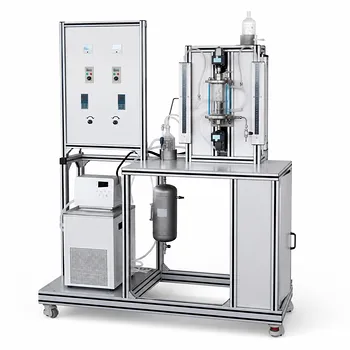
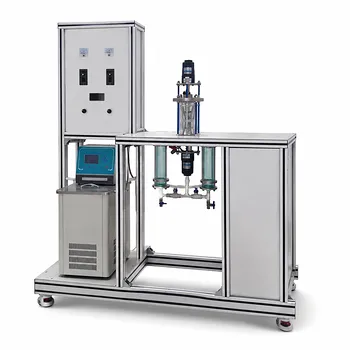
- Dual-Drive Stirred Gas-Liquid Mass Transfer Coefficient Determination Pilot Plant
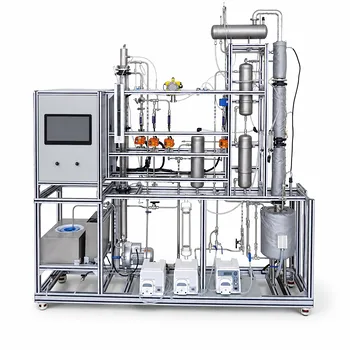
- Dual-Mode Rectification Pilot Plant for Practical Training Unit Operations
- Two-Dimensional Fluidization Hydrodynamics Educational Pilot Plant for Unit Operations Training
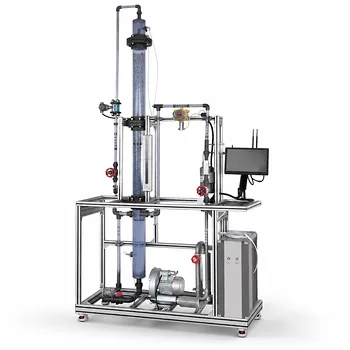
- Multimodal Absorption and Desorption Pilot Plant for Unit Operations Training
- Multi Pump Fluid Transport Process Piping Unit Operations Training Pilot Plant
People Also Ask
- How does column packing affect absorption intensification, and how is it evaluated experimentally?
- Why Compare Membrane-Reservoir Models with Pilot Plant Data? Ensure Successful Process Scale-Up
- Why is pilot plant gas absorption lower than isothermal model predictions? Interfacial heating explained.
- Which interphase forces dominate gas dispersion in stirred reactors? Master Gas Holdup Models
- What operational factors must be considered in viscous gas-liquid mass transfer? Pilot Plant Guide