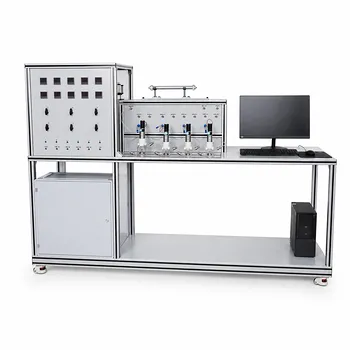
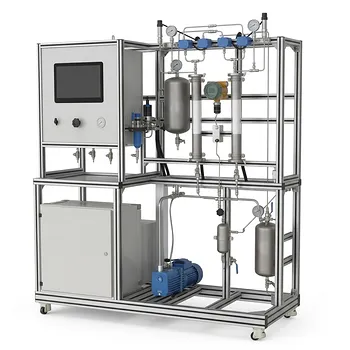
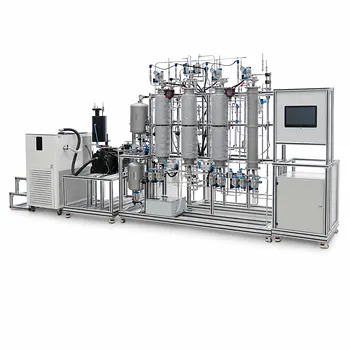
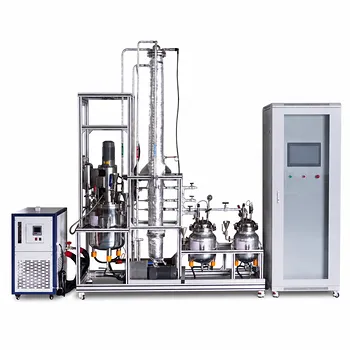
You can’t break the law—but you can bend it. In a chemical engineering pilot plant, mixed-matrix membranes (MMMs) turn the classic permeability-selectivity trade-off from an abstract theory into a hands-on, measurable experiment. By embedding molecular sieves like zeolites into a polymer film and then running real gas separations (e.g., CO₂/CH₄ or O₂/N₂) while you vary pressure, temperature, and feed composition, the unit operation directly reveals how inorganic fillers shift the performance curve. The pilot plant becomes a living laboratory where students and researchers watch the Robeson upper bound push outward—or snap back hard when material compatibility fails.
Core Takeaway: Gas separation pilot plants exploit MMMs to expose the permeability-selectivity trade-off in action. You can’t simply “buy” more of both properties, but by manipulating filler type, loading, and the polymer-filler interface under controlled process conditions, you learn exactly how far the bound can be moved—and what it costs. The real lesson is that MMMs don’t abolish the trade-off; they reveal the precise levers that control it.
The Experimental Bedrock: A Pilot Plant’s MMM Testbed
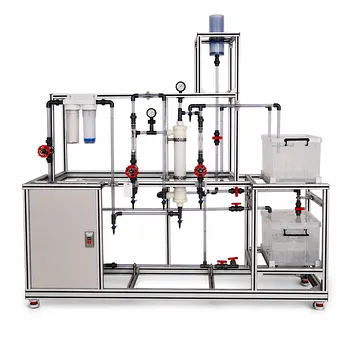
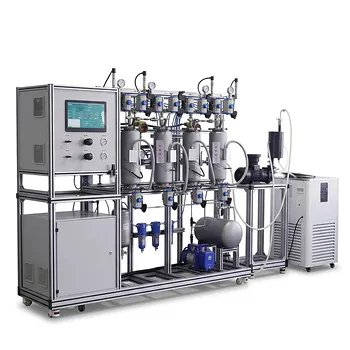
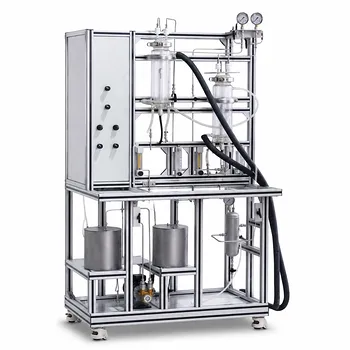
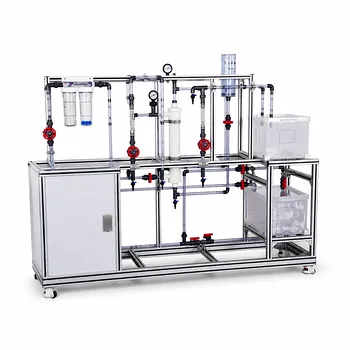
Chemical engineering pilot plants built around membrane gas separation are designed to make the invisible visible. They transform mass transport theory into pressure gauges, flow meters, and gas chromatograph readings that students can touch.
What Are Mixed-Matrix Membranes?
Mixed-matrix membranes combine a continuous polymer phase with a dispersed inorganic filler phase. The polymer gives you easy processability and mechanical flexibility; the filler—often a zeolite, silica, or metal-organic framework—acts as a molecular sieve with extremely sharp size discrimination.
When you cast these materials into a flat sheet and mount them in a spiral-wound or plate-and-frame module, you create a separation layer that behaves neither like a pure polymer nor like a pure sieve.
How the Pilot Plant Brings the Trade-off to Life
In a typical pilot-scale run, you feed a gas mixture (say, nitrogen and oxygen) to the membrane module. You then systematically adjust feed pressure, flow rates, and operating temperature while logging the permeate composition.
- You calculate the permeability from the flux and pressure drop.
- You calculate the selectivity from the enrichment of the faster gas.
- You plot the result against the industry benchmark: the Robeson upper bound.
And there, in one graph, you see the trade-off. Move one point up in permeability, and it often slides left in selectivity. The pilot plant doesn’t just tell you the trade-off exists—it lets you feel why it exists as you watch the data stream.
Decoding the Permeability-Selectivity Axis
To understand how MMMs reshape the trade-off, you first need the tools the pilot plant gives you to measure it.
Plotting Against the Robeson Upper Bound
The Robeson upper bound is an empirical limit drawn from decades of polymer membrane data. For a given gas pair, it marks the best any known polymer can do when you trade one property for the other.
In an educational pilot plant, you can run an older commercial polymer membrane side-by-side with a modern tailored polymer. When students plot both data sets, the bound shifts visibly. They see that material science, not magic, improves separation. MMMs take this one step further: you can now push past even the newest polymer-only bound.
Quantifying the Separation Factor (Alpha)
The pilot plant measures selectivity through the separation factor, computed directly from concentration samples:
α = (yA/yB)perm / (xA/xB)feed
A high α signals a membrane that strongly enriches the target gas. Permeability, meanwhile, tells you how fast that enrichment happens. The tension between “how much” and “how fast” is the heartbeat of every membrane experiment.
Using MMMs to Reshape the Trade-off Curve
Mixed-matrix membranes earn their place in the pilot plant because they let you experiment with the trade-off rather than simply accept it.
The Role of Inorganic Molecular Sieves
When you add zeolite crystals to a polymer, you create a dual-transport pathway. The polymer offers a diffuse, somewhat flexible route; the zeolite imposes a rigid size-exclusion gate. In a CO₂/CH₄ separation, for instance, the sieve can block larger methane molecules while letting carbon dioxide slip through.
By changing the filler loading in the MMM, you can watch permeability and selectivity move in opposite directions—but on a different curve than the pure polymer alone. A 20 wt% zeolite loading might boost selectivity by 50% at the cost of only a small permeability drop, temporarily beating the bound.
The Maxwell Model and Permeability Matching
The MMM’s true potential isn’t free. The Maxwell model—a classic theoretical framework for composite materials—teaches that you must match the permeability of the continuous polymer with that of the dispersed filler.
Maximum selectivity arrives when the polymer permeability is roughly three times lower than the filler permeability. If the polymer is too permeable, gas bypasses the sieve, and the membrane’s selectivity collapses back toward the unfilled value. In the pilot plant, you can demonstrate this directly by testing MMMs made from the same filler but different host polymers—some where the match is perfect, others where it’s poor. The data makes the abstract model concrete.
Temperature’s Amplifying Effect
Gas transport through both polymers and inorganic fillers follows an Arrhenius relationship. Raising the operating temperature increases permeability but almost always diminishes selectivity, because the entropic penalty for sieving shrinks.
In a pilot plant, you can program temperature ramps while holding pressure constant. You’ll capture how the MMM’s trade-off curve itself moves—not just your position on a fixed curve. This teaches a crucial engineering lesson: temperature is a global knob that shifts the whole balance of flux and separation.
Understanding the Trade-offs: When MMMs Underperform
A reliable technical advisor never sells a silver bullet. MMMs have failure modes, and a well-run pilot plant exposes them just as clearly as it reveals the successes.
Interface Defects and Agglomeration
The Achilles’ heel of an MMM is the polymer-filler interface. A microscopic gap between the two phases behaves as a non-selective flow channel, short-circuiting the sieve. In extreme cases, filler particles agglomerate, creating macro-defects that destroy selectivity while giving a false, artificially high permeability.
A pilot plant experiment can detect this by comparing the selectivity of an MMM with a high filler loading to the theoretical prediction from the Maxwell model. A drastic underperformance signals poor interfacial adhesion—a lesson in materials engineering that no simulation teaches as forcefully.
The Economic Trade-off: Area vs. Energy
The trade-off isn’t just a materials problem; it’s an economic one. For nitrogen production from air, for example, increasing membrane selectivity from 8 to 12 can slash compressor energy demand by nearly 29%. However, the same improvement can force you to use ten times more membrane area, ballooning capital cost.
In a pilot plant, you can attach a simple cost model to your experimental runs. Suddenly, the permeability-selectivity plot isn’t just a materials curve—it’s an operating-expenditure versus capital-expenditure frontier that teaches students how process design and material science entwine.
Making the Right Choice for Your Research Goal
How you use a mixed-matrix membrane pilot plant depends entirely on the question you’re trying to answer. Tailor your experimental design to your primary objective.
- If your primary focus is understanding fundamental transport limits: Start with a single gas pair, a simple polymer, and a well-characterized filler like a zeolite. Vary filler loading and temperature, and plot every result against the Robeson bound. The goal is a clean, repeatable demonstration of the trade-off.
- If your primary focus is process optimization for industrial deployment: Introduce variable feed compositions and realistic pressures. Capture energy consumption and membrane area trade-offs. Test the MMM under conditions that mimic a nitrogen rejection unit or a biogas upgrade plant to see where the economic balance tips.
- If your primary focus is materials development and interface engineering: Run parallel experiments with surface-modified fillers and untreated fillers at the same loading. Use the separation factor α as your diagnostic; a sudden jump signals that you’ve fixed interfacial bypass. Let the pilot plant validate or refute your synthesis strategy in real time.
Mixed-matrix membranes turn the pilot plant into a truth serum for separation science. You can’t dissolve the permeability-selectivity trade-off, but you can map its new frontier—and learn exactly what it costs to live there.
Summary Table:
| Parameter / Concept | Role in MMM Gas Separation | Experimental Insight in Pilot Plants |
|---|---|---|
| Inorganic Fillers | Create dual-transport pathways (e.g., zeolites) | Adjusting filler loading shifts the Robeson upper bound. |
| Maxwell Model | Balances polymer and filler permeability | Poor permeability match leads to bypass and selectivity collapse. |
| Temperature | Drives Arrhenius gas transport behavior | Ramping temperature boosts permeability but decreases selectivity. |
| Interface Defects | Identifies compatibility issues (agglomeration) | Underperformance vs. theory indicates poor polymer-filler adhesion. |
Equip Your Lab for Advanced Membrane Research
Bring theoretical chemical engineering concepts to life with LABPARK. We provide premium Educational and Vocational Unit Operations Pilot Plants in chemical engineering, bioprocess & biotech, and environmental & water treatment tailored for universities, research institutes, and enterprises.
Our custom pilot plants allow you to:
- Bridge Theory & Practice: Turn abstract concepts like the Robeson upper bound into hands-on, measurable experiments.
- Conduct Real-World R&D: Validate mixed-matrix membrane (MMM) performance and optimize process parameters under realistic conditions.
- Optimize Processes: Help students and researchers analyze the critical economic trade-off between membrane area and energy consumption.
Ready to elevate your engineering training and research? Contact LABPARK today to find the perfect pilot plant solution for your institution!
Related Products
- Multifunctional Membrane Separation Educational Pilot Plant with Ultrafiltration, Nanofiltration, Reverse Osmosis
- Multi-Functional Membrane Separation Educational Pilot Plant for Unit Operations Lab
- Ultrafiltration Membrane Separation Educational Pilot Plant
- Multi-Component Gas Pressure Swing Adsorption Pilot Plant for Unit Operations Education
- Gas-Solid Heterogeneous Separation Demonstration Educational Unit Operations Pilot Plant
People Also Ask
- How do PEI, PVDF, and PSU membranes compare in pilot plants? Find the best fit.
- Pervaporation vs. Vapor Permeation: Handling Suspended Solids in Membrane Pilot Plants
- What are the trade-offs of polymer vs inorganic membranes in teaching pilot plants? Key laboratory comparison.
- How can operators optimize operating conditions and cleaning protocols in membrane separation pilot plants to mitigate fouling?
- What are the advantages of membrane separation in pilot plants? Efficient Organic Vapor Recovery