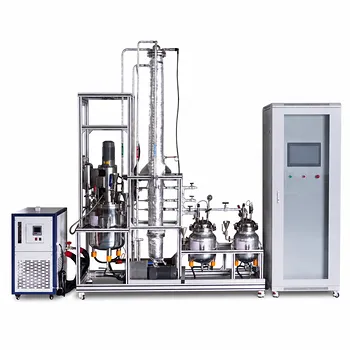
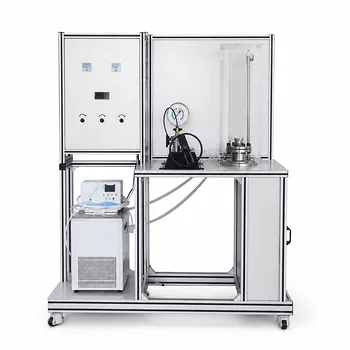
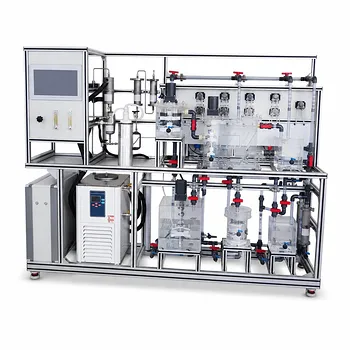
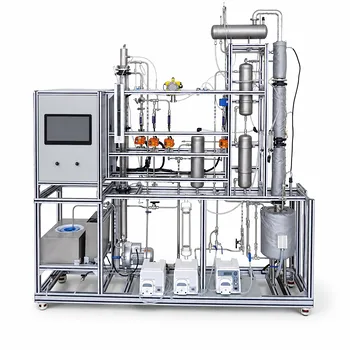
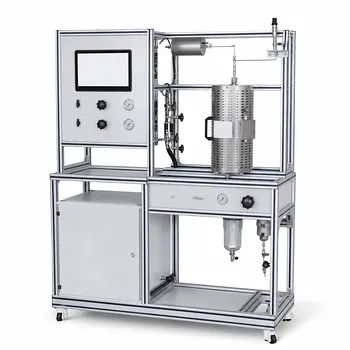
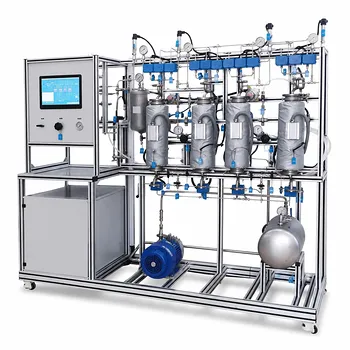
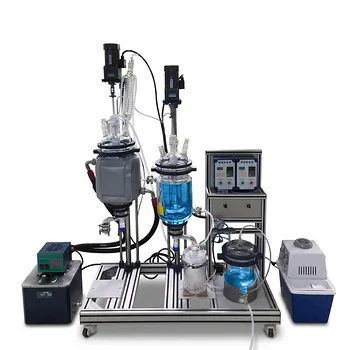
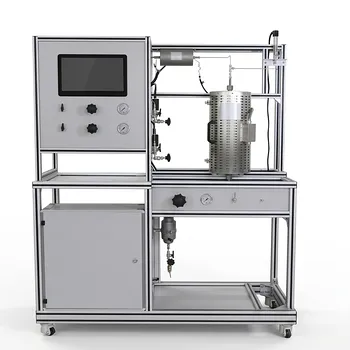
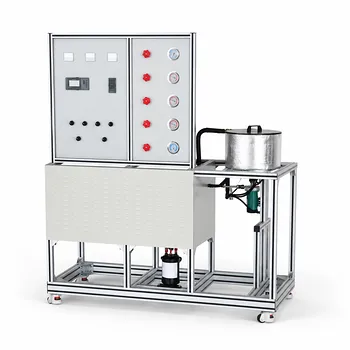
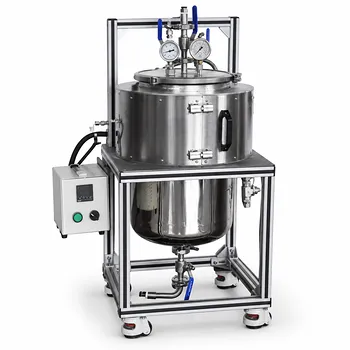
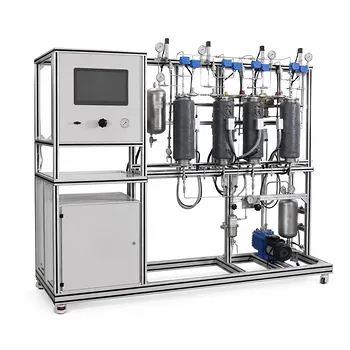
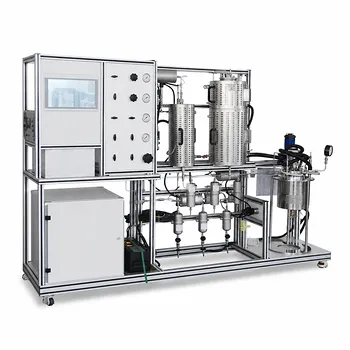
Here's the direct answer. Pilot plants model the reversible thermal decomposition of calcium carbonate by continuously sweeping the liberated carbon dioxide away from the solid reactant using a regulated countercurrent air flow. This sustained removal of the gaseous product prevents the reverse reaction from occurring, driving the equilibrium to near-complete conversion. By adjusting parameters like temperature, feed rate, and air velocity, students and researchers can directly observe how mass transfer, not just heat, governs the performance of a gas‑solid unit operation.
The reversible decomposition of CaCO₃ exemplifies a deep principle: a reaction that is thermodynamically reversible can be made practically irreversible through clever mass transfer. The pilot plant’s countercurrent sweep gas does exactly that – it separates the CO₂ product before it can recombine, turning an equilibrium‑limited batch process into a continuous, high‑conversion operation. This hands‑on demonstration teaches not only calcination chemistry but also the foundational engineering skills of manipulating flow, temperature, and residence time to control a gas‑solid reaction.
The Chemistry of Reversible Decomposition
The Reaction and Its Equilibrium
At approximately 900°C, calcium carbonate (CaCO₃) decomposes into calcium oxide (CaO) and carbon dioxide (CO₂) according to the reversible reaction:
CaCO₃(s) ⇌ CaO(s) + CO₂(g) ΔH = +177 kJ mol⁻¹
Being highly endothermic, the forward reaction is strongly favoured by high temperatures. However, even well above the transition temperature (around 826°C), the reaction will not reach complete conversion unless the CO₂ partial pressure above the solid is kept below the equilibrium value.
The Critical Role of CO₂ Removal
Left in a closed system, the CO₂ generated builds up and recombines with CaO, re‑forming CaCO₃. Removing the gaseous product is the key to driving the decomposition to completion. This is precisely what the pilot plant achieves: by continuously flushing the reaction zone with fresh air, the CO₂ concentration is diluted and swept away, shifting the equilibrium according to Le Chatelier’s principle.
Pilot Plant Design: Simulating an Industrial Lime Kiln
Countercurrent Gas‑Solid Contact
The pilot plant mimics an industrial rotary kiln or fluidised‑bed calciner. Solids – typically pelletised CaCO₃ – travel slowly through a heated tube, while a controlled stream of air flows in the opposite direction. This countercurrent arrangement is paramount: as the solids heat up and begin to decompose, the fresh air entering at the cooler end picks up the liberated CO₂ and carries it out, ensuring the exit gas stream has the highest CO₂ concentration while the solids leaving the kiln experience the lowest local CO₂ partial pressure.
Replicating Continuous Operation at Lab Scale
In a fluid‑bed demonstrator, the granular CaCO₃ is levitated by the airflow itself, promoting excellent gas‑solid contact. The continuous bleed of the off‑gas and continuous feed of fresh limestone creates a steady‑state process that is easy to instrument. Students see the direct link between the air flow velocity (mass transfer driver) and the calcination efficiency (conversion percentage), a relationship that is hard to visualise in a textbook equilibrium calculation.
Key Process Parameters Students Manipulate
Calcination Temperature
The pilot plant’s furnace can be set between 850°C and 900°C – safely above the 826°C decomposition threshold of CaCO₃ but well within the range of standard laboratory equipment. Raising the temperature simultaneously increases the reaction rate constant and shifts the equilibrium toward products. However, excessive temperatures waste energy and can cause particle sintering, so students learn to find an economical set point.
Feed Rate and Residence Time
The speed at which limestone is fed into the kiln, against the fixed airflow, determines the residence time of the solids in the hot zone. Faster feed rates reduce the time available for heat transfer and CO₂ removal, lowering conversion. By varying the feed rate, students map out the kinetic constraints of the system and observe how far the reaction can proceed under given mass transfer limitations.
Air Flow Velocity
This parameter directly controls how effectively CO₂ is stripped from the particle surfaces. Higher air velocities decrease the local CO₂ concentration, pushing the equilibrium further towards CaO. Students can demonstrate that even at a constant temperature, conversion improves when the sweep gas flow is increased – a vivid lesson in the interplay between thermodynamics and mass transfer.
Why Calcium Carbonate? A Pedagogical Choice
Balancing Reactivity and Practicality
The pilot plant’s entire design hinges on the thermochemical properties of the chosen solid. Calcium carbonate decomposes at a transition temperature of ~826°C, which is high enough to illustrate a real industrial process yet low enough to be easily achieved with standard nichrome‑ or silicon‑carbide laboratory furnaces. Its reaction enthalpy of +177 kJ mol⁻¹ is substantial but manageable, allowing the demonstrator to be built without exotic materials.
Comparison with More Stable Salts
Other oxyacid salts would render the demonstration impractical. For instance, calcium sulfate (CaSO₄) requires a transition temperature of 1848°C and an enthalpy input of +403 kJ mol⁻¹ to release SO₃. Such extreme conditions are energetically prohibitive and materially destructive for standard pilot‑scale equipment. CaCO₃ therefore serves as the ideal, safe feedstock that still faithfully represents the core unit‑operation principles.
Understanding the Trade‑offs and Limitations
Idealised vs. Real Mass Transfer
The pilot plant demonstrates the concept of CO₂ removal elegantly, but it also simplifies reality. The countercurrent airflow is assumed to provide perfect plug‑flow behaviour, whereas in industrial kilns, back‑mixing of gases and non‑uniform bed profiles can reduce efficiency. Students should recognise that the lab‑scale unit represents an idealisation of the mass‑transfer process.
Heat Integration and Energy Penalties
Continuously heating and then venting hot sweep gas carries a significant energy cost. In a full‑scale plant, the hot exhaust is often used for preheating the feed or generating steam, but many educational rigs do not include such heat recovery. This deliberately simplifies the model to focus on the gas‑solid reaction itself, but it means the observed operation is not yet an optimised industrial scheme.
Single‑Reaction Focus
The pilot plant treats CaCO₃ decomposition as an isolated system, ignoring impurities in the limestone and side reactions that can occur in real kilns (e.g., with silica or alumina). While this abstraction is valuable for teaching fundamentals, engineers must later account for these factors when scaling up.
Making the Most of the Pilot Plant Experience
How you approach the experiment determines which engineering muscle you build. Consider your primary focus:
- If your primary focus is understanding equilibrium shifting: Run the kiln at a constant temperature and vary only the air sweep rate. Map the exit CO₂ concentration to visualise how mass transfer transforms a reversible equilibrium into an essentially complete reaction.
- If your primary focus is process optimisation and kinetics: Perform a series of runs at different temperatures and feed rates. Plot conversion against these variables to identify the rate‑limiting step – whether it is heat transfer, chemical kinetics, or mass transfer – and discuss how you would size an industrial unit.
- If your primary focus is industrial design principles: Compare the performance of the pilot‑scale countercurrent kiln with a simple batch calciner. Quantify the improvement in conversion and start a conversation about capital costs, operational reliability, and scale‑up rules.
A pilot plant that demonstrates the thermal decomposition of calcium carbonate is much more than a chemistry demonstration – it is a miniature window into how process engineers control reversibility, heat, and mass flow to transform a raw material into a valuable product.
Summary Table:
| Parameter | Action / Manipulation | Process Effect |
|---|---|---|
| Temperature (850°C–900°C) | Heat above decomposition threshold | Increases reaction rate and shifts equilibrium |
| Air Flow Velocity | Increase countercurrent sweep gas | Lowers local $CO_2$ partial pressure, driving conversion |
| Feed Rate & Residence Time | Adjust solid limestone feed speed | Controls heat and mass transfer time in the hot zone |
Bring Gas-Solid Unit Operations to Life in Your Lab
Looking to enhance your chemical engineering curriculum or research capabilities? LABPARK provides premium Educational and Vocational Unit Operations Pilot Plants in chemical engineering, bioprocess & biotech, and environmental & water treatment. Designed specifically for universities, research institutes, and enterprises, our pilot plants deliver hands-on experience in thermodynamics, mass transfer, and process control.
Contact LABPARK today to request a quote or custom configuration!
Related Products
- Carbon Material Thermal Pretreatment Multiphase Separation Educational Pilot Plant
- Carbon Dioxide PVT Curve Determination Educational Unit Operations Pilot Plant
- Thermal Desorption Exhaust Gas and Tail Water Treatment Educational Pilot Plant
- Carbon Dioxide Absorption and Desorption Educational Pilot Plant for Carbon Capture Studies
- Carbon Dioxide Hydrogenation Methanol Synthesis Educational Unit Operations Pilot Plant
People Also Ask
- What challenges do gravity transitions present for pressure control in multiphase separation pilot plants?
- How does steady-state multiplicity affect the operation and safety of exothermic reactions within a CSTR pilot plant? - Guide
- Why is temperature regulation via a cooling jacket a critical feature in CSTR pilot plants used for laboratory training?
- What parameters to monitor transitioning from Batch to CSTR? Master Pilot Plant Setup
- How to select the right unit operations pilot plant for liquid separation? A complete guide.