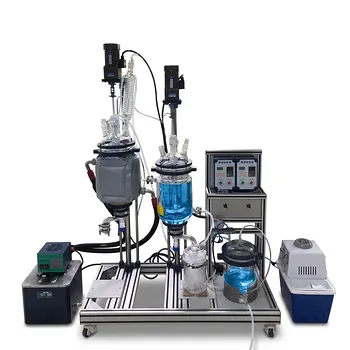
The core of safely managing a reaction like the thermal decomposition of ammonium nitrite in an educational setting is not just about containing it, but instrumenting it. In contrast to simple lab glassware, pilot-scale educational reactors are specifically designed to transform a high-risk, gas-generating reaction into a controlled, teachable moment for industrial process safety. These systems use a combination of real-time sensors, automated cooling, and pressure relief systems to allow students to safely observe the critical transition from external heating to a self-sustaining exothermic runaway.
Chemical engineering educational reactors handle highly exothermic, gas-producing reactions by integrating automated rapid cooling systems and dynamic pressure management. The goal shifts from mere experimentation to teaching students how to recognize and control the industrial hazards of thermal runaway and overpressurization in real-time.
Engineering a Controlled Learning Environment
The primary challenge of this decomposition is its dual hazard: it generates tremendous heat and a large volume of inert gas simultaneously. Educational reactors must manage both threats at once without sacrificing the data that makes the experiment valuable.
The Dual-Threat of Heat and Gas
A reaction like ammonium nitrite decomposition is dangerous because the two hazards amplify each other. The exothermic reaction increases the temperature, which in turn exponentially increases the rate of gas production, which can pressurize a vessel and further accelerate the decomposition.
In a basic flask, this loop can become uncontrollable in seconds. Educational reactor systems break this feedback loop by design, separating the thermal and pressure management tasks to teach the fundamentals of industrial process safety.
Rapid Heat Dissipation via Automated Jackets
The first line of defense against thermal runaway is the cooling system. Unlike a manual cold-water bath, pilot-scale reactors use automated cooling jackets with circulating thermal fluids or molten salts to absorb the reaction's heat.
These are not just for safety; they are instruments. For highly exothermic reactions, the cooling system activates the moment the reaction becomes self-sustaining. This teaches students about heat transfer coefficients under non-steady-state conditions and the critical industrial principle that cooling capacity is a primary safety limit, not an afterthought.
Using the Gas Itself as a Safety Valve
The gas generated is not just a waste product to be safely vented; it is a direct, real-time indicator of reaction rate. The educational system's pressure sensors and automated back-pressure regulators turn the gas production into a measurable variable for process control.
If the pressure rise accelerates unexpectedly, the control system instantly adjusts the venting rate or can trigger a full emergency shutdown. This teaches students to calculate mass transfer limitations and to see pressure as the "voice" of the reaction, directly communicating the rate of decomposition.
Turning a Hazard into a Measurable Data Point
The true educational value lies in how these systems use danger to teach advanced control theory. The reaction becomes a case study in process dynamics.
The Pedagogical Objective: From Initiation to Self-Sustainment
The key learning moment with ammonium nitrite decomposition is the transition from thermal initiation to a self-sustaining exothermic state. This "kick-off" point is where laboratory wizards become industrial engineers.
Educational reactors allow students to safely monitor this inflection point using real-time data flow. They can see the exact temperature where the cooling jacket’s duty spikes, correlating the rate of gas evolution with the calculated reaction enthalpy. This transforms an abstract thermodynamic concept into a concrete, visual event.
Simulating Industrial Emergency Protocols
A runaway reaction in an educational setting is not an accident; it is a pre-planned learning outcome. These pilot plants are programmed to simulate process deviations to trigger safety logic solvers.
When a deviation occurs—say, the temperature exceeds a pre-set thermal stability limit—the system demonstrates a controlled sequence: first increasing cooling flow, then initiating staged venting, and finally executing a full emergency shutdown. This ingrains the layered safety approach crucial for managing nitration or other high-energy reactions in industry.
Understanding the Trade-offs and Educational Constraints
The hardware is not a perfect simulation of a full-scale industrial plant. The educational focus requires certain simplifications that introduce their own limitations.
The Limits of Small-Scale Simulation
Pilot-scale vessels have a much higher surface-area-to-volume ratio than industrial reactors. This naturally enhances heat dissipation, making a true adiabatic runaway condition difficult to fully replicate without external compensation heating.
This means students must learn to interpret data critically, understanding that the thermal behavior they observe is inherently "safer" and more muted than what would occur in a large-scale reactor. The lesson shifts from pure reaction observation to one about the critical danger of scale-up geometry.
Cost and Complexity vs. Accessibility
The sophisticated automation described—with redundant sensors, molten salt systems, and logic controllers—is expensive and complex to maintain. Educational programs must balance this high-fidelity "industrial" experience with simpler setups.
A more basic unit might rely on a jacketed stirred tank with a simple burst disc for overpressure protection. While it cannot demonstrate automated emergency staging, it still powerfully teaches the fundamental heat and mass balance principles at a fraction of the cost, making the knowledge more accessible.
Making the Right Choice for Your Educational Goal
The correct reactor system depends entirely on the depth of the industrial control concept you intend to teach.
After evaluating a reaction's inherent hazards, select the platform that matches the pedagogical goal:
- If your primary focus is teaching fundamental heat and mass balances: A simpler jacketed stirred-tank reactor with manual backup cooling and a basic pressure relief device is sufficient and far more cost-effective for demonstrating core principles.
- If your primary focus is demonstrating advanced industrial process control and safety integrity systems: You need the fully automated pilot plant with circulating thermal fluid jackets, real-time sensor loops, and programmable emergency staging to teach the layered logic of industrial safety.
- If your primary focus is studying the reaction kinetics without the complexities of scale-up hazards: A microchannel reactor with integrated heat exchangers provides the precision and narrow temperature control needed to isolate the chemistry from the physics.
You are not just choosing a piece of equipment; you are selecting the specific, controlled failure mode that will teach the most powerful lesson in chemical process safety.
Summary Table:
| Reactor Type | Key Safety & Control Features | Best Educational Application |
|---|---|---|
| Jacketed Stirred-Tank | Manual backup cooling, basic burst disc pressure relief | Teaching fundamental heat and mass balances cost-effectively |
| Fully Automated Pilot Plant | Circulating thermal fluid jackets, real-time sensors, emergency safety staging | Demonstrating advanced industrial process control and safety systems |
| Microchannel Reactor | Integrated micro-heat exchangers, precise narrow temperature control | Studying reaction kinetics while eliminating scale-up hazards |
Bring Industrial-Grade Safety Training to Your Laboratory
Teaching complex chemical processes requires equipment that balances safety with real-world fidelity. LABPARK provides state-of-the-art Educational and Vocational Unit Operations Pilot Plants in chemical engineering, bioprocess & biotech, and environmental & water treatment. Designed specifically for universities, research institutes, and enterprises, our systems empower students and researchers to master advanced process control, thermal runaway mitigation, and safety protocols in a highly controlled environment.
Ready to upgrade your laboratory with robust, automated educational reactors? Contact our experts today to find the perfect pilot plant solution for your curriculum.
Related Products
- Thermal Desorption Exhaust Gas and Tail Water Treatment Educational Pilot Plant
- Multi-Reactor Educational Pilot Plant for Reaction Engineering Unit Operations
- Residence Time Distribution and Reactor Flow Characteristics Determination Educational Pilot Plant
- Methane Cracking Educational Unit Operations Pilot Plant
- Multifunctional Membrane Separation Educational Pilot Plant with Ultrafiltration, Nanofiltration, Reverse Osmosis
People Also Ask
- How is the number of transfer units (N_OL) calculated and verified? Master Desorption Mass Transfer
- What are inline fluorescence sensor risks, and how can they be managed? Key Strategies
- Lime-Soda vs. Cation Exchange Softening: How Do Effluent Characteristics Compare in Pilot Plants?
- How is P, M, and B alkalinity applied in pilot plants? Prevent Boiler Scaling & Corrosion
- How do anodic & cathodic inhibitors protect heat exchangers? Optimize Your Water Treatment Pilot Plant