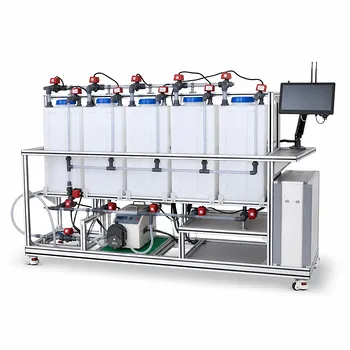
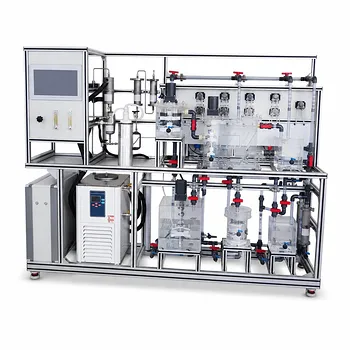
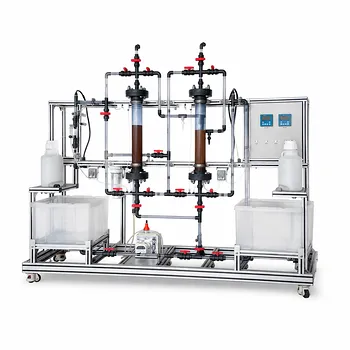
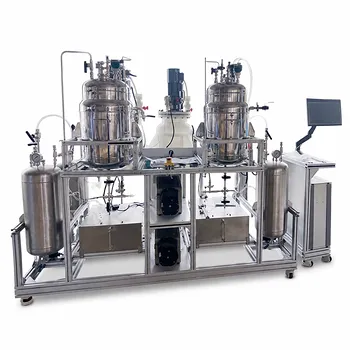
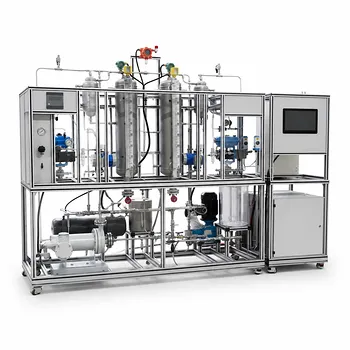
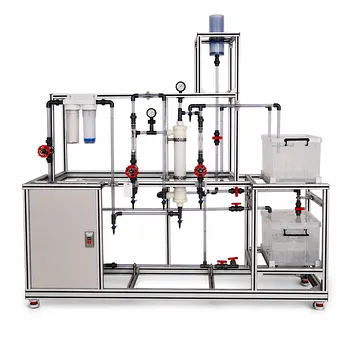
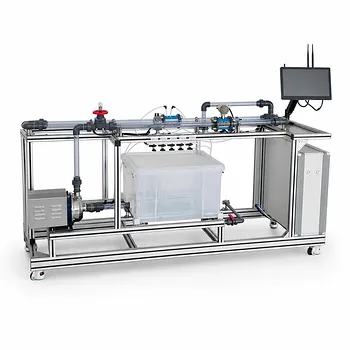
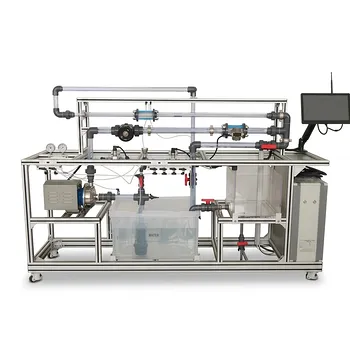
The determination of P, M, and B alkalinity values is the cornerstone of hands-on boiler water chemistry education. In educational water treatment pilot plants, these specific titration methods are applied as a foundational diagnostic toolset to move students beyond theory. They physically titrate samples to map the exact concentrations of hydroxide, carbonate, and bicarbonate ions—the direct chemical agents of scale and corrosion—and then manipulate these levels through chemical dosing and blowdown to prevent catastrophic industrial failures.
Boiler water failures are predictable chemical reactions, not random events. In an educational pilot plant, the P, M, and B alkalinity test trio transforms this complexity into a precise diagnostic map. It empowers students to visualize and neutralize the specific ions actively working to scale heat exchangers or corrode pressure vessels, teaching the direct link between a manual titration result and the physical integrity of a multi-million-dollar asset.
Decoding the Chemistry: What the Tests Actually Reveal
Before students can prevent scaling and corrosion, they must first identify the exact chemical species in the water. The P, M, and B values serve as a chemical decoding key.
The P and M Value Relationship: Mapping the Ions
The process begins with two classic titrations using a standard acid. The P value (Phenolphthalein alkalinity) is recorded when the sample is titrated to a pH of 8.3. The titration continues, and the M value (Methyl Orange or Total alkalinity) is recorded when the pH reaches approximately 3.9.
By comparing these two values, the specific concentrations of scale-forming carbonate and corrosive hydroxide alkalinity are calculated. The mathematical relationships (such as whether P is zero, equal to, or greater than half of M) directly reveal which ions are dominant. This allows students to practically apply solubility principles to predict when calcium will precipitate as hard scale.
The B Value: Isolating the Most Aggressive Ion
Not all hydroxide is created equal, and this is where the educational pilot plant diverges from basic water testing. To prevent caustic embrittlement—a dangerous form of inter-crystalline cracking in boiler steel—operators need to know the concentration of free hydroxide. A standard P value can be skewed by the presence of carbonate.
The B value directly targets this problem. A neutral barium chloride solution is added to the sample to precipitate out all interfering carbonate and phosphate ions. The sample is then titrated to the phenolphthalein endpoint. The result represents the true free hydroxide concentration. In an industrial context, this B value is often converted to equivalent ppm CaCO3 (by multiplying parts of CO3 per 100,000 by 16.6) to verify that chemical treatment dosages are safe and effective.
The Pilot Plant as a Diagnostic and Control Laboratory
Once the ionic composition is known, the pilot plant becomes a live-feedback control loop where students apply corrective actions to meet strict operational targets.
Controlling Scaling: The 80% Rule and Blowdown
Scale prevention is taught as a targeted ratio. For optimal efficiency, the boiler water’s P alkalinity should ideally be about 80% of the M alkalinity. Students physically cycle the water up, observing how total dissolved solids (TDS) increase. To prevent silica and carbonate scale, they must ensure that the M alkalinity does not exceed 20% of the total TDS concentration.
When these ratios drift, the corrective action is a controlled blowdown to physically remove concentrated ions and introduce fresh feedwater. This task teaches the operational balance between water conservation and chemical control.
Maintaining Chemical Passivation: pH Over 10.5
Corrosion prevention in the pilot plant pivots on protecting the magnetite layer. Students learn that a thin, protective film of iron oxide (Fe₃O₄) forms naturally on boiler steel only in a specific chemical environment. To keep this layer intact, the pH of the boiler water must be maintained above 10.5.
Using chemical dosing stations, students adjust feed rates to maintain this high pH using the hydroxide concentration verified by the B value. If the pH drops, the protective layer is stripped away, allowing water to directly attack the iron. Furthermore, maintaining a slightly lower but still critical pH above 9.3 is demonstrated to significantly reduce oxygen-driven pitting at the most vulnerable point: the water line.
Preventing Catastrophic Failures: The Sulfate-to-Alkalinity Audit
The most critical application of the B value is in preventing caustic embrittlement, which leads to a sudden, brittle fracture of boiler metal. Students simulate this risk by concentrating boiler water in an evaporator section. They learn that free hydroxide can concentrate under porous scale, attacking stressed steel.
To mitigate this, they calculate the sulfate-to-alkalinity ratio. By ensuring a specific excess of sulfate ions relative to the measured free hydroxide, the reaction chemistry is shifted away from embrittlement. This audit also addresses operational efficiency by preventing foaming-induced deposits—where high alkalinity destabilizes the water surface in the steam drum, causing water droplets to carry over into the turbine.
Bridging the Gap from Manual Titration to Automated Control
An educational pilot plant’s ultimate value is teaching the transition from manual lab work to industrial automation.
Calibrating the Industry 4.0 Brain with Wet Chemistry
The P, M, and B titration serve as the legal benchmark of truth. Students learn that online pH sensors and automated chemical dosing pumps are subject to drift, fouling, and calibration errors. The manual titration is the absolute reference method. A student cannot confidently configure an automated dosing system to neutralize scale-forming ions without first establishing the true alkalinity baseline with a burette and indicator. This hands-on process ingrains critical thinking for troubleshooting sensor failures that would otherwise shut down production.
Understanding the Common Pitfalls and Trade-offs
Expertise is measured by the ability to navigate ambiguity. A few critical lessons are universally demonstrated in the pilot plant.
The Obsolescence of Historical Conversions
A key lesson in accuracy comes from the B value’s reported units. The historical convention of calculating the B value in "parts of CO3 per 100,000" and multiplying by a conversion factor of 16.6 is an object lesson in operational risk. If a student blindly applies this conversion to a modern total alkalinity measurement without understanding the underlying chemistry, the resulting chemical dosage error can inadvertently drop the pH and destroy the magnetite layer. The pilot plant teaches the principle of hydroxide isolation, not the blind application of legacy factors.
The Acid Dosing Double-Edged Sword
To control scaling, feedwater M alkalinity can be reduced by injecting sulfuric acid before a cation exchanger. This is a high-risk, high-reward trade-off demonstrated visually in the pilot plant. While the acid effectively knocks down the carbonate ratio, a miscalculated flow rate instantly eliminates the alkaline buffer. This practice teaches that a momentary dosing pump failure can drop the pH into the acid range, causing rapid, general corrosion that destroys piping within hours.
The Blowdown Efficiency Paradox
High P values demand a blowdown response, but excessive blowdown flushes expensive, chemically treated hot water down the drain. Students quickly learn the operational trade-off between fuel efficiency (heat loss) and chemical safety. The pilot plant forces them to find the equilibrium where saturation indices are controlled without bankrupting the plant’s energy budget.
Applying the Principles: A Task-Based Guide for Students
The specific test you prioritize depends entirely on the operating challenge you are simulating in the pilot plant.
- If your primary focus is preventing hard carbonate scale: Center your control logic on the P/M ratio. Maintain P at roughly 80% of the M value, and strictly limit M to under 20% of the TDS, using calculated blowdown as your primary corrective loop.
- If your primary focus is ensuring structural integrity and passivation: Your process must revolve around the B value and direct pH measurement. Prove that free hydroxide keeps the pH above 10.5 to sustain the protective magnetite layer, and audit the sulfate-to-alkalinity ratio to definitively rule out caustic embrittlement risk.
- If your primary focus is calibrating automated sensor networks: Use the manual P, M, and B titrations as the gold-standard baseline. Back-calibrate all online pH probes and chemical injection pumps against this data to demonstrate how analog precision validates digital control systems.
By mastering this trio of tests, students don't just learn to operate a pilot plant—they develop the predictive intelligence to neutralize the exact chemical failures that threaten full-scale industrial assets.
Summary Table:
| Parameter | Target Ion / Purpose | Key Operational Action |
|---|---|---|
| P Alkalinity | Carbonate & Hydroxide | Maintain P at ~80% of M to prevent carbonate scale |
| M Alkalinity | Total Alkalinity | Limit M to <20% of total TDS; trigger blowdown as needed |
| B Alkalinity | Free Hydroxide | Verify pH >10.5 for passivation; audit sulfate ratio to prevent embrittlement |
Elevate Your Engineering Training with LABPARK
Bridge the gap between classroom theory and industrial application. LABPARK provides advanced Educational and Vocational Unit Operations Pilot Plants in chemical engineering, bioprocess & biotech, and environmental & water treatment. Tailored for universities, research institutes, and enterprises, our high-fidelity systems empower students and operators to master critical troubleshooting skills—such as boiler scaling control and water chemistry audits—in a safe, controlled environment.
Ready to upgrade your laboratory capabilities? Contact LABPARK today to discuss your custom pilot plant needs!
Related Products
- Electrochemical Water Treatment Educational Unit Operations Pilot Plant
- Thermal Desorption Exhaust Gas and Tail Water Treatment Educational Pilot Plant
- Ion Exchange Water Purification Educational Pilot Plant for Engineering Unit Operations
- Water Electrolysis Hydrogen Production and Storage Educational Pilot Plant
- Alkaline Membrane Water Electrolysis Educational Pilot Plant Unit Operations Training System
People Also Ask
- What design features do educational electrochemical pilot plants utilize to manage gas liberation and water loss?
- How can unit operations pilot plants show lead-acid concentration vs state of charge? Real-time monitoring guide.
- How do educational electrochemical pilot plants scale up electrolysis? Master industrial engineering.
- How to Estimate Sulfate in Water Treatment Pilot Plant Deposits: Gravimetric Guide
- How can foaming be managed during steam generation experiments in water treatment unit operations pilot plants? Tips