Scaling up a copper electrolysis experiment from a beaker to a pilot plant isn’t just about making it bigger—it’s about transforming a qualitative demonstration into a quantitative engineering process.
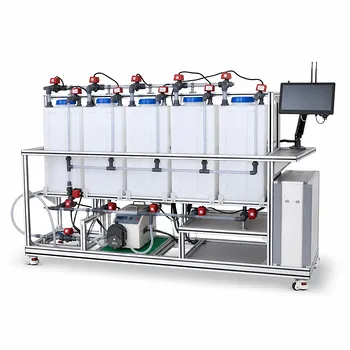
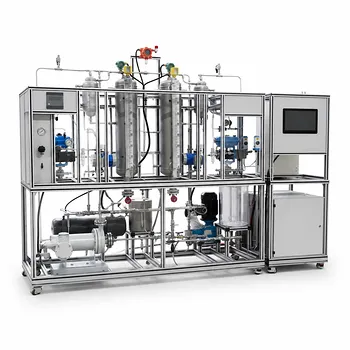
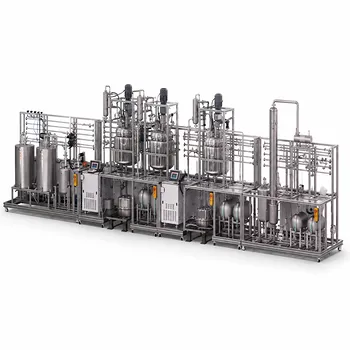
Educational electrochemical unit operations pilot plants achieve this by replacing laboratory glassware with pilot-scale electrochemical reactors (plate‑and‑frame or membrane electrolysers), industrial‑grade rectifiers, recirculating pumps, and heat exchangers. These systems add continuous‑flow operation and online sensors for temperature, flow rate, and cell voltage, enabling students to quantify mass‑transfer limitations, current efficiency, energy consumption, and electrode passivation in ways a bench‑top setup never can—bridging the gap between basic chemistry and real‑world electrodeposition.
A basic lab experiment teaches what happens in electrolysis; a pilot plant reveals how to make it happen reliably at scale. By introducing continuous flow, industrial hardware, and data‑driven analysis, these educational units unlock the engineering principles—mass transport, heat management, process control—that determine commercial viability and that remain invisible in a beaker.
From Beaker to Reactor: The Hardware That Defines Scale‑Up
In a typical copper electrolysis lab, you use a beaker, copper plates, and a manual power supply. The educational pilot plant re‑creates that same chemistry inside an engineered environment that mirrors industrial production.
The Heart of the System: Pilot‑Scale Electrochemical Reactors
Instead of an open beaker, students work with enclosed plate‑and‑frame or membrane reactors that precisely control electrode spacing and flow patterns.
This design immediately introduces the concept of current density distribution—a critical scaling factor that never appears in a beaker experiment.
Industrial‑Grade Power and Fluid Handling
A rectifier replaces the simple manual power supply, delivering stable, high‑current DC power while allowing students to measure energy input directly.
Recirculating pumps and heat exchangers maintain constant electrolyte concentration and temperature, turning the static bath into a dynamic continuous process where mass‑transfer and thermal effects become measurable.
Real‑Time Sensors, Not Visual Estimates
Online instruments for temperature, flow rate, and cell voltage replace manual observations.
This instrumentation moves the experiment from “it looks like copper is plating” to quantified performance—current efficiency, specific energy consumption, and electrode potential shifts—turning empirical observation into engineering data.
The Shift from Batch to Continuous Flow: Revealing Mass Transfer and Passivation
The most profound change is the move from a stagnant solution to a flowing electrolyte. This single shift exposes phenomena that dominate industrial electrochemistry.
Why Flow Changes Everything
In a beaker, diffusion is the only transport mechanism; at the industrial scale, convection and migration dominate.
The pilot plant’s recirculation loop forces students to consider mass‑transfer limitations: how quickly ions reach the electrode surface, and what happens when concentration gradients form.
Current Efficiency and the Real Cost of Driving a Reaction
With a simple lab, you may assume every electron reduces copper. In a pilot plant, side reactions and poor mass transport lower current efficiency, a direct economic parameter.
Measuring the actual metal deposited versus theoretical yield shows why industrial cells spend enormous effort on flow distribution and electrode design.
Electrode Passivation: The Hidden Degrader
Under continuous high‑current operation, electrodes can develop resistive films or surface deposits that increase cell voltage and waste energy.
The pilot plant’s long‑run capability lets students observe passivation firsthand, correlate it with current and flow conditions, and explore mitigation strategies—exactly the challenge faced in commercial copper electrorefining.
Instrumentation Turns Chemistry into Chemical Engineering
The laboratory electrolysis experiment asks, “Did a reaction happen?” The pilot plant asks, “How well is it happening, and how can we control it?”
From Gas Bubbles to Gas‑Liquid Separators and Mass Flow Meters
In basic labs, gas volume is measured with an inverted burette. In the pilot plant, automated gas‑liquid separators and mass flow meters give precise real‑time gas production data.
This is essential for calculating electrochemical equivalence, validating material balances, and designing safe industrial exhaust systems.
Online Monitoring for Dynamic Process Control
The marriage of sensors (pH, conductivity, temperature, voltage) with a data acquisition system transforms the reactor into a process unit rather than a single experiment.
Students learn to set control loops, respond to sensor drift, and interpret multi‑variable trends—skills directly transferable to operating full‑scale electrochemical plants.
Validating Theory with Predictive Models
The data stream also serves as input for mathematical models of the cell. By comparing model predictions to real‑time measurements, students experience the modern scale‑down and predictive scale‑up workflow, where models first simulate behavior before expensive physical trials.
Learning Industrial Safety and Process Integration
A beaker experiment rarely addresses process hazards. The educational pilot plant embeds safety into the learning, reflecting the reality of industrial operations.
Gas Handling and Ventilation
The generation of chlorine, oxygen, or hydrogen in electrolysis demands proper ventilation and gas‑separation protocols.
Transparent cell housings with dedicated gas collection lines teach industrial gas‑handling safety and how side‑reaction products are managed at scale.
Impurity Accumulation and Recycle Streams
In a continuous system, impurities in the electrolyte can concentrate over time, just as in commercial copper refining.
Students observe how anode slime forms, how electrolyte composition shifts, and why bleed streams and purification steps are necessary—insights impossible with fresh beaker solutions.
Understanding the Trade‑offs of Educational Pilot Plants
While these pilot plants are critical learning tools, they are still simplified models of a full industrial installation.
They Do Not Replicate Every Industrial Challenge
Long‑term material degradation, electrode wear, and the economics of energy contracts remain abstract.
The pilot plant scale may still mask channeling, maldistribution, or thermal runaway effects that appear only at very large electrode areas.
Complexity vs. Educational Clarity
A fully instrumented plant can overwhelm students if the fundamental redox concepts get lost behind data screens and control panels.
Well‑designed curricula keep the emphasis on linking sensor readings back to the Nernst equation, half‑reactions, and Faraday’s laws, so the technology enhances—not obscures—the core science.
Making the Right Choice for Your Training Goal
Pilot plant learning should always be aligned with the specific engineering skills you want to develop.
- If your primary focus is understanding scale‑up phenomena: Prioritize experiments that vary flow rate and current density to map mass‑transfer coefficients, current efficiency curves, and passivation onset times.
- If your primary focus is process control and data integration: Use the plant’s automation capabilities to build a real‑time monitoring dashboard, implement basic feedback loops, and validate process models against live data.
- If your primary focus is safety and industrial practice: Emphasize gas‑handling protocols, impurity management, and the interpretation of electrochemical performance under fault conditions—skills that make a graduate immediately valuable in an electrorefining or electroplating line.
These scaled‑down industrial environments turn electrolysis from a simple redox reaction into a rich problem‑solving platform, preparing chemical engineers to control, optimise, and safely scale the electrochemical processes that drive modern metal production.
Summary Table:
| Feature | Laboratory Beaker Setup | Educational Pilot Plant |
|---|---|---|
| Reactor Design | Open beaker, manual spacing | Enclosed plate-and-frame / membrane |
| Fluid Dynamics | Stagnant solution (diffusion only) | Continuous flow (convection & migration) |
| Power & Control | Manual power supply, visual observation | Industrial rectifier, online PLC sensors |
| Key Insights | Qualitative reaction verification | Quantitative current efficiency & passivation |
Elevate Your Chemical Engineering & Process Training
Ready to bridge the gap between classroom theory and industrial application? LABPARK designs and manufactures state-of-the-art Educational and Vocational Unit Operations Pilot Plants in chemical engineering, bioprocess & biotech, and environmental & water treatment. We empower universities, research institutes, and enterprises with hands-on, industrial-grade training systems.
Contact LABPARK today to upgrade your laboratory capabilities.
Related Products
- Electrochemical Water Treatment Educational Unit Operations Pilot Plant
- Electrolytic Hydrogen Production Educational Unit Operations Pilot Plant
- Ethyl Acetate Synthesis Unit Operations Pilot Plant for Practical Training
- Multi-Reactor Educational Pilot Plant for Reaction Engineering Unit Operations
- Multi-Modal Distillation Unit Operations Training Pilot Plant
People Also Ask
- What design features do educational electrochemical pilot plants utilize to manage gas liberation and water loss?
- How can unit operations pilot plants show lead-acid concentration vs state of charge? Real-time monitoring guide.
- How to Estimate Sulfate in Water Treatment Pilot Plant Deposits: Gravimetric Guide
- How can foaming be managed during steam generation experiments in water treatment unit operations pilot plants? Tips
- How do educational electrochemical pilot plants facilitate the study of electrolytic reduction processes?