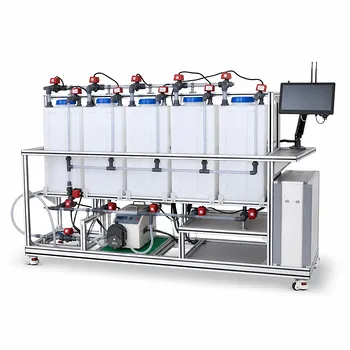
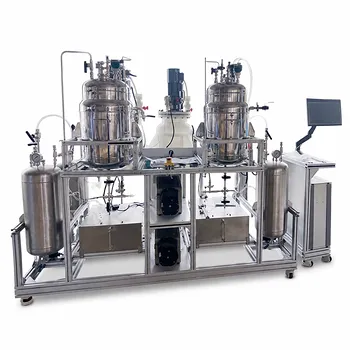
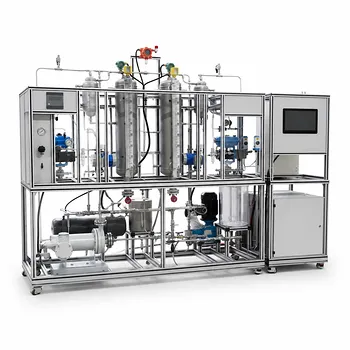
The missing link between a textbook equation and a real ton of metal is often a fire, a toxic fume, and a hefty electricity bill. Educational electrochemical pilot plants solve this by shrinking the hazards without shrinking the physics. These benchtop‑to‑pilot‑scale systems let you safely manipulate current density, electrolyte chemistry, and electrode geometry while collecting real‑time data on voltage, temperature, and deposit quality. In short, they turn the abstract study of electrolytic reduction into a hands‑on investigation where Faraday’s laws meet industrial constraints—without the smelter‑floor danger.
Without a pilot plant, students never see the gap between theory and reality. Educational electrolysis units provide a risk‑mitigated, instrumented environment to explore how current efficiency, mass transport, and electrode degradation determine whether a reduction process is a classroom curiosity or an industrial workhorse.
What a Pilot Plant Reveals That a Beaker Cannot
A simple benchtop electrolysis of zinc iodide in a beaker beautifully illustrates redox and stoichiometry. But the moment you ask, “Why does this process waste 40% of its energy at scale?” you need something that mimics industrial physics.
The Physics You Cannot Shrink Without Special Tools
Industrial electrolytic cells are thermodynamic and kinetic black boxes where heat dissipation, mass transfer boundary layers, and side reactions dominate. A pilot plant deliberately introduces these complexities at a scale small enough to control yet large enough to measure. Corrosion‑resistant flow cells, membrane compartments, and forced convection loops bring the real bottlenecks—concentration polarization, ohmic drop, and gas blinding—into the light.
From Single Compartment to Membrane Cell Configurations
Educational pilot plants often include partitioned cells with ion‑exchange membranes. This lets you study how separating anolyte and catholyte alters current efficiency in processes like the Betts refining of lead. Without a membrane, parasitic reactions at the anode can re‑dissolve your freshly deposited active metal. The pilot plant makes this invisible loss visible through continuous voltage and pH monitoring.
The Four Critical Levers You Can Pull in a Pilot Plant
Real‑world reduction processes hinge on a few variables that a pilot plant lets you systematically map.
1. Current Density: The Speed‑Quality Trade‑off
Current density (A/m²) is the accelerator pedal. Push it too hard and you get powdery, impure deposits and wasteful hydrogen evolution. Roll it back and production becomes unprofitable. The pilot plant’s regulated DC power supply allows you to sweep current density while logging cathode potential, so you can pinpoint the window where energy consumption meets purity targets.
2. Electrolyte Concentration and Temperature
In aqueous systems like copper refining from nitrate‑based electrolytes, a few degrees of temperature or a percentage point of acid concentration can shift the current‑efficiency curve by 15% or more. The onboard thermostatic baths and conductivity sensors let researchers ask: Does this electrolyte need to be heated, or does the process’s own ohmic heating create a runaway risk? You can map that boundary without damaging a full‑scale cell.
3. Electrode Spacing and Mechanical Design
Ohmic drop in the electrolyte is a silent energy thief. By varying the anode‑cathode gap and logging the resulting cell voltage, students directly experience why industrial cells are engineered with millimeter precision and how gas‑induced turbulence can rescue performance. Pilot plants make that geometry‑power link tangible.
4. Real‑Time Data Acquisition
Dedicated sensors for pH, temperature, and individual electrode potentials turn a black‑box reaction into a story told in numbers. Students learn to calculate energy consumption in kWh/kg of metal, plot specific energy vs. current density, and diagnose process upsets like anode passivation or dendrite formation—skills impossible to develop from a textbook.
Understanding the Trade‑offs in Pilot‑Scale Education
For all their power, educational pilot plants are not miniature industrial plants. Their value comes from the questions they force you to confront.
- Simplified feedstocks mask raw material challenges. A pilot plant often uses reagent‑grade salts, not the impure leachates of an industrial operation. Students see the pure electrochemistry but not the tankhouse headaches of impurity‑driven cathode contamination or slippery slurry electrodes.
- Batch operation hides continuous‑process dynamics. Industrial electrolytic cells run for weeks or months with steady metal bleed and electrolyte bleed. A pilot plant’s start‑stop cycles can exaggerate the apparent importance of pre‑treatment steps.
- Scale‑up is nonlinear. Heat management, bus‑bar design, and worker safety in a full‑scale pot room are their own discipline. The pilot plant teaches the core electrochemical relationship, but you must never assume that optimal current density in a 1‑L cell is the optimal current density in a 50‑000‑L tank.
Yet these very limitations make pilot plants superb teaching tools: they force you to ask the questions that matter before you ever step onto a factory floor.
How to Apply This to Your Project
The right pilot‑plant investigation depends entirely on your learning or research goal. Here are the sharpest paths based on common objectives.
- If your primary focus is teaching fundamental electrochemistry: Run a classic copper‑refining cell and vary the current density while measuring cathode mass gain. Graph the divergence from theoretical Faraday efficiency to make intangible overpotential feel concrete.
- If your primary focus is vocational training for metal production industries: Set up a membrane‑partitioned cell running a Betts‑type lead electrolyte. Let trainees experience how a single failed membrane gasket can ruin purity across an entire batch.
- If your primary focus is process optimization and research: Use the pilot plant as a design‑of‑experiments platform. Map the response surface of current efficiency versus temperature and electrolyte flow rate. The data you collect here is directly transferable to industrial process models.
- If your primary focus is safety and scale‑up reasoning: Deliberately test a “worst‑case” scenario—like losing cathode temperature control—to calculate the thermal runaway threshold. Document the heat‑dissipation limits of your cell design to understand the engineering that stands between a pilot study and a safe industrial hall.
The electrochemical pilot plant does not replace the reactor engineering of the real world, but it replaces guesswork with guided, measurable experience. It turns the reduction of a metal from a recipe into a reasoned choice.
Summary Table:
| Process Variable | Classroom Beaker Limitation | Pilot Plant Advantage | Educational & Practical Outcome |
|---|---|---|---|
| Current Density | Fixed/unregulated setting | Sweep DC power & log cathode potential | Determine optimal window for energy vs. purity |
| Cell Configuration | Single-compartment only | Membrane & partitioned cells | Study separation of anolyte/catholyte & efficiency |
| Electrolyte & Temp | No thermal/flow control | Onboard thermostatic baths & flow loops | Map thermal runaway thresholds and energy curves |
| Data Acquisition | Manual/visual observation only | Real-time pH, temp, & potential logging | Learn to calculate energy consumption (kWh/kg) |
Bridge the Gap Between Theory and Industrial Reality with LABPARK
Are you looking to equip your laboratory or training facility with industrial-grade educational systems? LABPARK designs and manufactures state-of-the-art Educational and Vocational Unit Operations Pilot Plants in chemical engineering, bioprocess & biotech, and environmental & water treatment.
We help universities, research institutes, and enterprises turn complex chemical equations into safe, hands-on, and highly measurable learning experiences. By simulating real-world thermodynamic and kinetic challenges at a controlled scale, our pilot plants prepare students and researchers for actual industrial conditions.
Ready to elevate your engineering curriculum or research capabilities? Contact us today to discuss your facility's custom pilot plant requirements!
Related Products
- Electrochemical Water Treatment Educational Unit Operations Pilot Plant
- Electrolyte Distillation Purification and Formulation Educational Pilot Plant
- Electrolytic Hydrogen Production Educational Unit Operations Pilot Plant
- Water Electrolysis Hydrogen Production and Storage Educational Pilot Plant
- Ethyl Acetate Synthesis Unit Operations Pilot Plant for Practical Training
People Also Ask
- What design features do educational electrochemical pilot plants utilize to manage gas liberation and water loss?
- How can unit operations pilot plants show lead-acid concentration vs state of charge? Real-time monitoring guide.
- How do educational electrochemical pilot plants scale up electrolysis? Master industrial engineering.
- How to Estimate Sulfate in Water Treatment Pilot Plant Deposits: Gravimetric Guide
- How can foaming be managed during steam generation experiments in water treatment unit operations pilot plants? Tips