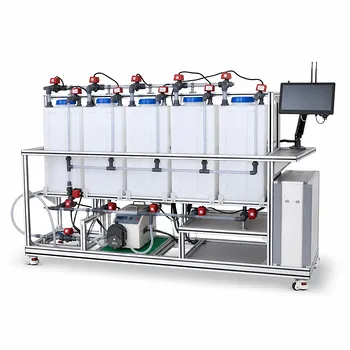
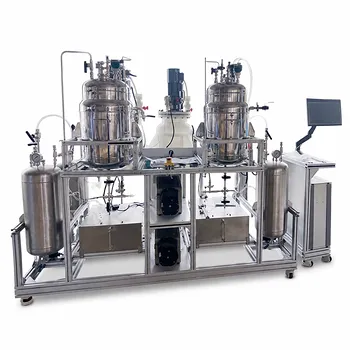
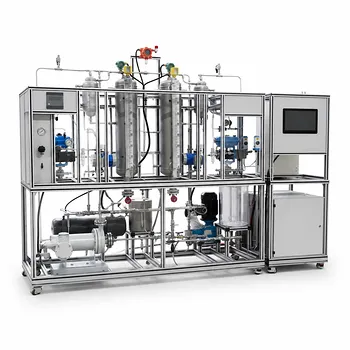
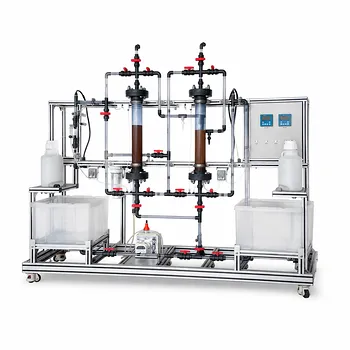
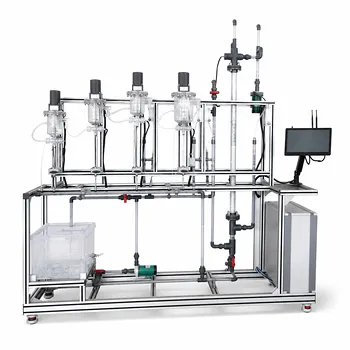
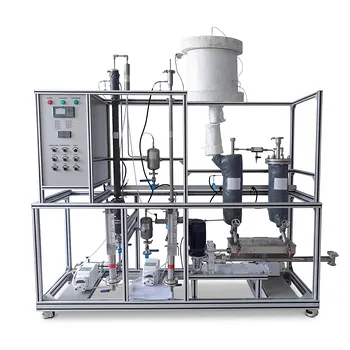
The safe and effective study of electrochemistry in a pilot plant hinges on the seamless integration of active gas management and precise water balance control. These educational plants are specifically designed with built-in gas venting or scrubbing systems, dedicated safety sensors for hydrogen, and automated liquid level controllers that replenish pure water. This integrated approach directly captures and safely dilutes the explosive hydrogen and oxygen by-products, while simultaneously compensating for the water consumed by the side-reaction, ensuring the electrolyte concentration remains stable for accurate student experiments.
While the liberation of hydrogen and oxygen gas and the associated water loss are unavoidable in aqueous electrolysis and battery charging, a well-designed educational pilot plant turns these physical phenomena from a safety hazard and an experimental variable into a controlled, measurable, and instructive part of the process. The core design philosophy is not just to mitigate risk, but to automate the mundane task of water replenishment so students can focus on investigating kinetics, mass balances, and Faraday's laws.
The Core Functional Requirements for Managing Gas and Water
The primary reference outlines a system designed around a specific electrochemical side-reaction: the decomposition of water during lead-acid battery charging. The design features required to manage this are not just safety add-ons; they are fundamental components that define the pilot plant’s educational capability.
Active Gas Venting and Scrubbing Systems
The most immediate threat from electrolysis side-reactions is the release of hydrogen and oxygen. In a sealed or poorly ventilated space, hydrogen gas forms an explosive mixture with air.
An educational pilot plant addresses this with an active venting system. This is not a passive vent, but a controlled pathway that directs the gas stream to a safe discharge point or through a scrubbing medium. The scrubbing system may not chemically neutralize hydrogen and oxygen, but it can dilute the gas stream with air to keep the concentration far below the lower explosive limit (LEL), or in some cases, catalytically recombine them back into water. This ensures the laboratory environment remains safe for students working nearby.
Integrated Safety Sensor Arrays
Active venting is effective, but it is not foolproof. A failure in a fan, a blockage in a line, or a sudden surge in gas production could lead to a hazardous accumulation. This single point of failure is managed by a dedicated safety sensor system.
These sensors, specifically calibrated for hydrogen gas detection, are positioned at the gas outlet and in the immediate vicinity of the reaction cells. They are hardwired into the plant's control logic. If the hydrogen concentration nears a critical threshold, the system triggers an automated safety interlock, which typically cuts power to the electrochemical cells, halting gas generation instantly. This layer of protection allows students to run experiments that deliberately push gas evolution rates to their limits, all within a safeguarded envelope.
Automated Liquid Level Controllers and Pure Water Replenishment
Water loss is the silent, companion problem to gas evolution. As water splits into gas, the electrolyte volume decreases and its concentration increases, which would ruin experiments designed to study mass balance or stable-state kinetics. Manually topping off water is imprecise and pulls a student away from critical observations.
The design solution is a closed-loop control system. A high-precision liquid level sensor continuously monitors the electrolyte volume in the cell or in a header tank. When the level dips below the setpoint, a controller activates a dosing pump that injects deionized or distilled water from a reservoir. This automated replenishment system achieves two crucial objectives:
- It maintains a perfectly stable electrolyte concentration, removing a major source of experimental error.
- It allows the pilot plant to run unattended for long periods, which is essential for charging lengthy battery cycles or collecting cumulative gas volume data.
Enabling Education Through Design: Beyond Safety
While safety is the foundational requirement, the primary reference explicitly states that these features allow students to "safely investigate mass balances, gas evolution kinetics, and the automated replenishment." This transforms a safety system into a teaching tool.
Visualizing Theory with Transparent and Instrumented Cells
To perform a mass balance, students must be able to see what is happening. The supplementary references highlight the importance of transparent, scaled reaction chambers. This design feature is vital in education because it lets students directly observe gas bubbles forming on electrodes, measure the volume of gas evolved against graduated markings, or watch the color change of an electrolyte.
Combined with an integrated gas flow meter, as recommended for measuring oxygen and hydrogen generation rates, the plant turns Faraday's laws from abstract equations into a visual, quantifiable event. Students can compare the measured volume of gas produced with the theoretical volume calculated from the total charge passed, all while the automated system silently keeps the water level constant, ensuring no variable is out of control.
Integrating Process Control for Dynamic Studies
The system's sensors for pH and temperature, mentioned in the supplementary references, are not peripheral. They are the data streams that allow a student to test the Nernst equation and analyze current efficiency. When a student changes the charging current, the integrated sensors record a corresponding immediate spike in gas flow and a gradual shift in temperature and pH.
The design of the educational plant consolidates all this data on a single interface. This automated data acquisition means the student isn't just a plant operator; they are a process engineer analyzing the dynamic response of a system, correlating the automated water dosing frequency directly to the rate of gas evolution they are measuring.
Understanding the Trade-offs and Limitations
An objective view requires acknowledging that this high level of automation and safety creates its own set of challenges in an educational context.
The "Black Box" Risk of Over-Automation
When water replenishment and gas venting are perfectly automated, a student might forget the fundamental reason they are necessary. The process can become invisible. An effective curriculum must therefore include specific exercises where a student opens the control loop—for example, disconnecting the auto-replenishment and manually recording the water level drop over time. This prevents the pilot plant from becoming a magical black box and reinforces the core chemical engineering lesson.
Cost, Complexity, and Maintenance
The infrastructure required—hydrogen sensors, dosing pumps, scrubbing columns, and an integrated safety PLC—adds significant capital cost. In a budget-constrained educational setting, this expense must be weighed against the cost of smaller, more manual benchtop kits. Furthermore, sensors require regular calibration. A hydrogen sensor that has drifted out of spec is a latent safety risk, and the water purity in the replenishment reservoir must be consistently high to avoid contaminating the electrolyte. This creates an ongoing operational burden that requires a dedicated technician, not just a professor.
The Limitation of Pure Water Replenishment
Automatically adding pure water only addresses the water that was split into gas. It does not account for electrolyte lost through aerosolized mist or droplets carried out with the gas stream. Over many cycles, the overall mass of the electrolyte solute can actually decrease, even as the water level is perfectly maintained. Students using this design for long-term mass balance studies must be taught to account for this "acid mist" carryover, otherwise their final concentration calculations will contain a systematic error. A more advanced design might integrate a demister in the vent line to condense and return this aerosol, but this adds further complexity.
Making the Right Choice for Your Educational Goal
The decision to use a specific set of design features—whether simple, transparent cells or fully automated pilot plants—depends entirely on what you want your students to learn and the resources you have available.
- If your primary focus is teaching Faraday's laws and basic electrochemistry: Choose a simple, transparent, manually operated plant. Let students see the gas evolution and top up the water themselves. The physical act of measuring and replenishing will cement the concept of mass loss far better than an automated system.
- If your primary focus is on process automation, safety systems, and long-duration battery charge/discharge studies: The automated venting, gas sensing, and water replenishment systems are non-negotiable. This design teaches process control logic, safety integrity levels, and the engineering needed for unattended operation, concepts that are central to modern chemical engineering.
- If your primary focus is on rigorous mass balance and reaction kinetics: Invest in the fully instrumented plant with precise flow meters, integrated data logging, and a stable, automated water balance, but pair it with a curriculum that includes "open loop" investigations. This will prevent the automation from hiding the science it's designed to reveal.
Designing an educational electrochemical pilot plant is an exercise in making invisible physics visible and dangerous reactions safe. The true art is in integrating these controls so seamlessly that they guide the student's attention to the scientific principle, not the machine's plumbing.
Summary Table:
| Key Design Feature | Primary Function | Educational & Practical Benefit |
|---|---|---|
| Active Venting & Scrubbing | Dilutes and safely discharges $H_2$ and $O_2$ | Ensures laboratory safety during gas evolution studies |
| Safety Sensor Arrays | Monitors $H_2$ levels and triggers automated shutoff | Teaches safety interlock logic and risk mitigation |
| Auto Level Controllers | Replenishes water via high-precision dosing pumps | Maintains stable electrolyte concentration for accurate kinetics |
| Transparent Cells | Visualizes gas bubbles and volume changes | Connects theoretical Faraday's laws with physical observations |
Bring Safe, Industry-Grade Process Control to Your Chemical Engineering Lab
At LABPARK, we empower universities, research institutes, and enterprises to deliver hands-on, practical education. We provide state-of-the-art Educational and Vocational Unit Operations Pilot Plants in chemical engineering, bioprocess & biotech, and environmental & water treatment. Our systems are designed with advanced safety automation—like active venting and automated level controls—allowing students to safely explore complex reaction kinetics, mass balances, and process control systems.
Ready to upgrade your laboratory with safe, robust educational pilot plants? Contact us today to discuss your custom project requirements!
Related Products
- Electrochemical Water Treatment Educational Unit Operations Pilot Plant
- Electrolyte Distillation Purification and Formulation Educational Pilot Plant
- Electrolytic Hydrogen Production Educational Unit Operations Pilot Plant
- Water Electrolysis Hydrogen Production and Storage Educational Pilot Plant
- Alkaline Membrane Water Electrolysis Educational Pilot Plant Unit Operations Training System
People Also Ask
- How can unit operations pilot plants show lead-acid concentration vs state of charge? Real-time monitoring guide.
- How do educational electrochemical pilot plants scale up electrolysis? Master industrial engineering.
- How to Estimate Sulfate in Water Treatment Pilot Plant Deposits: Gravimetric Guide
- How can foaming be managed during steam generation experiments in water treatment unit operations pilot plants? Tips
- How do educational electrochemical pilot plants facilitate the study of electrolytic reduction processes?