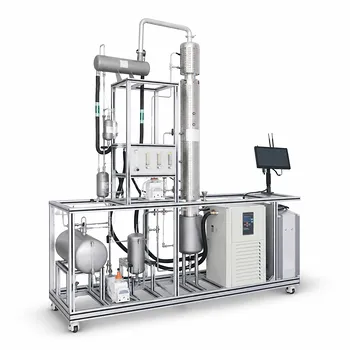
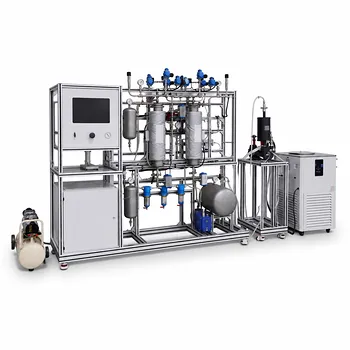
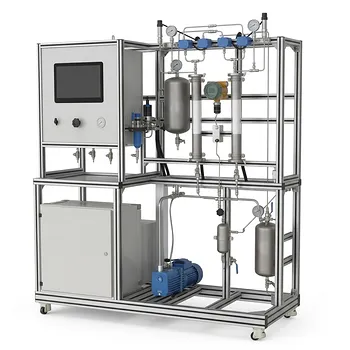
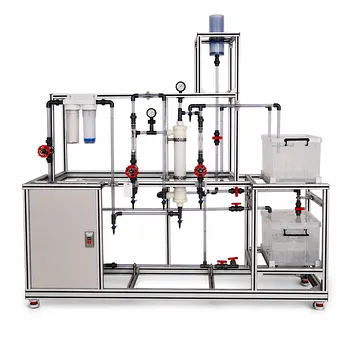
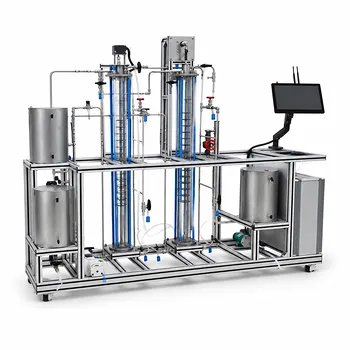
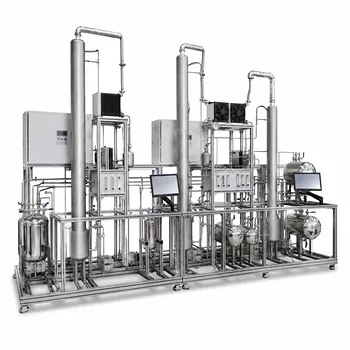
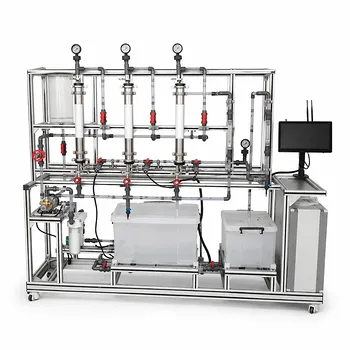
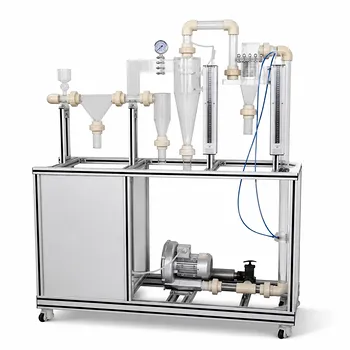
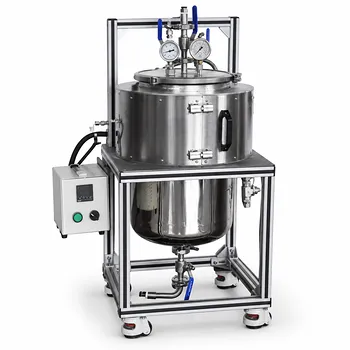
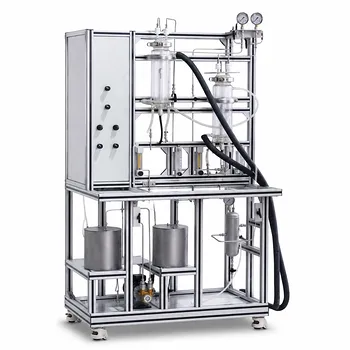
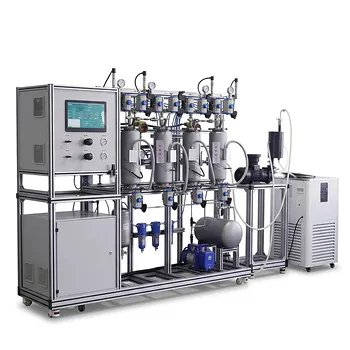
The integration is straightforward in principle, yet brilliantly effective. A pilot-scale vapor permeation unit is combined with two distillation columns to break a ternary mixture like alcohol/ester/water into its pure components. The ternary vapor mixture from the first column is passed directly over a vapor permeation membrane to selectively remove water. The water-depleted retentate, now a simpler binary mixture of alcohol and ester, is then separated in a second distillation column.
A ternary mixture of alcohol, ester, and water challenges conventional distillation alone due to azeotropes or close boiling points. The hybrid approach uses a membrane to remove water from the vapor stream between two columns, bypassing these thermodynamic limitations and yielding a clean binary separation. This configuration is a gold standard in pilot-scale training for multi-stage, multi-component separations.
Why a Ternary Mixture Demands an Unusual Strategy
The mixture of an alcohol, an ester, and water creates a separation problem that single-unit distillation cannot always solve efficiently.
The Core Difficulty: Not Just Three Boiling Points
The alcohol and water often form a minimum-boiling azeotrope. Simple distillation can concentrate the mixture only to that azeotropic composition, never reaching full purity. Similarly, esters and alcohols may exhibit close relative volatility, making their separation by distillation alone energy-intensive and equipment-heavy.
Why a Standard Two-Column Sequence Often Falls Short
A direct sequence would first remove the lightest component, then separate the remaining two. An indirect sequence takes the heaviest as bottoms first. However, when an azeotrope exists, neither sequence can cross the azeotropic barrier without an extra step. The distillation columns simply recycle the azeotropic mixture, wasting energy and delivering no further separation.
The Hybrid Separation Architecture: Step by Step
The pilot-scale vapor permeation unit solves this by inserting a membrane separation step precisely where the thermodynamic limit would otherwise appear.
Step 1: First Distillation Column – Concentrate and Vaporize
The ternary feed enters the first column. This column concentrates the alcohol-water azeotrope or near-azeotrope overhead, while possibly pulling a bottom product depending on the relative volatilities. Critically, the overhead vapor stream is not condensed and refluxed in the traditional sense; instead, it is sent as a hot vapor directly to the membrane unit.
Step 2: Vapor Permeation – Remove Water Selectively
The vapor mixture (alcohol, ester, and water) passes over a hydrophilic membrane. Water permeates preferentially through the membrane because of its strong affinity for the membrane material and its small molecular size. The permeate side is maintained at a lower pressure, driving water vapor across the membrane. The remaining retentate vapor, now dried and largely a binary alcohol–ester mixture, leaves the membrane unit for the next stage.
Step 3: Permeate Recycling – Closing the Water Loop
The water-rich permeate is condensed and recycled back to the feed or inlet of the first column. This prevents product loss and keeps the system in continuous operation. Water is finally discharged from the bottom of the first column, where it accumulates as the heaviest component under the given pressure profile.
Step 4: Second Distillation Column – Simple Binary Separation
The dry retentate vapor, now containing only the alcohol and the ester, enters the second distillation column. Without water in the mixture, the azeotrope is gone, and the two organics can be separated cleanly using a standard distillation sequence. The alcohol and ester exit as pure distillate and bottoms streams, depending on their boiling points.
Why Vapor Permeation, Not Pervaporation or Another Technique?
You might wonder why the membrane unit processes vapor rather than liquid. The answer lies in energy efficiency and process compatibility.
The Distinction Between Pervaporation and Vapor Permeation
Pervaporation feeds a liquid to the membrane; the permeate vaporizes on the low-pressure side, requiring latent heat. Vapor permeation directly uses the hot vapor from the distillation column, eliminating the need for an intermediate condensation and reheating step. This reduces energy consumption and integrates seamlessly with the upstream column.
How the Membrane Selectively Removes Water
Hydrophilic membranes (e.g., polyvinyl alcohol, PVA, or zeolites) excel at sorbing water. The high chemical potential difference for water across the membrane, combined with its faster diffusion, yields a separation factor often exceeding 1000 for water over alcohol. Ester permeation is minimal. The membrane thus “dehydrates” the stream without adding any third-party chemical (no entrainer needed), keeping the process clean and additive-free.
The Educational Value of This Setup
For students and researchers, this pilot plant is a living textbook. It visualizes phase interfaces, demonstrates how a membrane bypasses vapor-liquid equilibrium, and teaches the principles of heat and mass integration across multiple unit operations. The ability to adjust column pressures, temperatures, and membrane vacuum levels allows direct observation of process optimization.
Understanding the Trade-offs
While highly elegant, this hybrid configuration is not a one-size-fits-all solution. An objective advisor must highlight the limits.
Membrane Sensitivity and Lifespan
Hydrophilic membranes can foul or degrade if exposed to certain impurities or high temperatures over time. The ester component or trace acids may plasticize or chemically attack the membrane material, reducing selectivity and flux. Regular cleaning and careful feed pre-treatment may be needed.
Energy Balance and Capital Cost
The vapor permeation unit requires a vacuum pump or sweep gas, and the membrane modules themselves represent a capital expense. If the water content in the ternary mixture is low, the membrane area can be kept small, balancing costs. But for high water loads, the membrane system size and energy demand may approach those of conventional azeotropic distillation, though the hybrid route still avoids the use of an entrainer.
Pressure and Temperature Constraints
The membrane must operate within a temperature window that matches the hot vapor from the column (often around 100°C). If the column overhead temperature is too high for the membrane’s stability, an intercooler may be needed, partially sacrificing the direct vapor advantage. Similarly, the permeate pressure must be low enough to drive the water, which implies adequate vacuum capabilities.
Operational Complexity for Training
While the setup is an excellent teaching tool, it demands that students comprehend both distillation control and membrane operation simultaneously. Debugging a stably integrated system requires a higher level of troubleshooting skill than running a standalone unit. This is often a desired learning outcome, but it may be overwhelming without proper instruction.
Making the Right Choice for Your Goal
The way you configure and emphasize parts of this integrated system depends on what you aim to achieve.
- If your primary focus is teaching process integration: This exact ternary mixture setup is ideal—use it to demonstrate how a membrane breaks an azeotrope without entrainers, and let students map the mass and energy balances across the three units.
- If your primary focus is demonstrating industrial feasibility for a specific product: Characterize the actual membrane performance (flux, selectivity, stability) with your real mixture, and evaluate whether the capital and energy savings justify replacing a conventional azeotropic distillation train.
- If your primary focus is comparing direct vs. indirect distillation sequences: Start with the first column, then insert the membrane, and finally allow reconfiguration of the second column; this hybrid plant can physically swap between sequences, making it an unmatched platform for energy efficiency studies.
- If your primary focus is processing heat-sensitive esters: Ensure the membrane unit and the first column operate at moderate temperatures, and consider adding a vacuum to the distillation columns to avoid thermal degradation—pervaporation’s mild conditions are a key advantage here.
Seen as a whole, the pilot-scale combination of a first distillation column, a vapor permeation membrane, and a second distillation column transforms a stubborn ternary separation into a clean, teachable, and industrially relevant process.
Summary Table:
| Step | Process Unit | Key Function & Mechanism | Output Stream |
|---|---|---|---|
| 1. Primary Distillation | First Distillation Column | Concentrates alcohol-water near-azeotrope overhead | Hot ternary vapor |
| 2. Selective Dehydration | Vapor Permeation Membrane | Selectively removes water vapor via pressure driving force | Dry binary retentate vapor |
| 3. Water Recycling | Permeate Condenser | Recycles water-rich permeate back to the first column | Water discharge (bottoms) |
| 4. Final Purification | Second Distillation Column | Separates the dry alcohol-ester binary mixture without azeotropes | Pure alcohol & pure ester |
Bring Advanced Hybrid Separation Technology to Your Lab
Looking to elevate your chemical engineering curriculum or research capabilities? LABPARK provides state-of-the-art Educational and Vocational Unit Operations Pilot Plants in chemical engineering, bioprocess & biotech, and environmental & water treatment.
We help universities, research institutes, and enterprises bridge the gap between theory and industrial practice with hands-on, integrated systems. Contact us today to discover how our custom pilot plants can transform your training and research outcomes!
Related Products
- Continuous Sieve-Plate Distillation Pilot Plant for Unit Operations Laboratory Education
- Multi-Modal Distillation Unit Operations Training Pilot Plant
- Multi-Functional Special Distillation Educational Pilot Plant
- Continuous Batch Extractive Distillation Educational Pilot Plant
- Dual-Mode Rectification Pilot Plant for Practical Training Unit Operations
People Also Ask
- How to select the right activity coefficient model (Wilson, NRTL, UNIQUAC) for distillation pilot plants?
- Why is vacuum operation capability an essential feature for a distillation unit operations pilot plant? Unlock Efficiency
- What are the primary reflux ratio control strategies? Master Distillation Unit Operations
- How does catalyst water concentration affect distillation pilot plant design? Key separation train choices.
- How can real-time carbon number prediction improve distillation pilot plants? Optimize control.