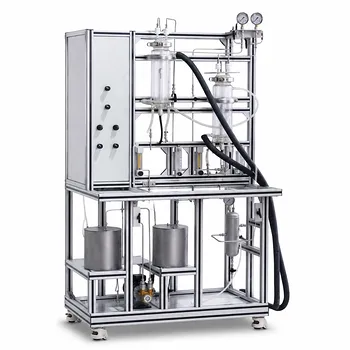
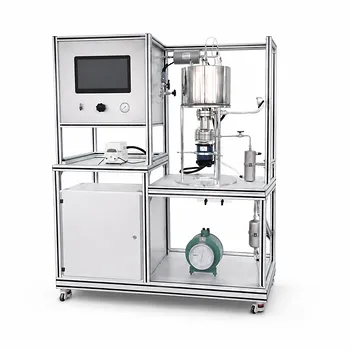
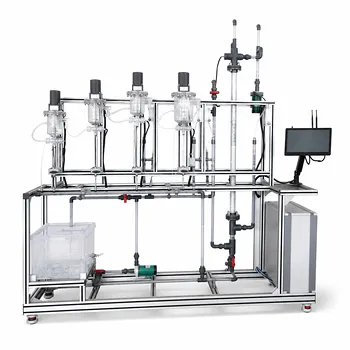
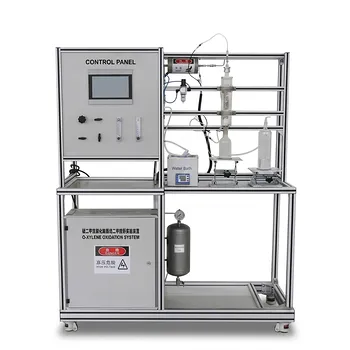
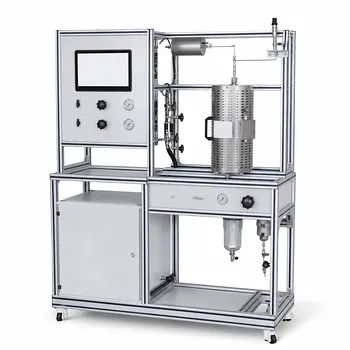
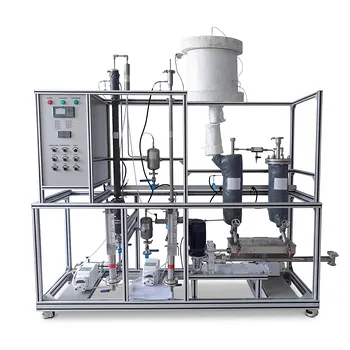
Photoreactors bridge the gap between theoretical photochemistry and real-world water treatment engineering. In environmental and water treatment unit operations training, pilot-scale photoreactors are the platform for demonstrating advanced oxidation processes (AOPs) — the only viable method for destroying truly recalcitrant contaminants. Students use them to run experiments on photocatalysis, observe sterilization kinetics, and gain the hands-on insight needed to scale a bench-top reaction into a field-ready system.
Pilot-scale photoreactors are a critical training tool because they make the invisible visible: they allow students to directly observe, measure, and optimize light-driven degradation reactions that are essential for treating modern waste streams, yet are impossible to fully grasp from theory alone.
Moving Beyond Conventional Treatment: The Core Teaching Value
Illuminating Advanced Oxidation Processes (AOPs)
Conventional unit operations training rightly focuses on mass-transfer-driven separations like adsorption and ion exchange. Photoreactors fill the critical gap by teaching the destruction, rather than the displacement, of pollutants. In training, the pilot-scale unit becomes the instrument for demonstrating how hydroxyl radicals are generated and used to mineralize refractory organic contaminants—compounds that would otherwise foul membranes or never be captured by carbon.
A Platform for Photocatalysis Studies
The primary reference highlights the use of photoreactors for photo-assisted heterogeneous catalysis. This is not just a theory lesson. With a pilot unit, students:
- Immobilize catalysts like TiO2 or ZnO on supports and evaluate their stability and activity over multiple cycles.
- Study reaction kinetics as a function of light intensity, wavelength, and catalyst loading, moving from idealized textbook equations to real, mass-transfer-limited environments.
- Conduct water-splitting experiments to grasp the fundamentals of solar fuel generation, tying wastewater treatment directly to the energy transition.
Critical Learning Outcomes from Pilot-Scale Operation
From Batch to Flow: Understanding Engineering Scalability
Books teach the physics of photon absorption. A pilot-scale photoreactor teaches the engineering of photon distribution. Students confront the core challenge of scale-up: how to deliver light uniformly to a larger volume. They learn to manage optical path length, residence time distribution, and mixing in continuous-flow mode—concepts that are absent in a small batch beaker but dominate process economics.
Bridging Sterilization and Dechlorination
The unit becomes a multi-functional training station. Trainees can pivot from running bacterial challenge tests for drinking water sterilization to dechlorinating organic wastes. This hands-on experience with one piece of equipment that solves two vastly different problems—microbial safety and chemical detoxification—builds the adaptive thinking required in modern environmental engineering.
Understanding the Trade-offs and Practical Constraints
The Light Distribution Dilemma
The biggest pedagogical moment often comes from failure. Photoreactors teach why AOPs can be energy-inefficient. Students see firsthand how light attenuation due to high pollutant concentrations or turbidity creates “dark zones” with zero reaction. This directly demonstrates the limitation of the Beer-Lambert law in process design and the need for pre-treatment before photochemical steps.
Catalyst Handling and Realistic Costs
Pilot-scale work removes any romanticism about nanotechnology. Trainees struggle with catalyst recovery, agglomeration, and mass transfer limitations between the pollutant and the photocatalyst particle. This drives home the total cost of operation—including membrane filtration for catalyst reuse—that is often omitted from pure chemistry lectures. They also learn the safety protocols for handling both hazardous chemicals and UV light sources, a non-negotiable for industrial readiness.
How to Apply This to Your Training Program
Choose your training focus and leverage the photoreactor accordingly to meet specific educational goals.
- If your primary focus is teaching the fundamentals of AOPs: Use the reactor to compare the degradation of a model dye pollutant under UV alone versus UV with a TiO2 catalyst, quantifying the synergistic effect and building a kinetic model from experimental data.
- If your primary focus is process engineering and scale-up: Challenge students to optimize the continuous-flow configuration for maximum throughput while minimizing electrical energy per order (EEO), forcing them to balance pump rates, light intensity, and reactor geometry.
- If your primary focus is environmental compliance and practicality: Run a side-by-side trial treating a real, complex industrial effluent with the photoreactor and a conventional adsorption column. This demonstrates the niche role of AOPs—destroying the non-biodegradable fraction that adsorption cannot handle.
A pilot-scale photoreactor does not just teach a single unit operation; it creates engineers who can diagnose when a conventional process will fail and when to confidently deploy light as the solution.
Summary Table:
| Training Focus | Core Teaching & Learning Activities | Practical Engineering Challenges |
|---|---|---|
| Advanced Oxidation (AOPs) | Radical generation, pollutant mineralization vs. displacement | Light attenuation, Beer-Lambert limitations in turbid streams |
| Photocatalysis Kinetics | Catalyst immobilization (TiO2/ZnO), degradation rates, water splitting | Catalyst recovery, mass transfer limitations, catalyst reuse costs |
| Process Scale-Up | Batch-to-flow operation, uniform photon distribution design | Optimizing energy efficiency (EEO), managing flow rate & light intensity |
Bring Industry-Grade Unit Operations to Your Lab with LABPARK
Are you looking to bridge the gap between classroom theory and real-world industrial application? LABPARK provides state-of-the-art Educational and Vocational Unit Operations Pilot Plants in chemical engineering, bioprocess & biotech, and environmental & water treatment.
Whether you are a university, research institute, or enterprise, our pilot-scale photoreactors and systems empower students and researchers to master:
- Advanced Oxidation Processes (AOPs) & Photocatalysis
- Process Scale-Up & Continuous Flow Dynamics
- Practical Catalyst Recovery & Safety Protocols
Enhance your training outcomes and research capabilities. Contact LABPARK today to discuss your project!
Related Products
- Photocatalytic Membrane Separation and Degradation Unit Operations Pilot Plant
- Micro-Scale Gas-Solid Catalytic Reaction Educational Pilot Plant
- Supercritical High-Gravity Flash Evaporation Educational Unit Operations Pilot Plant
- Internal Circulation Gradient Free Catalytic Reaction Educational Pilot Plant
- Multi-Reactor Educational Pilot Plant for Reaction Engineering Unit Operations
People Also Ask
- What are the key differences in membrane configurations? Choose the Right Unit Operations Pilot Plant
- How Do Pervaporation, Vapor, and Gas Permeation Differ in Pilot Plants? Key Comparison
- What are the structural & performance trade-offs of flat-sheet, spiral-wound, & hollow-fiber membrane modules?
- How do PEI, PVDF, and PSU membranes compare in pilot plants? Find the best fit.
- Pervaporation vs. Vapor Permeation: Handling Suspended Solids in Membrane Pilot Plants