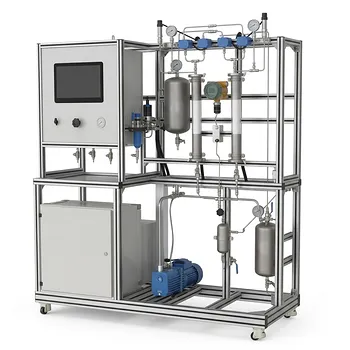
The key to predicting thermal runaway in a gas-solid pilot plant is to directly monitor the internal dynamics of the reacting particle—specifically its interface temperature and the nonisothermal effectiveness factor—in real time. Thermal instability in these systems arises when heat generation from the reaction outpaces heat removal from the solid, causing a sudden, self-accelerating shift in the rate-controlling mechanism. By combining sensors that track the particle's thermal profile with automated cooling interlocks, operators can detect the earliest signs of this destabilization and intervene before a runaway condition develops.
Thermal runaway in gas-solid reactors is not just an external jacket-temperature problem—it is driven by a rapid transition inside the solid particle from a kinetically controlled regime to a transport-controlled one. The most reliable prediction method is therefore to track the particle’s interface temperature and the nonisothermal effectiveness factor: when these deviate from safe steady-state patterns, the system is approaching the runaway boundary. Prevention then becomes a matter of using that early signal to trigger immediate, automated cooling or feed adjustments.
Why Gas-Solid Systems Are Uniquely Vulnerable
In a gas-solid reactor, the reaction does not occur uniformly throughout a fluid phase. It takes place at a moving boundary inside each solid particle, as described by the shrinking core model. This geometry creates a dangerous feedback loop that is different from liquid-phase or catalytic fixed-bed reactors.
The Sudden Shift in Rate-Controlling Steps
Under normal operation, the reaction rate is governed by chemical kinetics—how fast the gas and solid can react at the particle’s interface. Thermal instability begins when heat accumulation causes the interface temperature to rise so sharply that the reaction rate leaps upward. This shifts control from kinetics to heat and mass transport limitations, causing the solid to overheat internally even if the reactor's wall temperature appears stable.
Once this shift occurs, the particle’s center can reach temperatures hundreds of degrees above the external gas. The reaction rate becomes self-amplifying: higher temperature drives faster reaction, which releases more heat, which further increases the temperature.
The Role of the Nonisothermal Effectiveness Factor
The effectiveness factor is a classic metric for how much the actual reaction rate is reduced by diffusion resistance. In the nonisothermal case, this factor can actually exceed unity because the particle’s interior is hotter than its surface. A rising nonisothermal effectiveness factor in a pilot plant is a direct warning that heat is accumulating inside the particle faster than it can be conducted away. Monitoring its trend over time reveals whether the particle’s thermal profile is moving toward instability—well before bulk reactor instruments show an alarm.
Predicting Runaway: The Parameters That Matter Most
Prediction must be rooted in the specific physics of gas-solid reactions. The primary reference directs us to two critical internal metrics, but we can strengthen these with classic stability criteria.
Direct Particle Metrics: Interface Temperature
The interface temperature—the temperature at the reaction front within each solid particle—is the single most important prediction variable. In a shrinking core model, the interface temperature is governed by the balance between the exothermic heat of reaction and the conduction of heat through the ash layer and external film.
A continuous, upward drift in interface temperature that is not correlated with a change in external heating is the earliest signature of thermal instability. Operators should compare the interface temperature trajectory against the calculated adiabatic temperature rise; if it begins to approach a theoretical runaway threshold, the system is dangerously close to losing control.
The Heat Transfer Parameter vs. the Heat of Reaction
Supplementary references for tubular reactors introduce a stability boundary defined by the critical heat of reaction parameter $B_c$, which depends on activation energy, inlet temperature, and the dimensionless heat transfer parameter $\delta/\text{Da}$. Although the geometry is different, the principle applies directly to a single particle: runaway is highly likely when the heat released per unit temperature rise (heat of reaction parameter) exceeds the system's ability to remove that heat (effective heat transfer parameter).
In pilot plant terms, this means operators must continuously evaluate the ratio between the measured particle heat generation flux and the overall heat removal capacity of the surrounding gas and jacket. When the ratio approaches a critical threshold, the operating point is sliding into the runaway region.
The Slope Condition for Particle Stability
Drawing on the van Heerden analysis of CSTRs, the same stability logic can be applied to a single reacting solid element. In essence, the local heat generation curve $G(T)$ inside the particle and the heat removal curve $R(T)$ from that particle must satisfy $\partial G/\partial T < \partial R/\partial T$ at the interface temperature. If the slope of heat generation exceeds that of heat removal, a small temperature fluctuation will push the particle to a new, dangerously high-temperature steady state—or to complete runaway if no upper stable point exists.
Preventive Design and Operating Practices
Once the predictive signals are clear, prevention reduces to a combination of hardware, control logic, and operational discipline. The pilot plant must be designed not just for steady-state data collection, but for active thermal management.
Real-Time Sensing and Automated Interlocks
The primary reference emphasizes integrating real-time temperature sensors with automated cooling systems. In practice, this requires:
- Multiple thermocouples or fiber-optic sensors placed at different radial positions within a sample particle bed to reconstruct the internal temperature profile.
- High-speed data acquisition that calculates the interface temperature and the time-derivative of the effectiveness factor every few seconds.
- Automated interlocks that directly manipulate cooling water flow, feed gas preheater setpoints, or even emergency quench gas injection when deviation metrics cross predetermined safety envelopes.
Cooling Jacket and Refrigeration Strategies
Pilot-scale reactors, even fluidized or moving-bed gas-solid units, must be equipped with powerful cooling jackets. The jacket must be designed to remove not just steady-state heat but to provide a surge capacity that can handle the sudden spike in heat release during a thermal instability event. This often means using sub-ambient cooling loops, rapid-response valves, and a coolant reservoir with enough thermal inertia to absorb the calculated maximum adiabatic temperature rise of the full solid inventory.
Managing Activation Energy and Inlet Conditions
From the broader stability knowledge, reactions with large activation energies (high $\gamma$) are far more prone to runaway because their rate is extremely temperature-sensitive. In a pilot plant, this can be mitigated by:
- Limiting the hot spot potential by reducing preheat, using diluted gas feeds, or staging the solid addition.
- Operating at a lower inlet temperature than what is used in purely kinetic studies, unless the cooling system has been proven to handle a perturbation from that baseline.
Mitigation Systems for the Worst Case
Even with prediction, no system is foolproof. A comprehensive prevention strategy includes small-scale scrubbers, relief systems, and rupture disks that can safely vent hot gases or quench the reaction if the particle bed begins to approach an uncontrolled state. This mirrors the industrial practice of simulating safety barriers in a pilot environment.
Understanding the Trade-offs and Limitations
A purely monitoring-based strategy has its own pitfalls. Operators must weigh completeness of protection against operational realism and data quality.
Sensor Lag and Placement Limitations
Internal particle temperatures are inherently difficult to measure directly without disturbing the bed. Probes can create local bypasses, and even fast-response thermocouples have a thermal lag that can mask the true onset of runaway. Over-reliance on a single sensor location can create a false sense of security. A better approach uses a network of sensors combined with model-based inferential estimates of the interface temperature.
The Risk of Fouling and Heat Transfer Decay
Over time, solid deposition on reactor walls, cooling jackets, or even probe surfaces can degrade the effective heat transfer parameter. A pilot plant that was thermally safe at the start of a campaign can become unstable toward the end if fouling is not accounted for. Regular heat transfer calibration tests and predictive maintenance—or even in-situ cleaning cycles—are essential to ensure the safety margins remain real.
Overly Conservative Limits Hinder Research
If cooling systems are set to trip at the slightest deviation, operators may never be able to explore the conditions that reveal true kinetic or transport behavior. The art of pilot plant operation is to find the narrow window between false alarms and genuine risk. This is why the predictive metrics—interface temperature trajectory and effectiveness factor changes—are so valuable: they allow a tight, physics-based safety corridor rather than an arbitrary temperature limit.
Making the Right Choice for Your Pilot Plant
The correct prediction and prevention strategy depends on what you are trying to achieve—from education and training to high-consequence process development.
- If your primary focus is operator training and fundamental understanding: Use a simplified particle bed with multiple accessible thermocouples and teach staff to interpret the slope condition and interface temperature drift. Emphasize manual override and the relationship between cooling capacity and activation energy, using the van Heerden concept graphically.
- If your primary focus is kinetic research on exothermic gas-solid systems (ΔTad > 50 °C): Implement a model-predictive monitoring system that continuously calculates the nonisothermal effectiveness factor and compares it to a safe envelope based on the critical heat transfer parameter. Couple this with a rapid-response, high-capacity cooling jacket and automated interlock on feed preheat.
- If your primary focus is scaling up a highly hazardous solid-state reaction (e.g., metal oxide reduction, gas-solid polymerization): Integrate multiple independent protection layers: interface temperature sensors, jacket surge capacity, small-scale relief scrubbing, and a strict 20% initial charge limitation for the most dangerous reagents. Verify cooling capacity by direct adiabatic calorimetry tests on representative samples.
Every gas-solid pilot plant ultimately stands or falls on its ability to see inside the particle. By making the interface temperature and the nonisothermal effectiveness factor the central pillars of your safety logic—and by never losing sight of how activation energy and heat transfer decay shift the stability boundary—you create an operating regime that is both fast enough to gather meaningful data and robust enough to prevent a runaway.
Summary Table:
| Key Parameter / Metric | Significance in Thermal Stability | Recommended Prevention & Mitigation Action |
|---|---|---|
| Interface Temperature | Earliest indicator of internal particle overheating. | Trigger automated cooling or feed preheater shutoffs. |
| Nonisothermal Effectiveness Factor | Signals heat accumulation outpacing conduction ($>1$). | Implement real-time model-predictive monitoring. |
| Critical Heat of Reaction ($B_c$) | Defines the boundary where heat generation exceeds removal. | Dilute gas feeds, lower inlet temps, or stage solid addition. |
| Slope Condition ($\partial G/\partial T < \partial R/\partial T$) | Determines local steady-state stability. | Design cooling jackets with high surge capacity/thermal inertia. |
Safely Scale Your Chemical Processes with LABPARK
Thermal stability is critical when operating pilot reactors. LABPARK provides premium Educational and Vocational Unit Operations Pilot Plants in chemical engineering, bioprocess & biotech, and environmental & water treatment. Specifically designed for universities, research institutes, and enterprises, our pilot plants integrate advanced sensing, real-time data acquisition, and automated safety interlocks to ensure safe, stable, and highly accurate experimental runs.
Ready to upgrade your laboratory capabilities? Contact LABPARK today to discuss your custom pilot plant requirements!
Related Products
- Fixed Bed Gas Solid Catalytic Reaction Educational Pilot Plant
- Fixed-Bed Chemical Reaction and Gas Dust Tar Removal Unit Operations Pilot Plant
- Micro-Scale Gas-Solid Catalytic Reaction Educational Pilot Plant
- Fluidized Bed Gas Solid Catalytic Reaction Educational Pilot Plant
- Gas-Solid Heterogeneous Separation Demonstration Educational Unit Operations Pilot Plant
People Also Ask
- Fixed-Bed vs. Fluidized-Bed Reactor: How to Choose the Right Pilot Plant for Gas-Solid Catalytic Reactions
- How to determine catalyst pore radius & porosity? Optimize your chemical engineering pilot plant.
- What reactor configurations study gas-solid reactions? Guide to key types and applications.
- How does identifying the rate-limiting step optimize reaction conditions? Pilot Plant Guide
- How do reactor pilot plants safely study gas-solid reactions? Master kinetics with thermal & flow control.