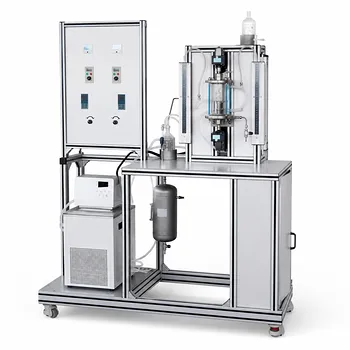
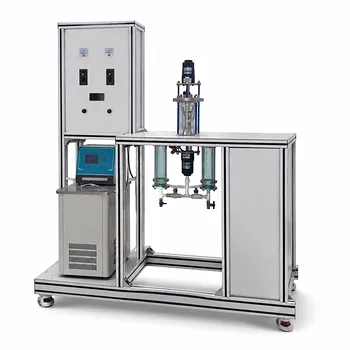
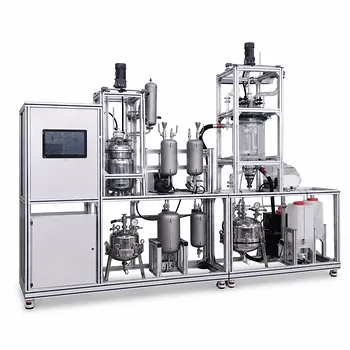
Gas absorption pilot plants serve as a bridge from abstract theory to tangible measurement, allowing you to directly calculate gas-liquid mass transfer coefficients by observing how solute concentrations change under controlled conditions. By running a packed column with a known gas-liquid system—like CO₂ in water—you can sample inlet and outlet streams, perform a material balance, and apply the classic two-film model to extract individual film coefficients or the overall volumetric coefficient ($K_Y a$). Alternatively, a transient pressure-decay method in a stirred vessel yields the volumetric liquid-side coefficient ($k_La$) in minutes. Each approach validates the foundational theories (two-film, penetration) with real data, turning textbook equations into a practical engineering skill.
Classic mass transfer theories define the resistance to solute movement, but they remain conceptual without experiments. Gas absorption pilot plants let you measure the actual coefficients that govern performance—giving you the numbers needed to design, scale, and troubleshoot industrial contactors.
Why Classic Absorption Theories Demand Experimental Validation
The Two-Film Theory at the Pilot Scale
The two-film theory states that gas-liquid mass transfer is controlled by two stagnant films at the interface. The overall resistance equals the sum of the gas-film and liquid-film resistances. In a pilot packed column, you cannot see these films, but you can measure the solute concentrations at the column ends and use Henry’s law to separate the contributions.
- Liquid-film control: For sparingly soluble gases like oxygen or CO₂ in water, the liquid film dominates. By changing liquid flow rate and observing how the outlet concentration shifts, you isolate the liquid-side coefficient ($k_L$).
- Gas-film control: For highly soluble gases like ammonia in water, the gas film is limiting. Varying gas flow rate while monitoring absorption rate reveals the gas-side coefficient ($k_G$).
The Penetration Theory’s Transient Signature
The penetration theory models mass transfer as unsteady diffusion into a liquid element that stays at the interface for a short contact time. Pilot plants validate this by systematically varying agitation speed or gas-liquid contact time in a stirred cell or short wetted-wall column. A higher stirring speed shortens contact time, and the measured $k_L$ should follow the prediction $k_L \propto \sqrt{D_{AB}/t_c}$.
These theories become more than elegant mathematics when you manipulate pilot plant parameters and see the predicted effects in your calculated coefficients.
Two Principal Experimental Approaches Used in Pilot Plants
1. Steady-State Method in Packed Columns: Measuring $K_Y a$ and Film Coefficients
A standard absorption pilot plant consists of a vertical column filled with structured or random packing, with gas entering at the bottom and liquid fed at the top. At steady state, you record:
- Gas and liquid flow rates.
- Inlet and outlet solute mole fractions (e.g., using gas chromatography or titration).
- Pressure drop, temperature, and liquid holdup if possible.
Step-by-step logic:
- Material balance: Calculate the solute transfer rate $G_A$ from the gas-phase mole fraction change, or from the liquid-phase gain.
- Driving force: Determine the log-mean concentration difference ($\Delta Y_m$) between the bulk gas and the equilibrium concentration corresponding to the bulk liquid at each column height. This uses Henry’s law or a known equilibrium curve.
- Overall coefficient: With the packed bed volume $V_p$, compute the volumetric overall mass transfer coefficient:
$K_Y a = G_A / (V_p \cdot \Delta Y_m)$. - Film coefficient separation: Repeat experiments under liquid-film-limited conditions. $K_Y a \approx k_L a$ in such cases. Otherwise, apply the two-film resistance equation $\frac{1}{K_Y a} = \frac{1}{k_G a} + \frac{m}{k_L a}$ (where $m$ is the local slope of the equilibrium line), and use data at multiple gas and liquid flow rates to regress the individual coefficients.
Direct tie to classic theories: The resistance-in-series approach is a direct application of the two-film model. You measure the overall resistance and then decouple it, verifying that liquid-side resistance indeed follows a $k_L \propto Re^{n}$ relationship typical of liquid flow over packing.
2. Transient Gas Uptake Method: Measuring $k_La$ in a Stirred Vessel
Sometimes your pilot plant is a gas-liquid stirred tank rather than a column. The non-reactive gas uptake method yields $k_La$ quickly without needing steady state.
Typical procedure:
- Fill the vessel with solvent (e.g., water) and degas it under vacuum with agitation.
- Stop the agitator, introduce the test gas (e.g., hydrogen) into the headspace to a known pressure $P_i$, and close the inlet valve.
- Restart the agitator and record the headspace pressure decay over time using a fast-response pressure transducer.
- The pressure decrease follows a first-order rate process, leading to:
$\ln\left(\frac{P_i - P_f}{P - P_f}\right) = \frac{P_f - P_0}{P_i - P_0},(k_La),t$
where $P_f$ is the final equilibrium pressure, $P_0$ is the solvent vapor pressure, and $P$ is the pressure at time $t$.
What you get: The slope of the pressure-time plot gives $k_La$ directly. By repeating at different agitation speeds, you map $k_La$ versus power input—crucial for scaling up reactors. This method is especially useful when you want to study liquid-side mass transfer without the complication of chemical reactions.
Connecting the Methods to Theory
- In the steady-state column, you probe the two-film theory by seeing whether the overall resistance can be split consistently with literature correlations for $k_L$, $k_G$, and the effective interfacial area $a$.
- In the transient uptake, you test the penetration theory by comparing the measured $k_L$ (derived from $k_La$ and known interfacial area) with the prediction $k_L = 2\sqrt{D_{AB}/(\pi t_c)}$, where contact time $t_c$ is estimated from turbulence theory.
Linking Measurements to Classic Correlations and Scaling
Using Onda’s Correlations as a Benchmark
Early work by Onda et al. provides correlations for $k_L$ and $a_e$ in packed columns based on liquid and gas Reynolds numbers, Schmidt numbers, and packing properties. A pilot plant experiment lets you validate or refute these correlations for your specific packing and solvent:
- Measure $k_La$ (or $K_Ya$) at several liquid flow rates.
- Use a known gas-film correlation to subtract gas-side resistance.
- Fit the resulting $k_L a_e$ values against the predicted $k_L$ and $a_e$ from Onda’s equations to see if the data align.
This exercise turns the pilot plant into a diagnostic tool: a deviation from the correlation can signal liquid maldistribution, channeling, or inaccurate physical property data.
From Pilot Data to Full-Scale Design
When you know $k_La$ or $K_Y a$ at several scales or operating conditions, you can apply the concept of mass transfer similarity. For example, if the pilot column achieves a certain $K_Y a$ at a given superficial velocity, you can scale up by maintaining similar hydrodynamic regimes (e.g., constant liquid-to-gas ratio and similar Reynolds numbers). The classic theories provide the framework to extrapolate, but only pilot plant data gives confidence that the extrapolation holds.
Understanding the Trade-offs and Limitations
Steady-State Column Method
- Advantages: Directly yields the design-relevant $K_Y a$ and reflects real counter-current flow dynamics. You can probe liquid distribution effects.
- Limitations: Requires careful steady-state operation, accurate analysis of dilute solute concentrations, and a well-defined equilibrium relationship. The separation of $k_G$ and $k_L$ relies on the chosen mass transfer model, and errors in Henry’s constant propagate. Wall effects in small column diameters can inflate the apparent mass transfer rate.
Transient Gas Uptake Method
- Advantages: Fast, simple, and directly yields $k_La$ without the need for chemical reactions. Excellent for screening liquid-side performance at different agitation speeds.
- Limitations: Only works for non-reactive gases; the measured $k_La$ is specific to the stirred tank’s gas holdup and bubble dynamics, so it cannot be directly translated to a packed column. The analysis assumes a perfectly mixed liquid and a gas-phase pressure that changes only due to absorption—deviations (e.g., vapor pressure contributions) complicate the math. If you need $k_G$ or $a$, you must employ additional methods.
Pitfalls in Linking Data to Classic Theories
- Assumptions of the two-film model: Real systems may have interfacial turbulence or solute-induced Marangoni effects that make resistances non-additive. Pilot plant anomalies can expose these breakdowns.
- Contact time estimation: For penetration theory, calculating $t_c$ from turbulence parameters is tricky. The pilot plant shows the aggregate coefficient, but attributing changes solely to contact time requires careful control of bubble size distribution.
Recognize these trade-offs up front; they clarify which method—and which theory—to trust under your specific conditions.
Making the Right Choice for Your Goal
Your choice of technique depends on whether you need design coefficients for a column, mechanistic insight, or a quick screening tool for solvent or packing.
- If your primary focus is designing or retrofitting a packed absorption column: Use the steady-state packed column method to measure $K_Y a$ and validate Onda’s correlations against your specific solvent and packing. This gives you the direct scale-up parameter.
- If your primary focus is understanding liquid-side mass transfer fundamentals or testing novel reactor internals: Use the transient gas uptake method to isolate $k_La$ and see how it scales with power input. It’s faster and connects neatly with penetration theory.
- If your primary focus is teaching or validating mass transfer theories themselves: Combine both methods on the same pilot plant. Have students measure $K_Y a$ in a column and $k_La$ in a stirred cell, then compare the extracted $k_L$ values against the two-film and penetration predictions. This dual approach cements the link between theory and experiment.
Your pilot plant is more than a training rig; it is a precision instrument that, when used thoughtfully, yields the coefficients that turn classic absorption theories into reliable engineering practice.
Summary Table:
| Method | Target Parameter | Key Advantages | Main Limitations |
|---|---|---|---|
| Steady-State Packed Column | Overall volumetric coefficient ($K_Y a$), film coefficients | Reflects real counter-current flow; validates Onda's correlations | Requires precise concentration analysis and steady-state control |
| Transient Gas Uptake | Volumetric liquid-side coefficient ($k_L a$) | Fast, simple; no chemical reactions required | Limited to non-reactive gases; vessel-specific dynamics |
Bridge Theory and Practice with LABPARK Pilot Plants
Are you looking to equip your lab or training facility with high-performance unit operations systems? LABPARK provides premium Educational and Vocational Unit Operations Pilot Plants in chemical engineering, bioprocess & biotech, and environmental & water treatment.
Specially designed for universities, research institutes, and enterprises, our pilot plants enable hands-on validation of mass transfer, distillation, and absorption theories.
Contact LABPARK today to discuss your project requirements and request a customized quote!
Related Products
- Dual-Drive Stirred Gas-Liquid Mass Transfer Coefficient Determination Pilot Plant
- Liquid-Liquid Mass Transfer Coefficient Determination Educational Pilot Plant
- Absorption and Desorption Educational Unit Operations Pilot Plant
- Carbon Dioxide Absorption and Desorption Educational Pilot Plant for Carbon Capture Studies
- Packed Bed Absorption Educational Unit Operations Pilot Plant
People Also Ask
- How does temperature affect mass transfer rates in chemical engineering educational pilot plants?
- How do pilot plants study gas solubility in polymer melts at high pressures? Key Mass Transfer Insights
- How does column packing affect absorption intensification, and how is it evaluated experimentally?
- Why Compare Membrane-Reservoir Models with Pilot Plant Data? Ensure Successful Process Scale-Up
- How does k_La affect hydrogenation scale-up? Critical insights for pilot reactors.