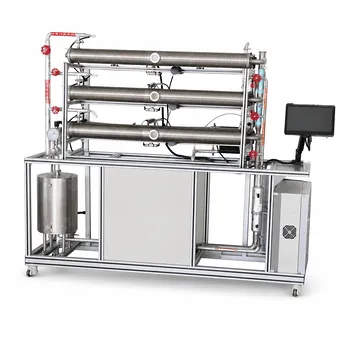
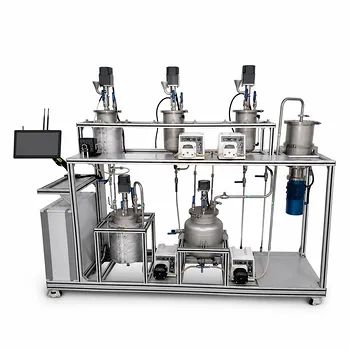
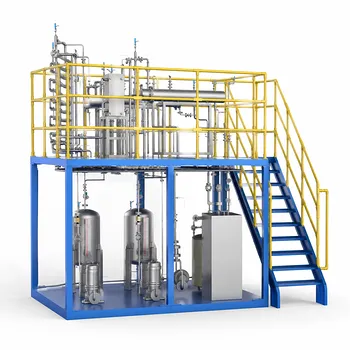
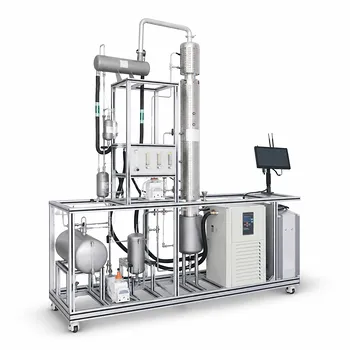
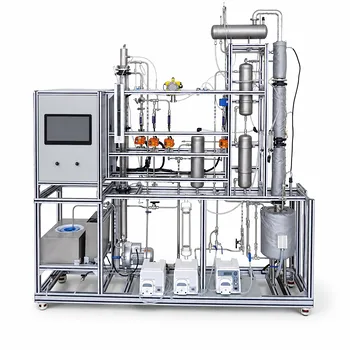
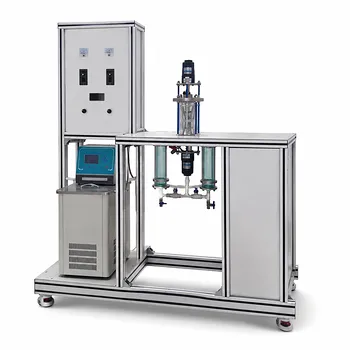
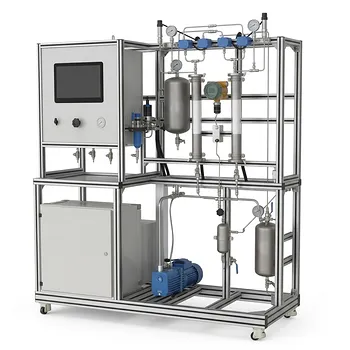
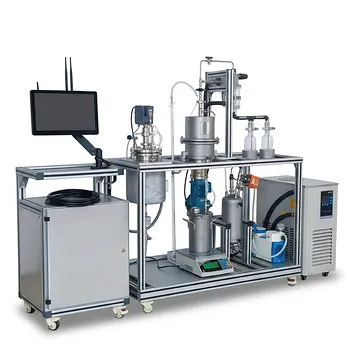
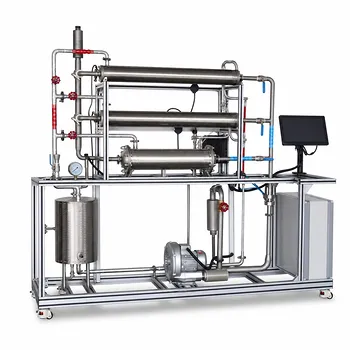
Validating Fick’s second law is a hands-on journey from abstract equation to tangible process behavior. Chemical engineering students utilize pilot-scale diffusion and mass transfer units—such as membrane diffusion cells, leaching vessels with polymer matrices, or stagnant fluid compartments—to create carefully controlled unsteady-state systems. By experimentally monitoring how concentration changes with time at a specific location, they directly observe the transient diffusion the law describes, then fit those profiles to analytical solutions for slabs, cylinders, or spheres to compute the diffusion coefficient (D). This process turns theoretical mathematics into a tool for predicting real-world diffusional transport.
The core challenge isn’t just calculating D—it’s learning to design an experiment where molecular diffusion truly governs the rate, to isolate it from convection, and to critically test whether Fick’s second law, with all its assumptions, can reliably describe a physical system. Mastering this bridges the gap between transport theory and the design of industrial separation and controlled-release processes.
Designing the Experiment to Isolate Pure Diffusion
To validate a law that assumes only random molecular motion, the experiment must eliminate or account for all other transport mechanisms.
Selecting the Right Pilot Plant Configuration
A membrane diffusion cell is a classic choice because it physically separates a donor and receiver phase with a well-defined stagnant barrier.
Alternatively, a solute-leaching setup—where a drug or dye is loaded into a polymer slab, cylinder, or sphere and then submerged in a well-stirred dissolution medium—creates a geometry with a known, fixed boundary condition.
The key is choosing a system where the diffusion path length and interfacial area are precisely known and do not change unpredictably during the experiment.
Engineering the Initial and Boundary Conditions
Fick’s second law requires a defined starting state. Students achieve this by preparing a uniform initial concentration of the solute within the matrix or by filling the donor compartment at time zero.
Maintaining a perfect sink condition (near-zero concentration) in the receiver is critical for simplified analytical solutions. This is often done by using a large receiver volume or continuous flow replacement, immediately sweeping away transferred molecules.
Capturing the Unsteady-State Concentration Profile
Validation means watching the concentration evolve over time, which is the unsteady-state diffusion Fick’s second law predicts.
Students use conductivity probes, spectrophotometers, or periodic sampling from the receiver to build a concentration-versus-time curve. The shape of this curve—initially steep, then gradually flattening—directly reflects the mathematical solution of the partial differential equation.
Analyzing Data Through the Lens of Fick’s Second Law
Raw data becomes validation when it is forced to obey the model. This involves fitting, not just observing.
Applying Analytical Solutions for Different Geometries
The law takes the form of a partial differential equation whose solution depends on geometry. For a 1D slab with uniform initial concentration and perfect sink, the fractional release early on is proportional to the square root of time.
For a sphere or a cylinder, the same physical law yields different, characteristic release profiles. Students validate the law by confirming that their experimental data for a given shape collapses onto the corresponding theoretical curve.
Extracting the Diffusion Coefficient with Rigor
The diffusion coefficient (D) is the single parameter that quantifies the system’s mobility. It is found by fitting the experimental concentration-time data to the appropriate analytical or numerical solution.
A successful fit, with a constant D value across the entire time range, is strong evidence that the system is truly diffusion-controlled and that Fick’s second law is valid for that experiment.
Critically Testing the Assumption of Diffusion Control
Validation means deliberately trying to disprove the hypothesis. If changing the stirring speed in the receiver alters the apparent D, the system is not purely diffusion-controlled; a convective boundary layer is interfering.
Similarly, if the fitted D changes with time, it suggests matrix swelling, polymer relaxation, or concentration-dependent diffusion—all violations of the simple law. Such “failed” validations are often the most instructive.
Bridging from Laboratory Validation to Industrial Mass Transfer
The principles validated in these controlled pilot plants scale directly to industrial unit operations.
Connecting Fickian Diffusion to Mass Transfer Coefficients
In a simple diffusion cell, the flux is described by Fick’s law. In a packed absorption column, the rate is described by a mass transfer coefficient (k). The two are fundamentally linked: the coefficient encapsulates the same molecular diffusion across a thin, stagnant boundary layer.
When students validate Fick’s second law in a membrane system, they are physically measuring the core molecular mechanism that, in turbulent contactors, is hidden inside the film theory’s mass transfer resistance.
Using Pilot Plants to Explore Regime Transitions
Gas-liquid pilot plants (packed columns, falling film reactors) let students intentionally break the diffusion-only assumption. By increasing gas and liquid flow rates, they directly witness the transition from molecular diffusion-dominated mass transfer to eddy (turbulent) diffusion-dominated transfer.
In a falling film reactor, the interfacial area is constant and known, so students can measure reaction and diffusion rates simultaneously. They then calculate the Hatta number (Ha)—a dimensionless parameter that, when much greater than 1, proves the reaction is so fast that diffusion across the liquid film is the only rate-limiting step, directly governed by Fick’s law.
Understanding the Trade-offs and Pitfalls
Experimental validation of a fundamental law in a pilot plant is an exercise in managing imperfections.
Convection’s Persistent Interference
Total elimination of convection is physically impossible. Even in a “stagnant” cell, slight thermal gradients or vibrations create micro-currents. A common pitfall is interpreting convection-enhanced transport as successful Fickian diffusion, leading to an overestimated and meaningless D value.
The Deceptive Boundary Layer
A well-stirred bulk receiver still harbors a stagnant hydrodynamic boundary layer at the membrane or particle surface. This layer adds a series resistance to mass transfer, and if it’s not accounted for, the student ends up validating a combined convection-diffusion process, not Fick’s second law alone.
When Sampling Destroys the System
For small pilot plants, the very act of pulling a 1 mL sample from the receiver can distort the concentration gradient, change the sink volume, and induce fresh convection. Validating a spatial law with a destructive measurement requires a careful mass balance correction or the use of non-invasive in-situ sensors.
Making the Right Choice for Your Learning Goal
-
If your primary focus is strictly validating the mathematical form of Fick’s second law: Use a simple unstirred membrane diffusion cell with in-situ optical or conductivity sensors. This minimizes convection and sampling artifacts, letting you focus purely on the fit between the unsteady-state data and the analytical solution for a slab.
-
If your primary focus is connecting Fick’s law to industrial separation design: Choose a falling film or packed column pilot plant. Operate it under low flow rates to first demonstrate diffusion-controlled performance, then deliberately increase turbulence to show where and why Fick’s law ceases to be the sole predictor, transitioning to mass transfer coefficients.
-
If your primary focus is materials characterization for controlled release: Use a well-stirred dissolution vessel with a polymer matrix of a known simple geometry (slab or sphere). Fit the full release profile to the complete series solution of Fick’s second law to confirm the material’s true, concentration-independent diffusivity.
True validation isn’t about obtaining a perfect match at all costs; it’s about mapping the precise boundaries where this foundational law holds, and understanding the physical reasons why those boundaries exist.
Summary Table:
| Pilot Plant Configuration | Best Learning Goal | Key Validation Mechanism | Major Challenge to Manage |
|---|---|---|---|
| Membrane Diffusion Cell | Strictly validating mathematical model | 1D slab analytical solution via stagnant barrier | Convection & sampling disturbances |
| Solute-Leaching Setup | Materials characterization & release | Dissolution profile of sphere/slab geometry | Hydrodynamic boundary layer resistance |
| Falling Film / Packed Column | Connecting diffusion to industrial scale | Hatta number & transition to turbulent transfer | Eliminating convective interference |
Elevate Chemical Engineering Education with LABPARK Pilot Plants
Bridge the gap between theoretical transport equations and hands-on laboratory experience. LABPARK provides state-of-the-art Educational and Vocational Unit Operations Pilot Plants in chemical engineering, bioprocess & biotech, and environmental & water treatment.
Designed specifically for universities, research institutes, and enterprises, our pilot plants empower students and researchers to model unsteady-state mass transfer, study diffusion control, and validate fundamental physical laws with precision.
Ready to upgrade your laboratory capabilities? Contact LABPARK today to request a catalog or discuss a customized unit operation pilot plant solution for your program!
Related Products
- Multimodal Absorption and Desorption Pilot Plant for Unit Operations Training
- Dual-Mode Rectification Pilot Plant for Practical Training Unit Operations
- Educational Unit Operations Pilot Plant for Intraparticle Diffusion Effective Factor Measurement
- Multi Pump Fluid Transport Process Piping Unit Operations Training Pilot Plant
- Three-Tube Heat Transfer Educational Pilot Plant for Unit Operations Training
People Also Ask
- How do predictive thermodynamic models integrate into pilot plants? Bridging Theory and Practice
- Which cross-validation strategy should be selected for pilot plant time-series & batch data? Avoid Data Leakage
- Why Use Center Points in Process Analyzer Calibration? Key Benefits Explained
- How can process control schemes be configured to teach basic and advanced control?
- How does polyphosphate hydrolysis affect scale and corrosion in pilot plants? Essential Monitoring Guide