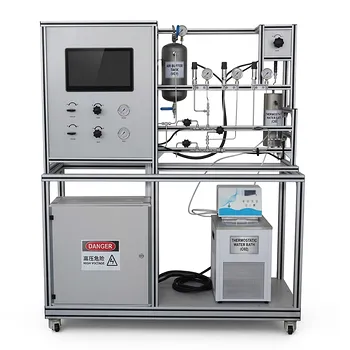
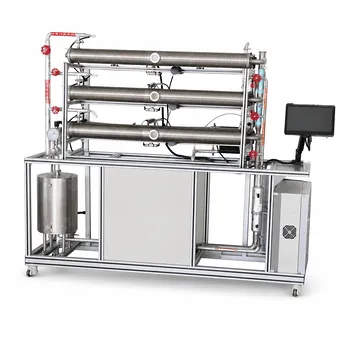
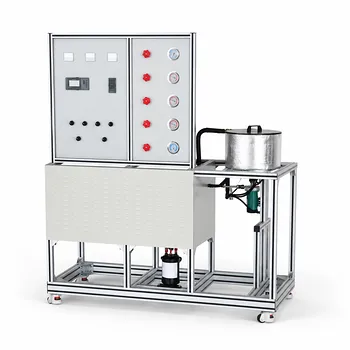
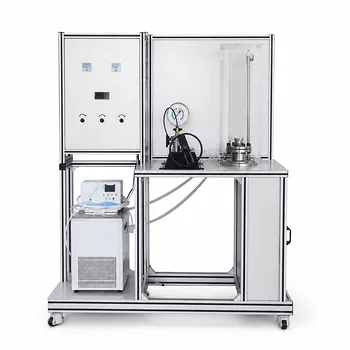
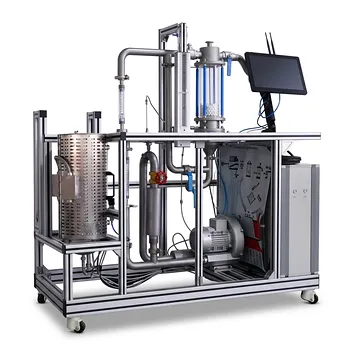
The key to unlocking real-world energy balances in a pilot plant lies in a mathematical bridge. Maxwell equations let students and researchers convert easily measured values—temperature, pressure, and volume—into the elusive properties of entropy and internal energy that govern process efficiency. In educational unit operations pilot plants, these relations are applied daily by taking real-time sensor data from compressors, reactors, or distillation columns and using them to compute the thermodynamic changes that no instrument can measure directly.
Pilot plants are full of sensors that stream T, P, and flow data, but entropy and internal energy remain invisible. Maxwell relations solve this by linking those hidden properties to the ones you can measure, turning raw instrument data into a complete picture of energy movement, spontaneity, and process irreversibilities. This is the practical heart of thermodynamics education.
The Measurement Gap in Pilot Plants
Why Fundamental Properties Can't Be Measured Directly
A pilot plant is a scaled-down industrial environment, rich with thermocouples, pressure transmitters, and flow meters. These devices excel at capturing temperature (T), pressure (P), and volume (V). However, core thermodynamic quantities like entropy (S) and internal energy (U) have no direct sensor. You cannot attach a probe to read out an entropy change.
This creates an educational challenge: students must perform energy balances and analyze process efficiency, but the very properties they need are intangible until a theoretical bridge is built.
The Role of Fundamental Property Relations
Thermodynamic property relations, particularly the Maxwell equations, act as that bridge. They are derived from the exactness of differentials of thermodynamic potentials (like Helmholz and Gibbs free energy). The relations express partial derivatives of non-measurable properties in terms of partial derivatives of easily measured ones.
For example, the relation (∂S/∂P)_T = -(∂V/∂T)_P tells you that the isothermal entropy change with pressure can be calculated from the temperature dependence of volume. In a pilot plant, if you record volume changes with temperature at constant pressure (a simple experiment), you can infer entropy changes under other conditions. This is the practical magic Maxwell relations bring to the lab floor.
How Maxwell Relations Power Pilot Plant Calculations
From Sensor Data to Entropy Changes
A student operating a gas compressor collects inlet and outlet temperatures and pressures. Using an appropriate equation of state (like the Peng-Robinson or ideal gas law) and a Maxwell relation, they compute the entropy change across the compressor. The sensor data gives P and T; the thermodynamic relations give ΔS.
Without this, the student could only guess at the compressor's isentropic efficiency or the energy lost to irreversibilities. With the relation, they can quantify it, compare it to theoretical models, and truly understand where the energy penalty comes from.
Validating Energy Balances with Invisible Terms
The First Law (ΔU = Q + W) is foundational, but ΔU is not measurable. In a pilot plant heat exchanger, operators measure heat flow Q (via flow and temperature difference) and work W. To close the energy balance, they need ΔU.
Maxwell relations enable this: from measured T, P, and V, they evaluate the partial derivatives that integrate to ΔU. For instance, using the relation (∂U/∂V)_T = T(∂P/∂T)_V - P, they can calculate internal energy changes at constant temperature if they have PVT data. Students then verify whether the energy balance closes, revealing heat leaks or measurement inaccuracies—a powerful lesson in real-world engineering.
Predicting Spontaneity in Reactors
In a pilot-scale reactor, a student may vary the temperature to see when a reaction becomes spontaneous (ΔG < 0). Gibbs free energy depends on ΔH and ΔS. While enthalpy changes are often available from thermodynamic databanks, entropy changes at reaction conditions require a path.
Maxwell relations allow calculation of ΔS from temperature and pressure data along a process path. Combining this with sensor data lets students compute ΔG on the fly, directly connecting the abstract spontaneity condition to the twist of a temperature controller knob. They see that the same mathematical relation they wrote on a whiteboard now predicts whether the reaction will actually go.
Integrating Databanks and Equations of State
The Synergy of Theory and Real-Time Data
Pilot plants increasingly incorporate computer-based thermodynamic databanks that store standard entropy (S°) and heat capacity coefficients (Cp = A + BT + CT² + ...) for each compound. Students take a base entropy at 298 K and then use Maxwell relations or integrated forms to compute entropy at operating conditions.
For a distillation column, they might use an excess Gibbs energy model (Wilson or van Laar) to describe phase equilibrium, then employ a Maxwell relation to link the derivative of Gibbs energy to volume changes. The databank provides the pure-component foundation; the sensor data (T, P) feeds the relation; the student gets a complete picture of phase behavior and energy requirements for the column.
From Boyle's Law to Real Fluids
When using a simple gas like air in a pilot plant, the ideal gas law allows straightforward integration of Maxwell relations. But with non-ideal mixtures, students use equations of state (EOS) like Peng-Robinson. The Maxwell relations remain unchanged; they just require the partial derivatives derived from the chosen EOS.
For example, to compute the entropy change during an absorption process, the student measures T and P, determines the EOS parameters from the databank, then applies (∂S/∂P)_T = -∂V/∂T)_P using the EOS's explicit volume form. This shows that the abstract relations adapt to any level of non-ideality, reinforcing their universality.
Understanding the Trade‑offs
Assumptions That Limit Direct Application
Maxwell relations are exact for simple, compressible substances in equilibrium. However, pilot plant processes often involve non-equilibrium conditions, transient behavior, or complex multiphase systems where the relations alone are insufficient. Students learn that they must first establish that the system is adequately close to equilibrium, or they must apply additional transport equations.
Measurement Noise and Propagation
Sensor data always carries noise. Derivatives, like (∂V/∂T)_P, amplify measurement errors. In a pilot plant, small fluctuations in temperature or pressure can lead to large scatter in computed entropy changes. This teaches an essential lesson about error propagation and the importance of careful experimental design and filtering—skills no textbook can convey as vividly as real data.
The Need for a Suitable Equation of State
A Maxwell relation is only as good as the equation of state used to evaluate it. If the chosen EOS poorly represents the fluid phase, the computed ΔS will be inaccurate. Students at pilot plants face this dilemma firsthand: they must select, validate, and sometimes adjust EOS parameters based on their own PVT measurements, bridging molecular science with plant-scale operation.
Making Thermodynamic Relations Work for Your Educational Goals
The way you apply Maxwell relations in a pilot plant should match your learning objective.
- If your primary focus is reinforcing fundamental thermodynamics: Have students manually compute entropy and energy changes from raw PVT data using Maxwell relations and a simple EOS. The goal is to internalize how the math translates to physical reality.
- If your primary focus is bridging theory with industrial practice: Introduce databank-driven calculations and commercial process simulators. Let students compare the built-in Maxwell-derived results with their own simplified calculations to understand where industrial software makes assumptions.
- If your primary focus is troubleshooting and process optimization: Design experiments where students must derive efficiency metrics from non-measurable properties. Ask them to estimate compressor isentropic efficiency or column exergy losses using only standard sensors, forcing them to rely on Maxwell relations.
- If your primary focus is preparing for research: Use the relations to validate new predictive models. Have students measure thermal conductivity or phase equilibria, then apply Maxwell-based thermodynamic consistency tests to evaluate the robustness of their data.
When a student sees that a set of partial derivatives scribbled in a notebook can reveal the heat lost from a distillation column or the work wasted in a compressor, thermodynamics ceases to be an abstract discipline. It becomes the brain of the plant.
Summary Table:
| Measured Sensor Data | Thermodynamic Relation | Derived Property | Practical Application |
|---|---|---|---|
| Temperature, Pressure, Volume | (\partial S/\partial P)_T = -(\partial V/\partial T)_P |
Entropy Change (ΔS) | Quantifying compressor & column efficiency |
| Heat Flow & Work | (\partial U/\partial V)_T = T(\partial P/\partial T)_V - P |
Internal Energy (ΔU) | Validating heat exchanger energy balances |
| Temperature & Pressure | Gibbs Free Energy Equation (\Delta G) |
Spontaneity (ΔG) | Predicting reactor reaction spontaneity |
Bridge Thermodynamics Theory and Practice with LABPARK
Help your students and researchers master complex thermodynamic property relations with hands-on experience. LABPARK provides state-of-the-art Educational and Vocational Unit Operations Pilot Plants in chemical engineering, bioprocess & biotech, and environmental & water treatment for universities, research institutes, and enterprises.
Our highly instrumented pilot plants enable precise data collection (T, P, V) to easily calculate entropy, internal energy, and energy balances. Contact us today to find the perfect pilot plant system for your laboratory.
Related Products
- Throttling Effect Determination Educational Unit Operations Pilot Plant
- Three-Tube Heat Transfer Educational Pilot Plant for Unit Operations Training
- Educational Compression Refrigeration Performance Determination Unit Operations Pilot Plant
- Carbon Dioxide PVT Curve Determination Educational Unit Operations Pilot Plant
- Multi-Reactor Educational Pilot Plant for Reaction Engineering Unit Operations
People Also Ask
- How does kinetic theory explain ideal vs real gas energy differences? Key Pilot Plant Insights
- How can educational pilot plants be used to teach process safety and risk assessment in chemical engineering curricula?
- Why Correct Sig Figs & Rounding Matter in Educational Pilot Plants: Ensure Data Accuracy
- How does nuclear yield inefficiency translate to chemical engineering education? Optimize kinetics with pilot plants.
- How are phase diagrams and triple point values applied practically in thermodynamics unit operations pilot plants?