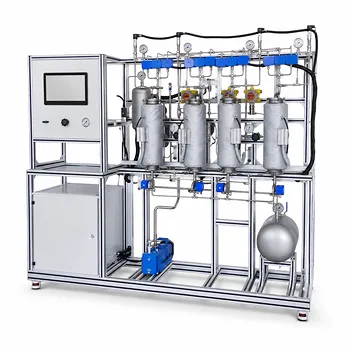
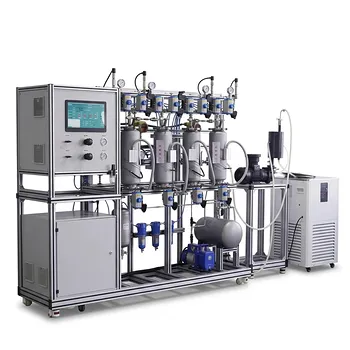
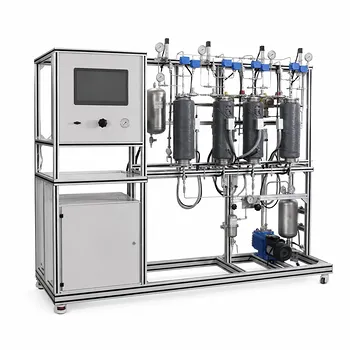
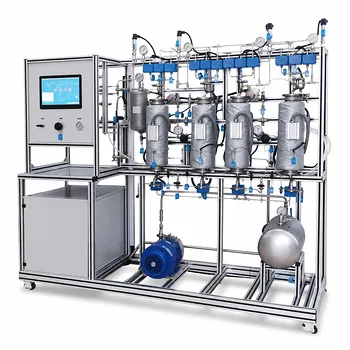
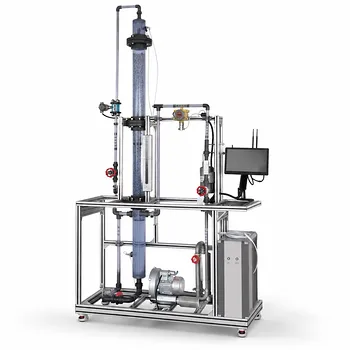
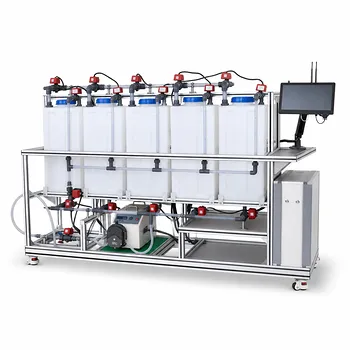
Pilot plants transform abstract textbook concepts into tangible engineering skills. In vocational and educational settings, adsorption and ion exchange unit operations are utilized through scaled-down column systems that treat synthetic or actual wastewater. Students pack columns with activated carbon, zeolites, or specialized ion exchange resins, then pump contaminated water through the beds to observe the real‑time removal of non‑biodegradable organics and trace heavy metals. By recording effluent concentrations over time, learners directly construct breakthrough curves, calculate adsorption isotherms, and execute regeneration cycles — the exact activities that define tertiary wastewater purification design.
The true purpose of these pilot‑scale units is not simply to clean water; they are engineered learning platforms. They force students to confront the gap between idealized equilibrium models and the messy realities of mass transfer zones, pressure drop, resin exhaustion, and economic regenerant use — all within a safe, repeatable environment that mirrors industrial‑scale advanced treatment.
Bridging Theory and Practice in Tertiary Treatment
Why Advanced Purification Demands Hands‑On Experience
Primary and secondary treatments leave behind dissolved recalcitrant organics and heavy metal ions that cannot be removed by biological or simple physical means. Adsorption and ion exchange are the most widely taught tertiary methods for polishing this effluent. Classroom equations can describe Langmuir isotherms or selectivity coefficients, but vocational competence requires feeling the impact of flow rate on breakthrough time or seeing how channeling inside a column invalidates a perfectly calculated bed volume.
The Role of Pilot Plants in Vocational Training
These educational rigs are miniature versions of industrial columns, complete with feed tanks, dosing pumps, flow meters, and online sensors (pH, conductivity). This setup allows students to:
- Simulate real industrial scenarios, such as recovering copper from plating rinse water or removing organic dyes from textile effluent.
- Quantify design parameters experimentally — for ion exchange, they can calculate total exchange capacity, determine the resin volume needed to reach 80 % breakthrough, and fix the exact regenerant dose (e.g., sodium hydroxide or brine) and flow rate required to restore the column within a target cycle time.
- Develop “engineering intuition” for what causes premature breakthrough, how temperature affects adsorption kinetics, and when it is more economical to replace rather than regenerate the adsorbent.
How Adsorption Columns Are Utilized in Pilot Plants
Running Breakthrough Curves and Studying Mass Transfer
The core experiment is simple: a solution with a known pollutant concentration is fed at a constant rate into a packed bed of activated carbon or zeolite. Samples are taken at the column outlet at set intervals, and the concentration is plotted against the volume treated. The resulting S‑shaped breakthrough curve reveals the dynamic behaviour of the adsorption zone.
Students learn to identify the breakthrough point and the exhaustion point, then calculate the length of the unused bed. By varying flow rate, particle size, or adsorbent type, they see first‑hand how the mass transfer zone widens or shortens, directly testing the equations taught in transport phenomena courses.
Exploring Adsorption Isotherms and Regeneration
A parallel batch or desorption experiment allows measurement of equilibrium adsorption capacities at different concentrations, fitting data to Freundlich or Langmuir models. Back in the column, thermal or chemical regeneration (e.g., steam stripping for activated carbon, acid washing for zeolites) is performed to evaluate loss of capacity after multiple cycles. This introduces critical economic thinking: does the cost of regenerant chemicals and down‑time outweigh the cost of fresh adsorbent?
The Role of Ion Exchange in Vocational Training
From Stoichiometry to System Design
Ion exchange resins — strong acid cation or strong base anion types — are packed into identical column setups, but the learning outcomes dive deeper into chemical reaction engineering. Students track how many equivalents of sodium or hydrogen ions are released as heavy metals like copper, zinc, or chromium are captured. They can then back‑calculate the bed’s total exchange capacity and compare it with the manufacturer’s specification, identifying deviations caused by sulfate precipitation, competing calcium ions, or insufficient regeneration.
Optimizing Regeneration and Resource Recovery
A defining vocational exercise is the closed‑loop regeneration study. Exhausted resin is treated with acid (for cation exchangers recovering metals) or caustic, and the regenerant effluent is collected to quantify the concentrated metal stream. Here, the pilot plant teaches:
- The relationship between regenerant concentration, flow rate, and the effective restoration of exchange sites.
- How to design a rinse step that minimizes dilution of the recovered metal stream.
- The potential for valorization — turning a waste problem into a sellable metal concentrate.
This directly addresses the deep need of future operators and process engineers: making advanced treatment not just compliant, but economically sound.
Understanding the Trade-offs and Real-World Limitations
Scalability and Bed Hydrodynamics
Pilot columns have small diameters and often operate at artificially high liquid‑to‑bed‑volume ratios to fit a lab period. Pressure drop measurements teach the relationship between particle size and pumping cost, but a 10‑cm column cannot fully mimic the wall effects and flow maldistribution that plague industrial beds 2 metres in diameter. Students must learn to interpret their data with these scale‑up risks in mind.
Regeneration Economics and Resin Life
The educational focus on achieving 100 % regeneration within a class session can be misleading. In industry, resin fouling by organics or oxidants progressively reduces capacity, and complete regeneration is often economically irrational. Pilot plant curricula should incorporate multi‑cycle aging tests and discuss how to evaluate whether it is cheaper to polish effluent with fresh adsorbent or accept slightly lower removal efficiency after years of use.
Selectivity and Competitive Adsorption
Both adsorption and ion exchange are limited by competitive effects: natural organic matter blocks activated carbon pores, and sulfate or hardness ions compete with target heavy metals for resin sites. A well‑designed pilot program includes mixtures of pollutants so that students observe these interferences and learn to design pretreatments (e.g., ultrafiltration before carbon or softening before ion exchange) that protect the expensive tertiary stage.
Making the Right Choice for Your Learning or Training Goals
The specific utilization of adsorption and ion exchange in vocational pilot plants should be tuned to the desired skill set. Consider the following guidance when planning experiments or curriculum:
- If your primary focus is mastering mass transfer and breakthrough dynamics: Prioritize adsorption columns with activated carbon and a coloured tracer (like a dye) so that the mass transfer zone is visually trackable. Emphasize variable flow rate experiments and data fitting to standard isotherm models.
- If your primary focus is process design and scale‑up for industrial wastewater: Centre the module on ion exchange resin columns that treat a synthetic heavy‑metal solution. Require students to calculate a full design package — bed volume for a specified throughput, breakthrough time, regenerant volume, and rinse requirements — and then validate their calculations against an actual experimental run.
- If your primary focus is resource recovery and circular economy principles: Combine ion exchange with a downstream regeneration‑and‑evaporation exercise. Have learners collect the regenerant eluate, analyse the metal concentration, and propose a simple flow sheet for recovering copper or zinc as a solid salt, thereby turning the pilot plant into a miniature resource factory.
Whichever path you choose, the lasting value of these pilot units is that they transform abstract unit operation theory into the kind of deliberate, critical thinking that modern water treatment facilities demand.
Summary Table:
| Process | Material Used | Core Practical Exercise | Key Engineering Concept |
|---|---|---|---|
| Adsorption | Activated carbon, zeolites | Constructing S-shaped breakthrough curves & thermal/chemical regeneration | Mass transfer zone, isotherm modeling, pressure drop |
| Ion Exchange | Cation & anion resins | Calculating exchange capacity & closed-loop regeneration for resource recovery | Stoichiometry, competitive ion adsorption, regenerant economics |
Equip Your Lab with LABPARK Pilot Plants
Bridge the gap between theoretical calculations and industrial reality. LABPARK provides premium Educational and Vocational Unit Operations Pilot Plants in chemical engineering, bioprocess & biotech, and environmental & water treatment.
Whether you are a university, research institute, or enterprise, our tailored systems help your students and operators master hands-on wastewater purification.
Contact LABPARK today to discover our custom pilot scale configurations and request a quote!
Related Products
- Ion Exchange Water Purification Educational Pilot Plant for Engineering Unit Operations
- Multimodal Absorption and Desorption Pilot Plant for Unit Operations Training
- Carbon Dioxide Adsorption and Capture Educational Unit Operations Pilot Plant
- Multi-Component Gas Pressure Swing Adsorption Pilot Plant for Unit Operations Education
- Pressure Swing Adsorption Educational Unit Operations Pilot Plant
People Also Ask
- How to Prevent Ion Exchange Channeling? Expert Solutions for Pilot Plants
- How does ion exchange work in water treatment pilot plants? Cost & process guide.
- What operational precautions should lab operators take for resin volume changes and air pockets? Key Guide
- How to use ion exchange pilot plants to verify alkalinity? A hands-on guide for engineering students.
- How can students use ion exchange pilot plants for column sizing? Master Wastewater Design