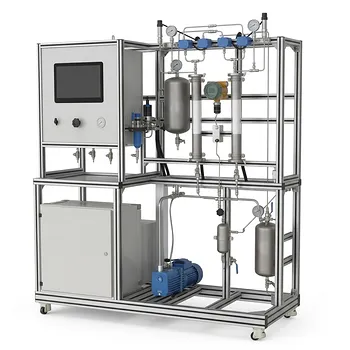
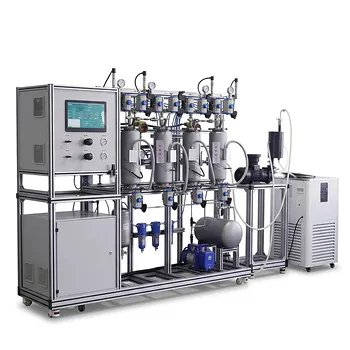
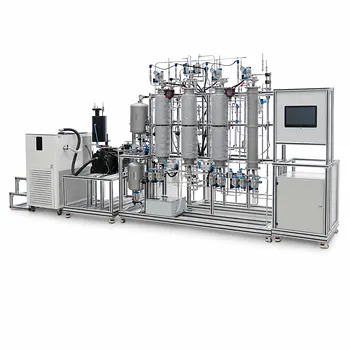
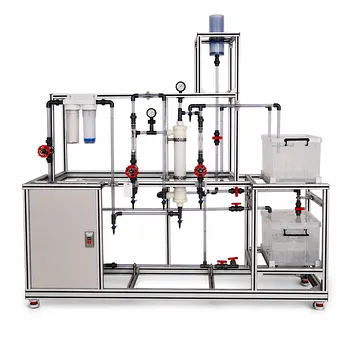
Your answer starts with understanding that liquid fugacity under pressure is not a given—it's a calculated state. The Poynting correction factor is the tool that makes this calculation accurate. In high-pressure separation pilot plants, the operating pressure far exceeds the liquid's saturation pressure, and the Poynting correction adjusts the liquid-phase fugacity accordingly. If you skip it, your equilibrium constants (K-values) will be wrong, eroding the entire basis for measuring column efficiency and optimizing feed tray locations.
Pilot plant VLE data is meaningless without thermodynamic consistency. The Poynting correction is the bridge that converts ideal, low-pressure liquid behavior into the compressed-liquid reality of high-pressure systems—directly preventing catastrophic errors in K-value predictions and the scale-up decisions that depend on them.
The Thermodynamic Necessity at High Pressures
Liquid fugacity is the true measure of a component's escaping tendency, and it’s highly sensitive to pressure when you move away from atmospheric conditions.
From Ideal to Real: Why Pressure Matters
At low pressures, the liquid fugacity is essentially equal to the saturation fugacity. But in high-pressure pilot plants, the system pressure dwarfs the components’ vapor pressures. The liquid is now in a compressed state, not a saturated one. This compression changes the chemical potential and, therefore, the fugacity. Without a correction, you’re treating a compressed liquid as if it were gently boiling at its normal point, which introduces a fundamental error into every VLE calculation.
The Poynting Factor: The Missing Piece in Liquid Fugacity
The correction takes the form (\exp\left[\frac{V_i^l (P - P_i^{sat})}{RT}\right]). It multiplies the saturated liquid fugacity, scaling it up (or down) by the exponential of the pressure difference times the liquid molar volume. Even a modest pressure increase of a few hundred psi can make this factor significantly different from 1.0, especially for components with larger molar volumes. This is not an academic subtlety—it’s the difference between a physically correct fugacity and a number that is essentially a guess.
Consequences for Pilot Plant Accuracy
Pilot plants are built to generate reliable data for scale-up. When the Poynting correction is omitted, the core of that data—the equilibrium relationships—becomes unreliable.
Errors in K-Values and Column Efficiency
K-values ((K_i = y_i / x_i)) are the backbone of any separation design. If your liquid fugacity is understated, the derived K-values will be systematically off. Consequently, your calculated number of theoretical stages, overall column efficiency, and the apparent performance of your packings or trays become a fiction. You might think you have a 90%-efficient column, but the real performance could be much lower or higher, leading to under- or over-designed commercial units.
Feed Tray Optimization and Scale-Up Pitfalls
The sensitivity of simulation models to wrong K-values cascades into every downstream decision. A pilot plant’s purpose is often to pinpoint the optimal feed tray location. With incorrect equilibrium data from an ignored Poynting factor, the “optimum” found in the pilot plant may be far from the true optimum at full scale. This misdirects capital investment and can create a commercial plant that never meets its separation targets.
Understanding the Trade-offs
Being critical means recognizing when the Poynting correction is essential and when its complexity can be managed.
When Simplification is Safe—But Dangerous
Most standard refinery separations—atmospheric distillation, vacuum towers, low-pressure stabilizers (below 400 psig)—operate in a regime where the Poynting correction is nearly 1.0. In these cases, using the simple (K = Y/X) approximation is acceptable and streamlines student and operator calculations. The danger arises when engineers extrapolate this simplification to high-pressure pilot plants (like high-pressure deethanizers or supercritical extraction), where the assumption collapses. The false sense of security from low-pressure norms is a major source of error.
The Data Problem: BWR Constants and Sensitivity
The Poynting correction itself is a faithful thermodynamic expression, but its accuracy hinges on reliable liquid molar volumes. In complex hydrocarbon mixtures, model parameters—such as those from the BWR-11 equation—can be extremely sensitive. Minor variations in regressed constants produce large discrepancies in predicted K-values and vapor pressures. Therefore, even with a perfect Poynting correction, if you load your simulation with poorly regressed data from pure components instead of comprehensive mixture VLE data, your corrected fugacity will still be wrong. The criticality of the Poynting factor is magnified when the underlying property models are fragile.
How to Apply This to Your Pilot Plant VLE Work
The decision to apply the Poynting correction should be deliberate, based on your operating pressure and the data quality you need.
- If your primary focus is precision scale-up of a high-pressure (>400 psig) separation: Always include the Poynting correction in your thermodynamic model. Pair it with fugacity coefficients from a reliable equation of state and, critically, with parameters regressed from mixture VLE data, not pure-component data alone.
- If your primary focus is educational demonstration of non-ideality: Use a high-pressure pilot plant to physically show students the deviation. Compare K-values calculated with and without the Poynting factor against real measured samples. The observed discrepancy will cement the concept far better than any textbook.
- If your column operates strictly below 300-400 psig with near-ideal mixtures: You can safely omit the Poynting correction for design calculations, but explicitly note this assumption in your methodology. This trains you to always ask: “Is my pressure high enough to compress the liquid, or is it still roughly a saturated condition?”
You cannot manage what you do not measure, and in high-pressure VLE, you are not truly measuring equilibrium if you leave out the pressure’s effect on the liquid. Committing to that correction transforms your pilot plant from a trial-and-error setup into a precision thermodynamic instrument.
Summary Table:
| Pressure Regime | Poynting Factor Impact | Consequences of Omission | Recommended Action |
|---|---|---|---|
| Low Pressure (<300-400 psig) | Negligible (~1.0) | Minimal impact; simple equations hold | Safe to omit, but note the assumption |
| High Pressure (>400 psig) | Critical (exponential deviation) | Erroneous K-values, wrong column efficiency, failed scale-up | Must include with verified mixture VLE data |
Optimize Your Separation Processes with LABPARK
Accurate thermodynamic modeling is the foundation of successful pilot plant scale-up. LABPARK provides premium Educational and Vocational Unit Operations Pilot Plants in chemical engineering, bioprocess & biotech, and environmental & water treatment for universities, research institutes, and enterprises. Our high-precision systems empower your researchers and students to analyze complex VLE phenomena and design reliable high-pressure separation processes.
Ready to elevate your research and teaching capabilities? Contact LABPARK today to find the perfect pilot plant solution for your laboratory!
Related Products
- Pressure Swing Adsorption Educational Unit Operations Pilot Plant
- Multi-Component Gas Pressure Swing Adsorption Pilot Plant for Unit Operations Education
- Educational Pressure Swing Adsorption Ethylene Capture Unit Operations Pilot Plant
- Ultrafiltration Membrane Separation Educational Pilot Plant
- Multifunctional Membrane Separation Educational Pilot Plant with Ultrafiltration, Nanofiltration, Reverse Osmosis
People Also Ask
- How does Pressure Swing Adsorption (PSA) technology operate? Optimize gas separation with pilot plants.
- How to demonstrate physical vs chemical absorption using a pilot plant? A practical lab guide.
- What are the key differences between PSA and TSA? Choosing the Right Adsorption Pilot Plant
- How do physical vs chemical adsorption impact pilot plant design? Key operational & regeneration strategies.
- How is moisture removal managed in an adsorption unit operations pilot plant? Dew Point Control Guide