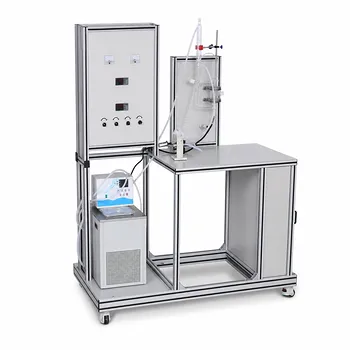
The short answer is that computer models paint a useful map, but the actual territory of a chemical process is riddled with imperfections they cannot fully capture. Predictions of solubility in binary solvent mixtures rely on idealized thermodynamic equations and assumed parameters. They can show you where a solubility peak should be or whether a mixture should stay single-phase. But only a physical pilot plant reveals the real, often unforgiving, behavior—accounting for factors like imperfect mixing, wall effects, and complex fluid dynamics that software either simplifies or ignores entirely. This hands-on validation is not a nice-to-have; it is the bedrock of designing safe, reliable, and economically viable extraction, crystallization, and purification unit operations.
Thermodynamic models are indispensable for narrowing down options, but they are systematically blind to the messy reality of non-ideal dynamics, heat transfer limitations, and phase instability. The physical pilot plant bridges this gap, transforming a theoretical possibility into a verifiable process. Without it, you risk scaling up a failure.
The Limits of Predictive Models in Binary Solvent Systems
Idealized Assumptions Break Down in Complex Mixtures
Computer models calculate solubility based on activity coefficient equations like NRTL or UNIQUAC. These equations, while powerful, are fitted to data that rarely covers every operating condition you will encounter. When you move into a real vessel with real mixing, the model’s idealized assumption of instantaneous thermodynamic equilibrium can fail. Local concentration gradients and imperfect mixing create zones where the actual solvent ratio differs from the intended ratio, triggering premature precipitation or phase splitting that the model’s global calculation never predicted.
Non-Linear Solubility Peaks Often Miss Their Mark
Binary solvent mixtures frequently exhibit extreme non-linearity. A solubility peak, like acetaminophen in a water/acetone mixture, might be predicted at one composition but actually occur a few percent away. The supplementary references highlight that models can shift the location of a solubility peak or systematically overpredict solubility values. In a pilot plant, you physically measure the real solubility curve. You see the actual crystal yield at a given ratio. That single data point can correct an entire design basis, preventing a commercial-scale crystallizer from operating at a suboptimal condition that yields 20% less product.
Model Parameters Require Experimental Anchoring
No thermodynamic model springs into existence fully formed. Every interaction parameter in an activity coefficient model is ultimately derived from experimental data—or from estimation methods that are themselves calibrated on experiments. When you run a pilot-plant experiment, you generate the very physical data needed to regress accurate binary interaction parameters. This closes the loop. You use models to screen compositions, then you physically validate the best candidate and, in doing so, refine the model for future use. This is the core engineering methodology: the model proposes, the experiment disposes.
Phase Stability and the Hidden Danger of Oiling Out
One of the most critical parameters when selecting a binary solvent for crystallization is the BETA value, which indicates whether the mixture will remain a single liquid or separate into two distinct liquid phases. A model might show a BETA value slightly below 1—foretelling liquid-liquid phase separation, or "oiling out". But the exact onset of this phenomenon is sensitive to trace impurities, temperature fluctuations, and surface nucleation. A pilot plant lets you visually observe and physically measure this separation in real time. Avoiding oiling out in a commercial crystallizer is not a theoretical exercise; it’s a matter of preventing batch failure and equipment fouling that a simulation could have missed by a fraction of a mass percent.
Simulation Discrepancies Demand a Physical Referee
When different thermodynamic models (e.g., UNIFAC vs. COSMO-SAC) give conflicting solubility predictions, you have no choice but to arbitrate with reality. A flash calculation in a process simulator can swing wildly depending on the chosen property method. The pilot plant becomes the definitive judge. By running a physical distillation or extraction, you collect the real VLE or LLE data. This data tells you which model is accurate—or if none are, it gives you the foundation to build a custom, validated approach. Skipping this step means you are betting your process design on a guess, not a fact.
The Blind Spot of Solid Handling
Commercial simulation software has a genetic weakness: it was built for fluids. Processes that involve crystallized solids, pastes, or powders—like those from spray dryers or centrifuges—defy the standard unit-operation models. Particle attrition, agglomeration, and clogging are physical realities that sit in a software’s blind spot. A pilot-plant centrifuge or rotary dryer shows you exactly how a particular crystal slurry behaves under real shear and thermal stress. This hands-on insight teaches you what no spreadsheet subroutine ever could, and it prevents catastrophic blockages in a scaled-up line.
Understanding the Trade-offs
The Cost of Certainty
It is tempting to view the pilot plant as an expensive, time-consuming step that delays a project. That is a shortsighted view. While physical runs consume resources, they dramatically reduce the financial risk of process failure at scale. The cost of a pilot-plant campaign is a fraction of the cost of fixing a full-scale chemical plant that suffers from chronic fouling, low yield, or safety incidents. The trade-off is between investing in validation upfront or paying many times more for corrective re-engineering later.
When Simulation Alone Is Sufficient
That said, physical piloting is not a blunt universal requirement. For early-stage solvent screening across hundreds of combinations, simulation is irreplaceable. It allows you to intelligently narrow the field to five candidates instead of fifty, saving vast amounts of time and material. The intelligent workflow is simulation-first, pilot-validation-second. Use the model to discard obviously poor choices and to pinpoint the most promising and most hazardous compositions. Then, validate only those high-stakes candidates in the pilot plant.
The Danger of False Confidence
The greatest risk of relying solely on a model is the creation of false confidence. A beautiful, colorful simulation report can feel more authoritative than a hastily collected experimental data point. But that feeling is an illusion. A model is a series of algebraic approximations to a complex reality. The pilot plant grounds your decisions in thermodynamic and kinetic truths, not approximations. For processes where safety, product purity, or yield are non-negotiable, there is no substitute for this physical truth.
Making the Right Choice for Your Process Development
The decision to physically study a binary solvent mixture in a pilot plant hinges on the phase of your project and the consequences of being wrong. Use this goal-based guide to calibrate your approach.
- If your primary focus is early-stage solvent screening: Use computational predictions aggressively to rank solvent compositions and discard clear non-performers. Your goal is speed and breadth, not final certainty.
- If your primary focus is optimizing a crystallization or extraction process for pilot scale-up: Run targeted physical experiments on your top 2-3 solvent candidates. Your goal is to lock down the real solubility peak, confirm single-phase stability, and generate scale-up kinetic data.
- If your primary focus is ensuring process safety and avoiding oiling out: Never rely solely on a calculated BETA parameter. Physically observe the mixture at its operational concentrations and temperatures to catch incipient phase separation that models may miss by a tiny margin.
- If your primary focus is developing a process involving solids: Assume the simulator is insufficient. Plan for pilot trials to characterize particle attrition, flowability, and clogging tendencies, which are outside the software’s native predictive envelope.
The physical pilot plant is not a rejection of modern computational tools; it is the essential partner that turns a promising digital blueprint into a robust industrial reality. Use the model to think, but use the experiment to know.
Summary Table:
| Feature | Predictive Computer Models | Physical Pilot Plants |
|---|---|---|
| Mixing & Dynamics | Assumes ideal equilibrium | Reveals local gradients & mixing limits |
| Solubility Peaks | Often overpredicts or shifts peaks | Measures actual yield & peak location |
| Phase Separation | Estimates theoretical stability (BETA) | Directly observes phase separation ("oiling out") |
| Solid Handling | Poorly models slurries and powders | Tests real shear, attrition, and clogging |
Bridge the Gap Between Theory and Reality with LABPARK
Don't risk scaling up an unverified chemical process. LABPARK provides state-of-the-art Educational and Vocational Unit Operations Pilot Plants in chemical engineering, bioprocess & biotech, and environmental & water treatment.
Designed specifically for universities, research institutes, and enterprises, our pilot plants enable you to physically validate thermodynamic simulations, prevent costly batch failures, and optimize process safety.
Contact LABPARK today to find the perfect pilot plant solution for your lab or facility!
Related Products
- Binary System Vapor Liquid Equilibrium Data Determination Educational Unit Operations Pilot Plant
- Agitation and Mixing Educational Unit Operations Pilot Plant
- Gas-Solid Heterogeneous Separation Demonstration Educational Unit Operations Pilot Plant
- Solid Waste Pyrolysis and Refining Educational Pilot Plant for Unit Operations
- Dual-Mode Rectification Pilot Plant for Practical Training Unit Operations
People Also Ask
- How can pilot plants assist in validating VLE models? Bridge theory and physical reality.
- Why Collect Isothermal vs. Isobaric VLE Data? Key Pilot Unit Advantages
- How Do Equations of State Predict VLE in Pilot Plants? Optimize Your Separation Design
- How do intermolecular forces and molecular kinetic energy govern gas liquefaction and vaporization? Explore VLE pilot plants
- For VLE Experiments: Fugacity vs. Activity Coefficient Method Selection Criteria