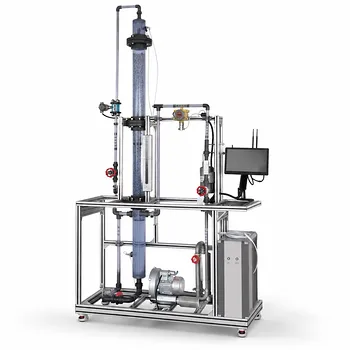
It’s the industry’s go-to shortcut for thermodynamic truth. The Peng-Robinson Equation of State (PR EOS) dominates pilot-plant modeling because it uniquely balances simplicity, reliability, and accuracy for hydrocarbon systems. It requires only two component parameters—critical properties and acentric factor—yet delivers excellent predictions of vapor-liquid equilibrium, liquid densities, and near-critical phase behavior. This makes it the default choice for students and engineers validating distillation columns, gas separators, and hydrate formation experiments in real time.
The PR EOS solves a fundamental pilot-plant dilemma: you need research-grade fidelity without the computation time of complex multi-parameter models. It achieves this by fixing the Achilles’ heel of earlier cubic equations—liquid density predictions—while remaining simple enough for analytical solution and rapid flowsheet iteration.
The Thermodynamic Fundamentals of PR EOS
A Two-Constant Cubic Engine
PR EOS is a cubic equation of state, meaning it can be rearranged into a polynomial of degree three in volume or compressibility factor.
This structure allows analytical solution for liquid and vapor roots without iterative procedures. For a pilot plant running multi-component hydrocarbon streams, that directly translates to fast, stable calculations of coexisting phase densities and fugacities.
Superior Prediction Near the Critical Point
The Peng-Robinson equation was specifically designed to overcome the liquid density weakness of the earlier Soave-Redlich-Kwong (SRK) model.
By adjusting the temperature dependence of the attractive term, PR gets the critical compressibility factor right for hydrocarbons. This dramatically improves saturated liquid volumes and makes it trustworthy in the retrograde condensation region—exactly where industrial gas processing units often operate.
Why Pilot Plants Demand the PR EOS
Accurate Vapor-Liquid Equilibrium (VLE) Predictions
In a pilot distillation column or phase separator, VLE calculations are non-negotiable. PR EOS predicts equilibrium ratios (K-values) with an average error of just 2–3% in pressure and around 1.3% in temperature for light paraffins, N₂, CO₂, and H₂S mixtures.
These small errors mean that the simulated bubble points, dew points, and flash curves match what students and operators actually see on the plant’s readouts. This closes the theory-practice gap instantly.
Handling Complex Real-World Systems
Pilot-plant hydrocarbons never flow dry. Water is always present, bringing risks of liquid dropout, corrosion, and hydrate plugs.
PR EOS can be extended with a fitted binary interaction parameter for water-hydrocarbon pairs to accurately calculate water content in both vapor and liquid phases. It reliably predicts three-phase (L₁L₂G) equilibria and hydrate formation conditions, making it a single model for both process design and safety analysis.
Balancing Simplicity with Speed for Real-Time Use
Unit operations like demethanizers or gas compressors require rapid property calls in flowsheeting software. PR EOS needs only T_c, P_c, and ω—no mixture-specific data—so it integrates effortlessly into simulations.
Its analytical roots and low parameter count keep computational overhead minimal. Students can run multiple case studies during a lab session, and industrial pilot plants can perform real-time model-predictive checks without waiting on external thermodynamic servers.
Understanding the Trade-offs
PR EOS is not a universal tool. Its accuracy shines for non-polar and slightly polar hydrocarbons—natural gas, condensates, light crude cuts. For highly polar, hydrogen-bonding, or electrolyte systems, the model’s inherent mixing rules become unreliable unless heavily customized.
Additionally, the water-hydrocarbon extension requires careful interaction parameter fitting. Using default values may lead to erroneous water dew points, so pilot-plant operators must validate against measured solubility data.
Compared to SRK, PR offers superior liquid volumes but can sometimes underestimate vapor pressures for heavy-aliphatic hydrocarbons, while SRK can overestimate them. The choice thus depends on whether liquid density or vapor pressure fidelity is more critical for your experiment.
Making the Right Choice for Your Pilot Plant Application
- If your primary focus is accurately simulating distillation columns and VLE: Choose PR EOS without hesitation. Its robust phase-equilibrium predictions for paraffinic mixtures ensure your theoretical plates match experimental performance.
- If your primary focus is studying retrograde condensation or near-critical behavior: PR is the clear winner. The model’s improved upper dew point predictions capture the complex liquid dropout you’ll observe in high-pressure gas condensate rigs.
- If your primary focus is hydrate and wet-gas processing: Use PR EOS with carefully tuned binary interaction parameters. It unifies phase behavior, water content, and hydrate formation in a single consistent framework, simplifying safety analysis.
- If your primary focus is speed and educational clarity: PR’s analytical solution and minimal input requirement let students focus on thermodynamic principles, not parameter guesswork. It’s the fastest path from theory to validated pilot-plant data.
The Peng-Robinson equation doesn’t just predict thermodynamics—it gives you a reliable, fast, and teachable lens through which hydrocarbon pilot-plant behavior becomes both predictable and profoundly understandable.
Summary Table:
| Aspect | Pilot Plant Application | Key Benefit |
|---|---|---|
| Two-Constant Cubic Structure | Fast flowsheet iterations | Analytical solutions with minimal computational overhead |
| Critical Point Tuning | Retrograde condensation modeling | High-fidelity prediction of liquid density and volumes |
| Accurate VLE Prediction | Distillation & phase separation | Low error margins (2-3%) matching physical plant readouts |
| Water-Hydrocarbon Extension | Hydrate & wet-gas processing | Reliable safety analysis and three-phase equilibrium data |
Bring Thermodynamic Theory to Life with LABPARK
At LABPARK, we design and manufacture premium Educational and Vocational Unit Operations Pilot Plants for chemical engineering, bioprocess & biotech, and environmental & water treatment. Tailored for universities, research institutes, and enterprises, our systems provide the perfect hands-on environment to validate thermodynamic models like PR EOS.
Ready to elevate your engineering lab's capabilities and research accuracy? Contact us today to discover our customizable pilot plant solutions!
Related Products
- Carbon Dioxide PVT Curve Determination Educational Unit Operations Pilot Plant
- Binary System Vapor Liquid Equilibrium Data Determination Educational Unit Operations Pilot Plant
- Throttling Effect Determination Educational Unit Operations Pilot Plant
- Ternary Liquid-Liquid Equilibrium Educational Pilot Plant
- Multi Functional Catalytic Reaction and Reactor Evaluation Educational Unit Operations Pilot Plant
People Also Ask
- How do temperature variations affect CO2 transport models in pilot plants? Model vs Reality
- What unit operations are critical for CCUS training pilot plants? Build hands-on engineering expertise.
- What key thermodynamic properties & engineering challenges affect scCO2 reactions in pilot plants?
- How are titration curves used in pilot plants? Guide to process control & endpoint accuracy
- What are the applications and limitations of the Virial EOS? Enhance Your Pilot Plant Lab