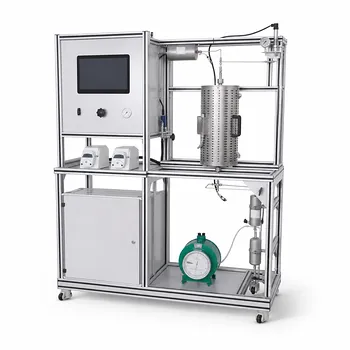
The heartbeat of any photochemical reactor is light—specifically, how much light energy is absorbed locally within the reaction volume. The Local Volumetric Rate of Energy Absorption (LVREA) is the critical parameter that directly links the incoming radiation field to the chemical reaction. In a photochemical reactor pilot plant, the rate of the primary photochemical activation step is proportional to the LVREA, not simply to the lamp power or the concentration of reactants. This means that to design a reactor, choose the right lamp, position it optimally, and predict conversion, you must understand how LVREA is distributed throughout the reacting fluid. Without this understanding, scale-up remains guesswork and educational experiments fail to connect theory to real-world behavior.
The LVREA is the fulcrum of photochemical reactor engineering. It governs local reaction rates, dictates quantum efficiency, and determines whether a pilot plant can be successfully scaled. Yet evaluating it accurately is one of the most challenging tasks because the light absorption field is tightly coupled to the changing concentration of the absorbing species. Mastering this coupling—and learning when to simplify it—is what separates a well-designed photoreactor from a poorly performing one.
The Foundational Role of LVREA in Photoreactor Kinetics
Why Light Absorption Replaces Temperature as the Driving Force
In a conventional thermal reactor, the reaction rate is controlled by temperature—a scalar field that evolves according to heat transfer and reaction enthalpy. In a photochemical reactor, the activation step is photonic, not thermal. The rate of the light-triggered initiation step at any point in the reactor is directly proportional to the LVREA at that point. This means that the spatial distribution of absorbed light energy replaces the thermal field as the primary driver of conversion.
LVREA as the Link Between Photon Flux and Chemical Conversion
The LVREA (measured in units like einstein/cm³·s) quantifies how much radiation energy is absorbed per unit time and per unit volume of the reaction mixture. Multiplying the LVREA by the primary quantum yield of the activation step gives the local initiation rate. This local rate then feeds into the dark (thermal) propagation and termination steps that complete the chemical transformation. Therefore, the global reactor performance—productivity, selectivity, and photon efficiency—is entirely built upon the LVREA distribution. For a pilot plant aimed at advanced oxidation processes or synthesis, a poor LVREA profile means wasted light, hot spots, or unreacted zones, all of which undermine the reactor’s purpose.
The Challenge of Coupled Radiation and Mass Balances
The Coupling Problem in a Nutshell
The LVREA depends on the local attenuation coefficient of the medium, which in turn depends on the concentration of the absorbing species. As the reaction proceeds, the concentration of that species changes, altering the attenuation coefficient and thus the radiation field itself. This creates a two-way coupling: the mass balance equations depend on the LVREA, and the LVREA depends on the concentration fields that the mass balance solves. In a pilot-scale reactor, this coupling makes the mathematical modeling multi-dimensional and highly non-linear, demanding iterative numerical solutions that can obscure physical insight.
Why This Coupling is a Central Obstacle in Pilot Plant Design
For both researchers and students, the coupled nature of the problem transforms what seems like a straightforward scale-up task into a complex systems-engineering challenge. Placing a lamp in a tank and expecting uniform light absorption is rarely valid. The attenuation coefficient can vary dramatically from inlet to outlet, especially in a flow reactor. Without decoupling the radiation and mass balances—or at least understanding their interdependence—it is impossible to reliably size the reactor, predict the required lamp power, or even interpret experimental yield data correctly. In educational settings, ignoring this coupling leads to a superficial understanding that fails to prepare students for industrial problems.
Simplifying the Complex: Strategies for Educational and Research Reactors
Perfectly Mixed Conditions: Decoupling by Uniformity
Operating the reactor in a perfectly mixed mode eliminates spatial concentration gradients. Because the attenuation coefficient becomes uniform throughout the volume, the LVREA is no longer a function of the local concentration field. The radiation field can then be solved independently of the mass balance, dramatically simplifying the modeling. This is an ideal starting point for teaching core photochemical engineering principles without getting lost in computational complexity.
Photosensitized Reactions: A Non-Consumed Light Absorber
When a reaction uses a photosensitizer—a species that absorbs light but is not consumed in the overall reaction—the concentration of the absorbing species remains constant. Benzophenone in the liquid phase, or sulfur dioxide/benzene in the gas phase, are examples. With a fixed attenuation coefficient, the LVREA profile is steady and decoupled from reaction progress. This scenario closely mirrors classic chemical engineering assumptions of constant physical properties and allows researchers to isolate the study of the dark reaction kinetics.
The Black Body Reactor: Confining Absorption to the Wall
A “black body reactor” employs a strongly absorbing medium so that virtually all radiation is absorbed within a very thin layer near the reactor wall. In this limit, the entire absorption event can be modeled as occurring on the wall itself, akin to a surface reaction. The LVREA becomes a boundary condition rather than a volumetric field, eliminating the need to solve the radiation transport equation in the bulk. This is a powerful simplification for certain photocatalytic and AOP pilot units where high optical density is a design feature.
Understanding the Trade-offs
Accuracy vs. Manageability in Academic Settings
Each simplification trades a measure of realism for tractability. Perfect mixing, for example, may be physically impossible in a pilot-scale annular photoreactor with laminar flow. Photosensitized reactions bypass the most interesting coupling problem that students need to learn for real photocatalysis. The key is to use simplified models as cognitive scaffolding, not as final design tools. Researchers should validate the assumptions against more rigorous models or experimental actinometry before scaling up.
When Simplifications Break Down
Simplified LVREA models fail when the reaction is strongly autocatalytic, when multiple absorbing species compete for photons, or when the reactor geometry creates optically thick regions with severe gradients. In these cases, relying on a uniform attenuation coefficient or a wall-absorption assumption will produce misleading predictions of conversion and selectivity. An educational pilot plant must therefore include experiments that deliberately stress these assumptions, teaching students where the boundaries of simplified models lie.
The Data Pipeline for Accurate LVREA Evaluation
Essential Inputs for Radiant Field Modeling
Rigorous LVREA evaluation demands a systematic collection of data. The four categories are:
- Radiation source characteristics: lamp power, spectral output, dimensions, operating conditions.
- Reactor physical characteristics: geometry, wall material transmission spectrum (quartz vs. Pyrex), pressure/temperature limits.
- Reaction kinetics and optical properties: absorption spectra of all species, microkinetic pathway, primary quantum yield.
- Reflector characteristics (if used): geometry, spectral reflectivity.
Collecting this information forces a discipline that is at the heart of pilot plant practice—conducting mass, energy, and radiation balances in a holistic manner.
The Educational Value of Collecting and Interpreting This Data
For chemical engineering students, the process of building an LVREA model is a capstone exercise that marries fundamentals of transport phenomena, reaction kinetics, and optics. It teaches them how laboratory kinetic data (like that from the ammonium persulfate/potassium iodide system) are not isolated curiosities but the raw material for reactor design. By evaluating the LVREA, students see firsthand why a lamp cannot be treated as a simple “heat source” and why scale-up demands a multi-physics mindset.
Making the Right Choice for Your Educational or Research Goal
- If your primary focus is fundamental photochemical research: Prioritize a rigorous, coupled model of the LVREA. Validate it with local actinometry to confirm the radiation field, even if the computations are demanding. This reveals the true interplay of optics and kinetics that drives quantum yields.
- If your primary focus is chemical engineering education: Start with the simplified regimes—perfectly mixed, photosensitized, or black body—to teach the foundational principles. Then intentionally move to a coupled case study so students appreciate why the LVREA is not a simple input but a core design variable.
- If your primary focus is pilot plant scale-up for environmental water treatment: Use the LVREA to guide lamp placement and reactor geometry. Aim for a relatively uniform attenuation field, and model the trade-off between optical path length and mixing. Efficiency often lies in making the optical thickness manageable, not maximum.
- If your primary focus is reactor optimization and cost reduction: Calculate the LVREA distribution at various operating points to identify zones of over-irradiation or photon starvation. This enables you to right-size the lamp power and reflector design, directly reducing energy costs and improving the overall economics of the process.
Mastering the LVREA is not just an academic exercise—it is the practical bridge that turns a lamp and a vessel into a predictable, scalable photochemical reactor.
Summary Table:
| Simplification Strategy | Operational Mechanism | Ideal Application |
|---|---|---|
| Perfect Mixing | Decouples radiation & mass balance via uniform concentrations | Educational teaching & basic kinetic modeling |
| Photosensitized | Uses non-consumed absorber to keep attenuation constant | Isolating dark reaction kinetics |
| Black Body Reactor | Confines absorption to reactor wall boundary | High optical density & photocatalytic units |
Accelerate Your Research & Education with LABPARK
Building the next generation of chemical engineering talent requires hands-on, high-fidelity equipment. LABPARK offers premium Educational and Vocational Unit Operations Pilot Plants spanning chemical engineering, bioprocess & biotech, and environmental & water treatment.
We help universities, research institutes, and enterprises master complex concepts like photoreactor scale-up and LVREA modeling.
Contact LABPARK today to discover how our tailored pilot plant solutions can transform your laboratory training and research capabilities!
Related Products
- Photocatalytic Membrane Separation and Degradation Unit Operations Pilot Plant
- Fixed-Bed Chemical Reaction and Gas Dust Tar Removal Unit Operations Pilot Plant
- O-Xylene Oxidation to Phthalic Anhydride Educational Unit Operations Pilot Plant
- Multi-Reactor Educational Pilot Plant for Reaction Engineering Unit Operations
- Tubular Reactor Flow Characteristics Determination Educational Unit Operations Pilot Plant
People Also Ask
- What are the key differences in membrane configurations? Choose the Right Unit Operations Pilot Plant
- How Do Pervaporation, Vapor, and Gas Permeation Differ in Pilot Plants? Key Comparison
- What are the structural & performance trade-offs of flat-sheet, spiral-wound, & hollow-fiber membrane modules?
- Pervaporation vs. Vapor Permeation: Handling Suspended Solids in Membrane Pilot Plants
- How do PEI, PVDF, and PSU membranes compare in pilot plants? Find the best fit.