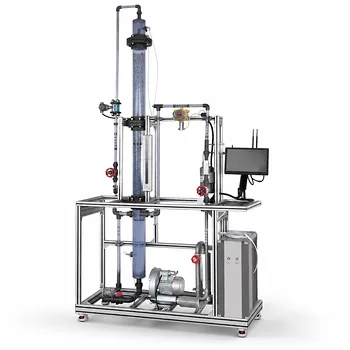
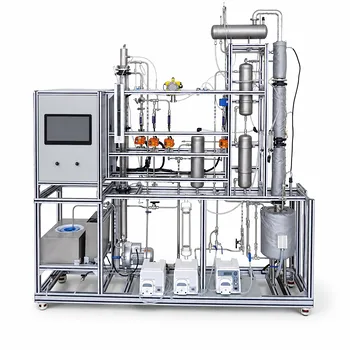
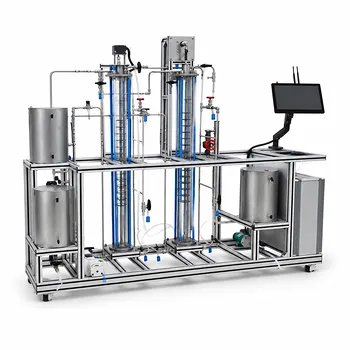
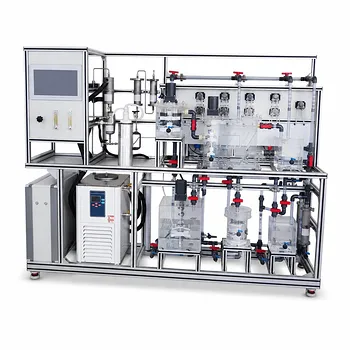
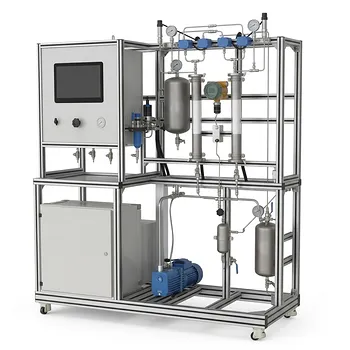
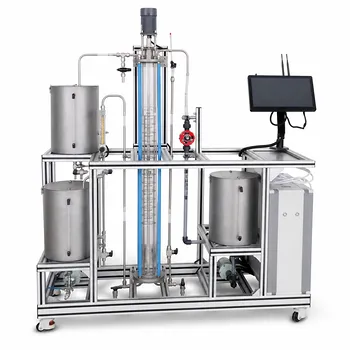
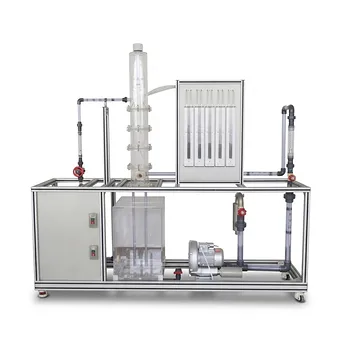
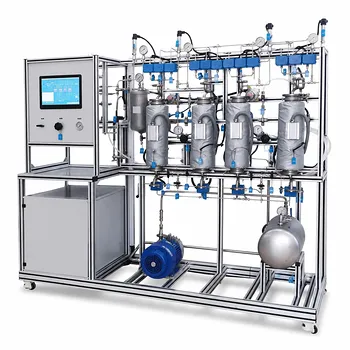
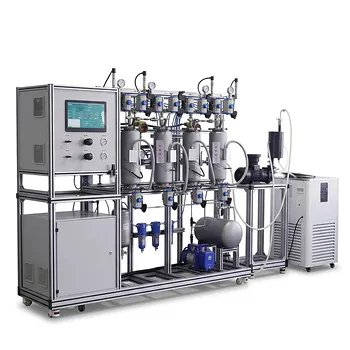
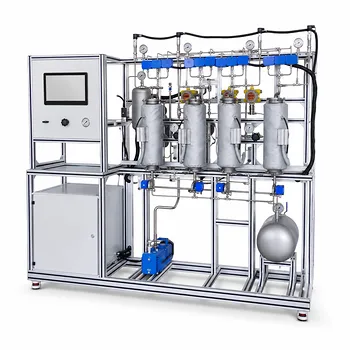
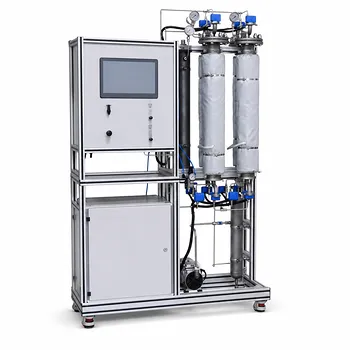
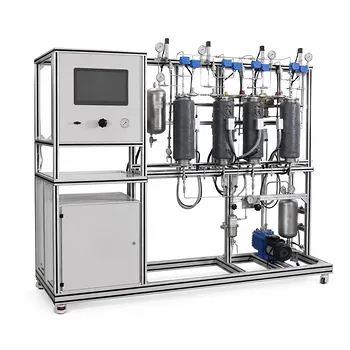
The integration is not just a convenience—it is the economic and operational backbone of any continuous absorption process. The absorption column captures the target gas, but its value is only realized when the expensive solvent is recovered for reuse. Connecting it to a desorption (stripping) column creates a closed-loop cycle: the "rich" solvent from the absorber is thermally stripped of its gas load in the desorber, regenerated into a "lean" solvent, and sent back to the absorber. In a pilot plant, this configuration must be a complete, instrumented system including two columns, a reboiler, a condenser, and liquid pumps to precisely replicate industrial conditions and study the critical interplay of heat integration and mass transfer dynamics.
The surface need is to understand the "why" of a coupled absorption-desorption system. The deep need is to design a pilot plant that teaches the real-world trade-offs between operating costs, capital expenditure, and dynamic process control. The true value lies not in the absorber alone, but in the closed-loop integration that reveals the economics and physics governing full-scale chemical plants.
Deconstructing the Closed-Loop Imperative
The fundamental driver for coupling absorption with desorption is solvent economics, but the implications for a flexible research tool are far greater.
The Economics of Solvent Recovery
Fresh solvent is a continuous operating cost. Simply discarding "rich" solvent after absorption is both economically and environmentally unsustainable.
- Direct Cost Reduction: The desorption column strips the absorbed gas, restoring the solvent's carrying capacity. This allows a single batch of solvent to be reused thousands of times, slashing chemical purchase and waste disposal costs.
- The Lean/Rich Interlock: The absorption efficiency in the primary column is directly linked to the "lean" solvent's purity. The desorption unit's performance therefore dictates the overall system's capability. A poorly regenerated solvent reduces the driving force for mass transfer in the absorber.
Capturing the Industrial Reality in a Pilot Plant
A simple single-pass absorption setup is a fundamental experiment. A coupled system is a process simulator for the plant floor.
- Replicating Complete Unit Operations: The closed loop introduces interdependent variables. A change in desorber temperature reverberates through the entire system, altering the lean solvent quality and, consequently, the absorber's efficiency. The pilot plant must demonstrate this cascade effect.
- A Platform for Heat Integration Studies: The primary reference highlights a critical industrial practice: heat integration. The hot, lean solvent exiting the desorber's reboiler must be cooled before re-entering the absorber. Simultaneously, the cool, rich solvent from the absorber must be heated before entering the desorber. A well-designed pilot plant incorporates a cross-flow heat exchanger, using the outgoing lean stream to preheat the rich feed. This visualizes how plants drastically reduce external utility consumption.
Configuring the Pilot Plant for Deep Learning
The configuration must be a fully instrumented, closed-loop system designed not just for operation, but for quantifiable analysis of its performance limits.
Standard System Architecture
The hardware must mirror an industrial unit in miniature, connecting all core components for continuous operation.
- Core Units: The system requires a packed absorption column, a packed desorption column, a reboiler at the desorber's base, a condenser at the desorber's top to recover stripped gas and reflux, and two liquid pumps (one for lean solvent feed, one for rich solvent transfer).
- The Heat Exchanger Network: The rich solvent line from the absorber’s bottom sump should be routed through a shell-and-tube or plate heat exchanger, where it is preheated by the hot lean solvent leaving the desorber’s reboiler. This is the physical manifestation of energy efficiency.
Critical Instrumentation and Measurements
The system’s educational value is directly proportional to the quality of its sensors. Without data points, it's just a machine.
- Temperature Profiling: Place multiple thermocouples along the height of both columns. The supplementary references confirm that the heat of absorption can cause a significant temperature bulge in the absorber, shifting the equilibrium and reducing efficiency. Mapping this profile teaches the difference between isothermal models and exothermic reality.
- Flow and Concentration: Install rotameters and control valves for liquid and gas flows. Crucially, integrate inline sensors or sample ports at the absorber's inlet (lean) and outlet (rich) liquid streams. This data allows calculation of the actual mass transfer performance, comparing it against models like the Kremser equation.
Optimizing Operations Through Fundamental Principles
A properly configured plant is a research tool for navigating the key trade-offs in an absorption-desorption cycle.
The Desorption Factor ($S$) and Column Design
The supplementary references introduce the desorption factor as the counterpart to the absorption factor. Managing it is key to balancing equipment size against energy cost.
- Driving Force and Heat Load: A low desorption factor ($S = mV/L$) means using a high stripping gas rate ($V$) in the desorber. While this maximizes the driving force for regeneration, the entire circulating liquid inventory must be heated to the reboiler's temperature, incurring a massive energy penalty. The pilot plant must demonstrate this trade-off by allowing manipulation of the reboiler duty and stripping gas flowrate.
- The Regeneration Penalty: A deeply regenerated solvent (very low solute concentration) is fantastic for absorption but exponentially expensive to produce via desorption. The pilot plant teaches the economic optimum by allowing students to measure the incremental energy cost of achieving a marginally higher solvent purity.
The Twin Trade-offs: Absorption vs. Desorption
The overall system is governed by two interconnected operating points, not just one.
- The Liquid-to-Gas ($L/V$) Ratio’s Dual Role: A high $L/V$ in the absorber improves capture but produces a dilute rich solvent, requiring more energy in the desorber to generate a concentrated gas stream. The pilot plant's configuration with flow meters on both columns allows operators to see this connection directly. An optimal $L/V$ in the absorber is not a universal constant; it must be chosen in concert with the desorption step's energy cost. The guideline of using $1.1$ to $2.0$ times the minimum $L/V$ is the starting point for this exploration.
Understanding the Trade-offs and Design Pitfalls
A pilot plant must also be a safe environment to encounter and diagnose process failures, governed by the column's hydraulic limits.
Navigating the Stable Operating Envelope
Each column has a performance diagram bounded by weeping, flooding, and entrainment limits, as detailed in the supplementary references. The pilot plant must be designed to safely demonstrate these boundaries.
- Flooding and Weeping: A transparent section in at least one column allows a visual demonstration of hydraulic phenomena. Increasing gas flow to the flooding point, then backing off, shows the catastrophic loss of efficiency at the upper limit. Going too low causes weeping, where the liquid drips through the packing rather than being spread as a film.
- Packing Wetting Rate: You must ensure the pilot-scale liquid flowrate is high enough to fully irrigate the packing. The supplementary reference correctly warns that a flow below the minimum wetting rate creates dry zones, causing a dramatic drop in apparent mass transfer efficiency that has nothing to do with the chemistry and everything to do with poor fluid mechanics.
Managing Exothermic Behavior
The heat of absorption is not a minor perturbation—it is a dominant effect that a pilot plant must reveal.
- The Performance-Killing Bulge: An exothermic absorption process, like scrubbing an acid gas into an alkaline solution, will create a hot zone in the middle of the column. This locally reduces gas solubility, creating a "pinch" in the operating line. The pilot plant's temperature probes will map this thermal bulge. The primary design lesson is that simply adding more packing height beyond this pinch point yields minimal benefit, a critical insight for industrial scale-up.
Making the Right Choice for Your Pilot Plant Goal
The final configuration of your absorption-desorption pilot plant must follow its primary research or educational objective. There is no single perfect design.
- If your primary focus is fundamental pedagogy: Choose a system with extensive transparent sections and a simple model like air-water-oxygen. Focus the instrumentation on visualizing fluid mechanics (flooding, weeping) and basic mass transfer, keeping the distinction between physical and chemical absorption clear.
- If your primary focus is advanced process dynamics and control: Instrument a reactive absorption system (like CO2-MEA) with a full heat integration network. The goal is to study the dynamic response of the closed-loop to disturbances, such as changes in absorber gas feed rate, and to design the control strategy that manages the cascade to the desorber’s reboiler duty.
- If your primary focus is validating industrially relevant mass transfer models: This requires the highest level of instrumentation—precise temperature probes down the column length, inline gas analyzers, and sample ports for liquid concentration. You will use this data to calculate the geometric mean of the absorption/desorption factors and rigorously compare them to the Kremser equation predictions, directly confronting the model's limits with exothermic, non-isothermal reality.
The true critical nature of integrating these two columns is that it transforms two isolated unit operations into a single, dynamic economic system, where every efficiency gain in one part creates a cost or constraint in another—and mastering that tension is the essence of chemical engineering.
Summary Table:
| Component | Function in Closed-Loop | Key Control & Design Parameters |
|---|---|---|
| Absorption Column | Captures target gas into the solvent phase. | $L/V$ ratio, liquid wetting rate, temperature profiling |
| Desorption Column | Strips gas to regenerate lean solvent for reuse. | Reboiler heat duty, stripping gas flow rate, pressure |
| Heat Exchanger | Performs heat integration between rich/lean solvents. | Heat recovery efficiency, temperature approach |
| Instrumentation | Monitors process dynamics and limits (e.g., flooding). | Multi-point thermocouples, flow rotameters, inline sensors |
Optimize Your Process Engineering Education and Research
Designing a closed-loop absorption-desorption system requires precise engineering and robust process control. LABPARK provides premium Educational and Vocational Unit Operations Pilot Plants in chemical engineering, bioprocess & biotech, and environmental & water treatment.
Whether you are a university upgrading your engineering labs, a research institute testing mass transfer models, or an enterprise scaling up chemical processes, our custom-configured pilot plants deliver the reliability and instrumentation you need.
Contact LABPARK today to discuss your pilot plant requirements and get a customized solution!
Related Products
- Absorption and Desorption Educational Unit Operations Pilot Plant
- Multimodal Absorption and Desorption Pilot Plant for Unit Operations Training
- Packed Bed Absorption Educational Unit Operations Pilot Plant
- Dual-Mode Gas Absorption and Desorption Unit Operations Training Pilot Plant
- Carbon Dioxide Absorption and Desorption Educational Pilot Plant for Carbon Capture Studies
People Also Ask
- How to demonstrate physical vs chemical absorption using a pilot plant? A practical lab guide.
- Why are liquid-phase mass transfer rates in pilot plants comparable to gas-phase rates? Key Insights
- Why is interface composition critical in absorption pilot plants? Bridging Theory & Practice
- How to Calculate HTU & NTU for Pilot Plant Packing Height: A Complete Guide
- How do absorption pilot plants assist students in calculating mass transfer coefficients and sizing column parameters?