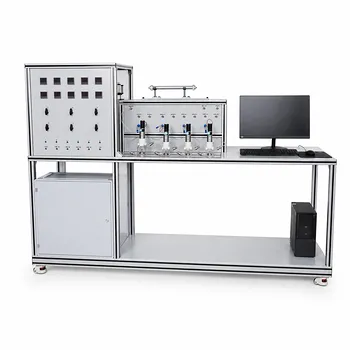
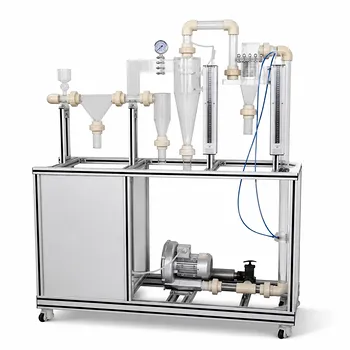
Determining the minimum liquid-to-gas ratio ((L/G)_\text{min}) is critical because it defines the thermodynamic boundary of your absorption process—operate below this limit and achieving your target separation becomes physically impossible, regardless of column height. In a pilot plant, calculating ((L/G)_\text{min}) gives you the baseline from which you design a practical, optimized system, typically operating at 1.2 to 2.0 times this minimum to balance capital costs, energy consumption, and stable column operation.
The minimum liquid-to-gas ratio is not just a textbook concept; it’s the single most important calculation for avoiding pilot plant failure. It marks the point where the driving force for mass transfer vanishes, establishing the absolute lower limit for solvent flow. Mastering this ratio lets you intentionally explore the trade-off between an impossibly tall column and an excessively costly solvent loop, turning your pilot data into actionable scale-up knowledge.
The Thermodynamic Limit: Why ((L/G)_\text{min}) Defines Feasibility
At its core, ((L/G)_\text{min}) is the value at which the operating line touches or becomes tangent to the equilibrium curve. This pinch point is a thermodynamic dead end.
The Pinch Point and Zero Driving Force
When the operating and equilibrium lines intersect, the local mass transfer driving force drops to zero. To achieve the desired solute recovery under these conditions, you would need an infinite number of theoretical stages—an infinitely tall column. In a real pilot plant, this is impossible. Even approaching this limit with a very low solvent rate will cause the column to fail to meet its separation target.
It’s the Absolute Lower Boundary
No amount of packing, improved internals, or operational tweaking can overcome this thermodynamic constraint. If your pilot plant is operated with an (L/G) ratio below ((L/G)_\text{min}), the target outlet gas purity is simply unreachable, no matter how tall the column is. This makes the determination of the minimum ratio the first essential step in any experimental design, ensuring you’re working within a physically feasible region.
Why Pilot Plant Operators Cannot Ignore ((L/G)_\text{min})
In an educational or research pilot plant, the goal is to learn and to generate scalable data. Neglecting ((L/G)_\text{min}) undermines both objectives.
Avoiding Wasted Experimental Runs
If you unknowingly set a solvent flow rate below the minimum, you’ll waste valuable lab time chasing a performance target that the laws of thermodynamics prohibit. Recognizing this limit before starting a run guarantees that your experiments will produce meaningful, interpretable results. It also allows you to intentionally test the model: you can verify that as you lower the liquid rate, the column’s efficiency plummets when you near the predicted pinch.
Setting the Anchor for Economic Optimization
Actual pilot plants operate at a practical liquid-to-gas ratio that is a multiple of the minimum—usually 1.2 to 2.0 times ((L/G)_\text{min}), with 1.4 being a common starting point. The minimum ratio is the non-negotiable foundation upon which all cost-saving optimizations are built. Without it, you have no frame of reference for reducing solvent consumption or energy load.
From ((L/G)_\text{min}) to a Real Operating Point
Identifying the minimum is just the start. The true value lies in how you use it to find the sweet spot for your specific system.
The 1.2–2.0 Multiplier: Balancing Capital and Operating Costs
Increasing the liquid-to-gas ratio above the minimum increases the absorption driving force. This reduces the required number of transfer units ((N_\text{OG})) and allows for a shorter, cheaper column. However, a higher ratio also requires:
- Greater solvent circulation, increasing pump work and chemical costs.
- Higher thermal loads for solvent regeneration, which is often the dominant energy consumer.
The 1.2–2.0 range empirically balances these factors, preventing an expensive over-design of the liquid handling system.
The Hidden Risk of Flooding and Poor Wetting
An excessively high liquid flow rate can push the column towards flooding, where liquid backs up and pressure drop spikes, destroying mass transfer efficiency. Conversely, operating too close to ((L/G)_\text{min}) might result in a liquid rate so low that it falls below the minimum wetting rate of the packing. This creates dry zones and drastically reduces effective interfacial area, making the column perform far worse than theoretical predictions.
The Power of Pilot-Scale Verification
The determination of ((L/G)_\text{min}) relies entirely on accurate vapor-liquid equilibrium (VLE) data. Computer simulations can produce varying results, especially for reactive systems like amine scrubbing. Your pilot plant is the ultimate tool for:
- Measuring empirical VLE under real operating conditions.
- Observing film resistances: In chemical absorption, the actual absorbent concentration relative to the critical concentration determines whether you’re under gas-film or two-film control. Operating at (L/G) ratios derived from pilot data helps you maintain conditions where the liquid-phase resistance is eliminated.
- Validating the absorption parameter ((m G_m / L_m)) within the often-cited optimal range of 0.7 to 0.8, confirming that your chosen (L/G) translates into a practical column design.
Understanding the Trade-offs
Determining ((L/G)_\text{min}) is not about finding a single perfect number; it’s about gaining the insight to manage competing priorities.
- Lower (L/G) (closer to the minimum): Reduces solvent and regeneration costs but demands a taller, more capital-intensive column. The process becomes more sensitive to disturbances and can easily fall into a region of poor performance.
- Higher (L/G) (farther from the minimum): Shrinks the needed column height but inflates liquid handling infrastructure and operational energy bills. It also risks flooding and diluted outlet liquids, which increases downstream recovery costs.
- System-Specific Nuances: The recommended multiplier of 1.4 is a starting point. For systems with high regeneration energy costs, you may lean closer to 1.2. For those where column height is the chief constraint, you might push towards 2.0. The pilot plant is where you generate the data to make that choice confidently.
Making the Right Choice for Your Pilot Plant Goal
How you use the minimum liquid-to-gas ratio depends on what you need to learn or prove.
- If your primary focus is teaching fundamental mass transfer: Set one run at a ratio safely above the minimum and another barely above it. The sharp drop in performance as you approach the pinch vividly demonstrates the thermodynamic limit.
- If your primary focus is generating data for scale-up: Calculate ((L/G)\text{min}) with the most accurate VLE data possible, then run a matrix of experiments at 1.2, 1.5, and 1.8 times the minimum. Measure the actual (N\text{OG}) and pressure drop at each point to build a robust economic model.
- If your primary focus is minimizing operational cost: Determine the ((L/G)_\text{min}), but also experimentally verify the minimum wetting rate of your packing. Your final operating point must sit at the intersection of feasibility, good wetting, and a cost-effective multiplier, often starting near 1.2–1.3 times the minimum.
Calculating ((L/G)_\text{min}) is the act that transforms a pilot plant from an arbitrary assembly of pipes into a precise scientific instrument for de-risking and optimizing a full-scale absorption process.
Summary Table:
| L/G Ratio Range | Column Height | Solvent & Utility Cost | Key Operational Risks |
|---|---|---|---|
| Below Minimum (< 1.0x) | Infinite (Physically Impossible) | Low (Inactive system) | Total separation failure; zero mass transfer |
| Optimal Range (1.2 – 2.0x) | Balanced / Standard | Optimized & Economical | Safe, stable operation within design limits |
| Excessively High (> 2.0x) | Shorter | Very High | Column flooding, packing bypass, dilute outlet |
Optimize Your Process Scale-Up with LABPARK
Are you looking to avoid experimental failures and achieve precise mass transfer calculations in your laboratory?
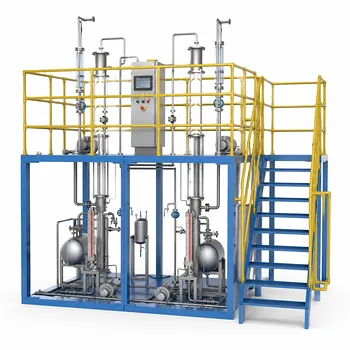
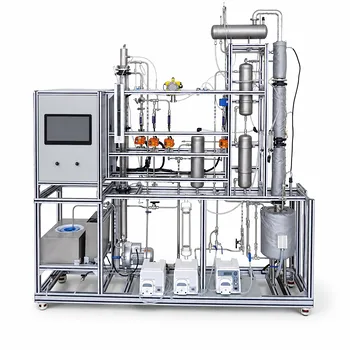
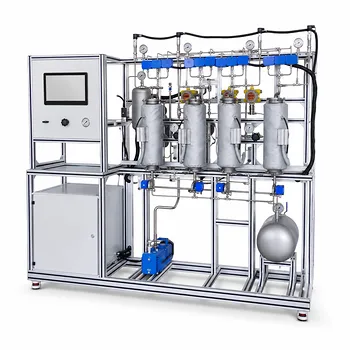
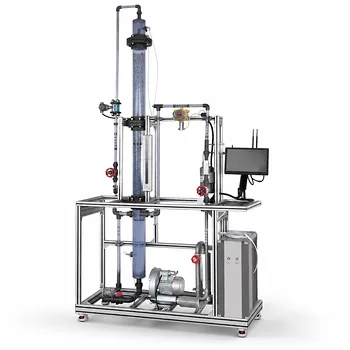
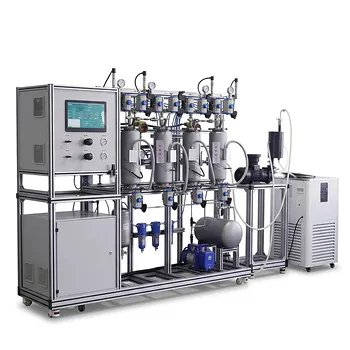
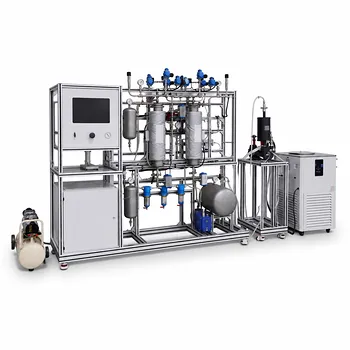
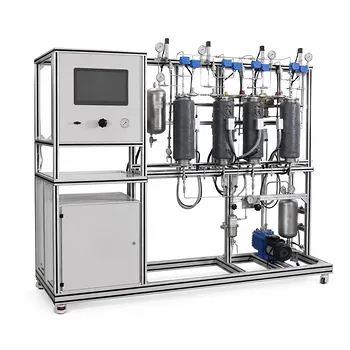
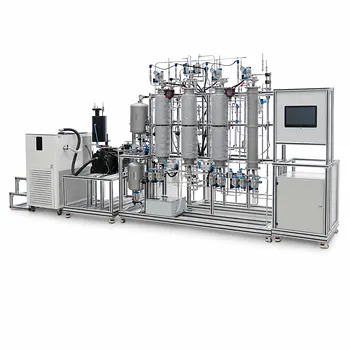
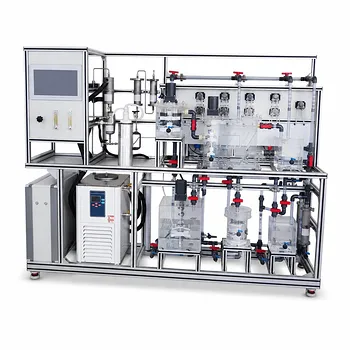
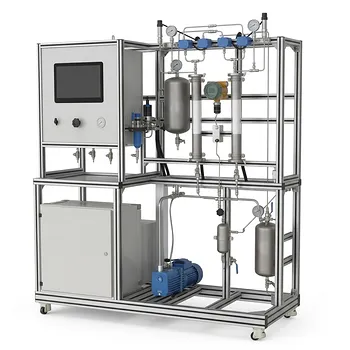
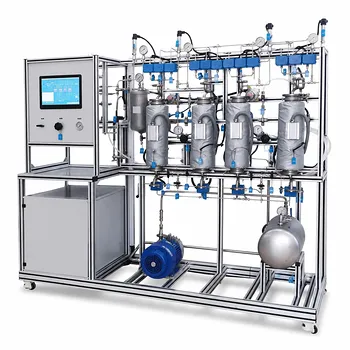
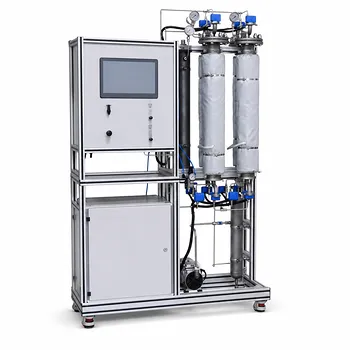
LABPARK provides premium Educational and Vocational Unit Operations Pilot Plants in chemical engineering, bioprocess & biotech, and environmental & water treatment. Specially designed for universities, research institutes, and enterprises, our advanced pilot plants empower you to accurately determine critical parameters like $(L/G)_{\text{min}}$ and transition smoothly from theoretical calculations to real-world industrial applications.
Contact LABPARK today to find the perfect pilot plant solution for your educational or research facility!
Related Products
- Dual-Mode Gas Absorption and Desorption Unit Operations Training Pilot Plant
- Carbon Dioxide Absorption and Desorption Educational Pilot Plant for Carbon Capture Studies
- Carbon Dioxide Adsorption and Capture Educational Unit Operations Pilot Plant
- Absorption and Desorption Educational Unit Operations Pilot Plant
- Packed Bed Absorption Educational Unit Operations Pilot Plant
People Also Ask
- How do two-film & penetration theories apply to gas absorption pilot plant teaching? Key pedagogical insights.
- How does partial pressure behavior influence gas absorption pilot plants? Master Mass Transfer
- How is the direction and driving force of mass transfer determined in a gas absorption unit operations pilot plant?
- What are the limitations of Henry's Law in gas absorption pilot plants? Avoid critical lab errors.
- Why does increasing flow fail to enhance absorption in fast chemical reactions? Pilot Plant Insights