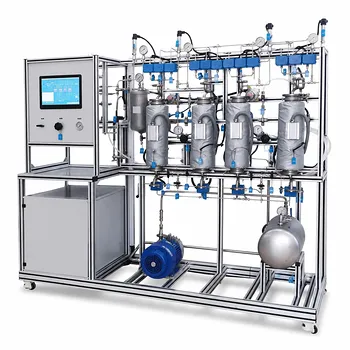
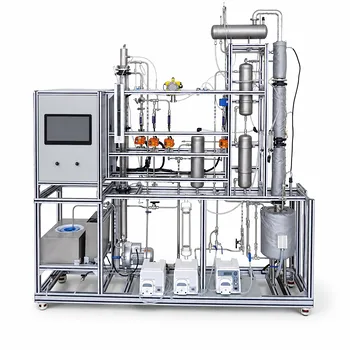
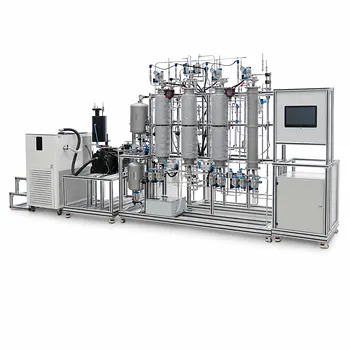
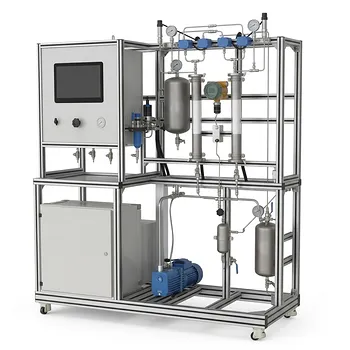
Controlling acid circulation volume and spray density is not a secondary detail—it is the primary lever that determines whether your gas absorption pilot plant delivers usable data or teaches you the harsh lessons of column failure. These parameters directly govern the wetting of the packing, the removal of reaction and dilution heat, the mass transfer area, and the hydrodynamic stability of the column. Getting them wrong—either too low or too high—immediately compromises separation efficiency, safe operation, and the very validity of your experimental results.
The control of acid circulation volume and spray density is critical because it dictates the balance between mass transfer performance and hydrodynamic limits. Too little liquid flow creates dry, inactive packing zones and dangerous temperature spikes that kill the absorption driving force; too much flow wastes energy, increases pressure drop, and risks flooding or liquid entrainment that destroys separation. A pilot plant’s true value is that it lets you find and operate within the narrow optimal window between these two failure modes.
The Hidden Cost of Under‑Circulation
When you starve a packed absorption column of liquid, the problems multiply quickly and silently. The damage is not just a small drop in efficiency—it is often a catastrophic collapse of the process conditions.
Loss of Effective Mass Transfer Area
Packing only works if the liquid spreads evenly across its surface. When the circulation volume is too low, the wetting rate falls below the packing’s minimum threshold. Dry spots form, large portions of the packing become inactive, and the interfacial area for gas-liquid contact shrinks dramatically. In a pilot plant, this manifests as a sudden, misleading decline in the measured mass transfer coefficient—data that would lead to a dangerously undersized industrial column.
Uncontrolled Temperature Rise and Lost Driving Force
The absorption of acid gases like SO₃ is highly exothermic. Insufficient liquid flow fails to carry away the heat of dilution and reaction. Local temperature spikes occur, especially near the gas inlet. Because the vapor pressure of SO₃ above sulfuric acid rises sharply with temperature, these hot spots create a high back-pressure of the very component you are trying to absorb. The absorption driving force collapses, and unabsorbed gas breaks through—even if the bulk liquid concentration looks acceptable on paper.
The Mist‑Formation Hazard in Acid Systems
This temperature effect is particularly insidious in sulfuric acid absorption. When hot acid falls below optimal concentration due to local water evaporation, or when water vapor meets SO₃ in the gas phase above an overheated, poorly wetted zone, stable acid mist forms. These sub‑micron droplets are nearly impossible to capture in a standard packed column and escape with the tail gas, rendering the absorption step useless. Proper circulation volume keeps the liquid film cool and the absorption front controlled.
The Risks of Over‑Circulation and Excessive Spray Density
Turning up the pump is not a free solution. Pushing liquid flow beyond the column’s design limits triggers a different set of performance‑killing problems that are just as severe as under‑wetting.
Flooding and Column Instability
Every packed column has a maximum hydraulic capacity. Excessively high liquid rates increase the hold‑up in the packing void spaces. Beyond a certain spray density, the gas flow can no longer push through the liquid; the column floods. In pilot plant operation, flooding appears as a sudden, massive increase in pressure drop, loss of separation, and violent surging. The experiment becomes worthless, and in a poorly designed pilot unit, you can physically destroy the packing or instrumentation.
Liquid Entrainment and Solvent Loss
Even before full flooding, high liquid rates generate fine droplets at the packing‑gas interface. These droplets are entrained in the up‑flowing gas. If the top disengagement section or a mist eliminator is not perfectly sized, you lose acid into the downstream piping, corrode equipment, and destroy the mass balance of your closed‑loop system. For a pilot plant designed to teach recycling economics, entrainment invalidates the solvent regeneration data.
Wasted Energy and Diminishing Returns
Pumps consume power, and pressure drop rises non‑linearly with liquid load. Operating at a spray density far above the optimum wastes energy without any corresponding gain in mass transfer. The liquid‑side resistance is already minimized; forcing more liquid through the column just adds resistance to gas flow without creating appreciably more surface area. In a teaching or research setting, this masks the true process economics and teaches poor design habits.
The Central Role of the Liquid‑to‑Gas Ratio
Spray density does not exist in a vacuum. Its significance comes from its relationship to the gas flow—the liquid‑to‑gas ratio (L/G) . Pilot plants that allow you to vary circulation volume independently are designed to explore this ratio’s boundaries.
The Thermodynamic Minimum and Process Reality
The column has a theoretical minimum L/G below which separation is impossible regardless of packing height. Actual circulation volumes are typically set 20–100% above this minimum to provide an economic operating window. In a pilot plant, deliberately testing flows below this threshold demonstrates the hard thermodynamic limit: the outlet specification can never be met, no matter how tall the column, because the operating line cannot cross the equilibrium curve. This is a lesson no simulation teaches as vividly as a real column bleeding target gas into the exhaust.
Drift Effects in High‑Concentration Streams
When absorbing a high‑concentration acid gas, the gas‑phase molar flow rate changes significantly along the column. The resulting bulk flow (drift) must be accounted for in the design equations. Spray density and circulation volume directly influence how this drift interacts with the packed height. Pilot plants with intermediate sampling ports let you measure the concentration gradient, validate the drift‑factor correction, and see why assuming constant gas flow—a common textbook simplification—leads to dangerous under‑design.
Understanding the Trade‑offs
Control is about accepting that there is no perfect universal setting. Every adjustment in circulation volume forces a trade‑off between competing objectives, and a pilot plant’s role is to make these trade‑offs visible.
Mass Transfer Efficiency vs. Pressure Drop
Increasing spray density boosts the wetted area and the liquid‑side mass transfer coefficient—up to a point. Beyond the loading point, the gain in absorption rate is outpaced by the rise in pressure drop. You end up spending more on blowers than you save on packing height. The optimal circulation volume is the one that achieves the target outlet concentration with the minimum total annual cost, a balance that pilot plant data can pinpoint.
Heat Removal vs. Pumping Cost
For strong‑acid absorbers, the circulation rate is often set by the heat balance, not the mass transfer alone. You need enough liquid to maintain an acceptable temperature rise across the column. A larger circulation volume keeps the acid cool and the SO₃ vapor pressure low, but it raises electricity costs. In a pilot plant, you can map the exact relationship between flow, temperature profile, and absorption efficiency, giving you the data to challenge a rule‑of‑thumb heat balance.
Operational Safety vs. Process Intensification
In a teaching pilot plant using aggressive chemicals like concentrated acids, safety margins are non‑negotiable. Operating too close to the flooding or dry‑spot boundaries can cause sudden releases or equipment damage. The trade‑off is that running at a conservative, high‑flow setting may mask the column’s true intensification potential. The pilot plant’s instrumentation must be good enough to show you where the limits are so that you can design the industrial column to operate safely closer to them.
Optimizing Your Pilot Plant Operation
Your target dictates where you should position the circulation volume and spray density. Use the pilot plant’s flexibility to test, not to guess.
- If your primary focus is maximizing mass transfer efficiency: Set the spray density to achieve full wetting of the packing and a liquid‑film resistance as low as possible, but verify that the resulting pressure drop and entrainment are still acceptable. Look for the point where the rate of improvement flattens.
- If your primary focus is energy minimization and solvent regeneration: Run at the lowest circulation volume that still ensures the target outlet concentration and safe temperature rise. Calculate the actual L/G ratio and confirm it stays above the thermodynamic minimum; push it close to 1.2 times the minimum only if the column’s hydrodynamics remain stable.
- If your primary focus is safe, stable operation for teaching or screening: Pre‑determine the column’s loading‑point curve from cold‑fluid tests. Operate in the region where the pressure drop is linear with flow, far from flooding, and use the data to educate on the consequences of deviating from that safe window.
Understanding exactly why acid circulation volume and spray density matter transforms a pilot plant from a black‑box demonstration into a precision tool for process design. The column will tell you everything you need to know—provided you control the liquid that flows through it.
Summary Table:
| Circulation Level | Key Physical Consequences | Impact on Experimental Data & Operations |
|---|---|---|
| Under-Circulation (Too Low) | Dry packing zones, exothermic heat spikes, acid mist formation | Collapsed driving force, falsely low mass transfer coefficients |
| Over-Circulation (Too High) | Column flooding, liquid entrainment, increased pressure drop | Wasted pump energy, invalidated solvent recovery and economic data |
Optimize Your Chemical Engineering Lab with LABPARK
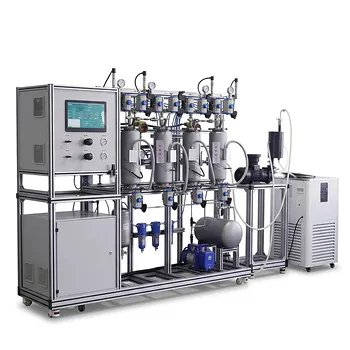
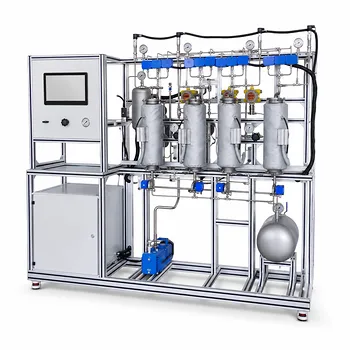
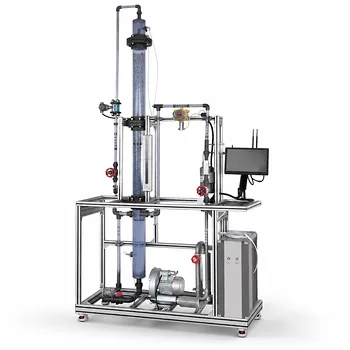
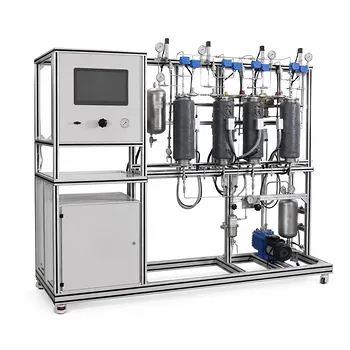
Accurate data in gas absorption depends on precise control systems. LABPARK provides state-of-the-art Educational and Vocational Unit Operations Pilot Plants in chemical engineering, bioprocess & biotech, and environmental & water treatment.
Designed specifically for universities, research institutes, and enterprises, our pilot plants feature advanced instrumentation to help you safely study fluid dynamics, heat transfer, and mass transfer limits without risking column failure.
Ready to elevate your research and training capabilities? Contact us today to request a quote or customize your pilot plant!
Related Products
- Dual-Mode Gas Absorption and Desorption Unit Operations Training Pilot Plant
- Multi-Component Gas Pressure Swing Adsorption Pilot Plant for Unit Operations Education
- Carbon Dioxide Adsorption and Capture Educational Unit Operations Pilot Plant
- Packed Bed Absorption Educational Unit Operations Pilot Plant
- Absorption and Desorption Educational Unit Operations Pilot Plant
People Also Ask
- How do two-film & penetration theories apply to gas absorption pilot plant teaching? Key pedagogical insights.
- How does partial pressure behavior influence gas absorption pilot plants? Master Mass Transfer
- How is the direction and driving force of mass transfer determined in a gas absorption unit operations pilot plant?
- What are the limitations of Henry's Law in gas absorption pilot plants? Avoid critical lab errors.
- Why does increasing flow fail to enhance absorption in fast chemical reactions? Pilot Plant Insights