Accurate thermodynamic prediction is the bedrock of safe and effective pilot-scale separations. For unit operations pilot plants, particularly those involving distillation or high-pressure separators, precisely knowing a mixture’s critical pressure prevents accidental excursions into a supercritical state where the liquid and vapor phases merge, making separation impossible. Simultaneously, the bubble-point density is essential for calculating liquid fugacity, which governs phase equilibrium, and for determining liquid hold-ups, which directly impact column hydraulics and vessel sizing.
The core challenge is that standard equations of state often fail near the saturation envelope and critical region. Relying on generic models without specialized, semi-empirical correlations for critical locus and liquid density leads to catastrophic process design, unsafe operation, and invalid experimental data that cannot be scaled up to production.
Defining the Operating Envelope with Critical Pressure
The critical pressure of a mixture is not a fixed value like that of a pure component; it traces a critical locus as composition changes. In a pilot plant, this locus maps the absolute limit of subcritical, two-phase operation.
Avoiding the Supercritical Collapse of Phase Separation
When a distillation column or high-pressure separator operates above the mixture’s critical pressure, the distinct liquid and vapor phases disappear. Separation processes fundamentally fail because there is no phase boundary to drive mass transfer. Predicting the critical pressure ensures operators stay within the two-phase region where volatility differences can be exploited.
Preventing Equipment Damage and Safety Incidents
Crossing the critical pressure can cause sudden density changes, leading to thermal and mechanical stress. In a pilot plant filled with fragile instrumentation and glassware, an unexpected supercritical transition can result in catastrophic over-pressurization or the failure of seals and gaskets. Accurate prediction is a primary layer of safety.
Determining the Feasible Operating Window
The critical pressure defines the maximum operating pressure for a given mixture temperature. Using methods like the Chueh-Prausnitz correlation or the modified Redlich-Ngo equation of state with quadratic mixing rules allows researchers to map the critical locus at mole fraction intervals. This defines a clear, subcritical envelope for safe experimental campaigns.
The Role of Bubble-Point Density in Liquid Handling and Design
While bubble-point temperature and pressure tell you when boiling starts, the bubble-point density tells you how much liquid mass fills your equipment at that exact thermodynamic state.
Accurate Calculation of Liquid Fugacity
Fugacity coefficients for the liquid phase depend on the liquid’s molar volume—the inverse of density. An error in bubble-point density directly corrupts the fugacity calculation, causing the entire vapor-liquid equilibrium (VLE) model to drift. This means your predicted separation steps, stage counts, and reflux ratios become meaningless.
Proper Vessel Sizing and Hold-Up Estimation
Liquid hold-up in reboilers, condensers, and column trays determines residence time, control-response dynamics, and potential for flooding. Using an inaccurate liquid density at the bubble point leads to undersized or oversized vessels, causing unexpected flooding or dry tray operation that destroys separation efficiency and stops the experiment.
Bridging the Gap Between Theory and Physical Measurement
In educational pilot plants, students measure actual hold-up and compare it to model predictions. A large discrepancy, often caused by using a generic EOS for bubble-point density, highlights the need for specialized empirical liquid density correlations. This directly teaches the limitations of theory and the importance of empirical refinement.
Why Standard Equations of State Fail Near Saturation
The very conditions that make a pilot plant useful—operating near the saturation envelope—are where standard cubic equations of state like Peng-Robinson or Soave-Redlich-Kwong exhibit their greatest weaknesses.
Inability to Capture Complex Molecular Interactions
Standard EOSs are tuned to vapor-phase properties and struggle with the dense, structured liquid phase near saturation, especially for polar or associating mixtures. They cannot accurately capture hydrogen bonding or molecular misfit, which dominate liquid density.
Singularities in the Critical Region
Derivatives of free energy fluctuate wildly near the critical point, making numerical solutions unstable. Semi-empirical mixing rules and correlations like Chueh-Prausnitz bypass these singularities by providing direct, smoothed predictions of the critical locus, while specialized density correlations avoid the fundamentally flawed EOS liquid-root problem.
Understanding the Limitations and Trade-offs
Adopting specialized predictive methods is not a silver bullet. There are intrinsic trade-offs that an objective advisor must acknowledge.
Empirical Correlations Require Validated Data
Correlations like those for liquid density or the Chueh-Prausnitz method are only as good as the experimental data used to regress their parameters. Extrapolating beyond the validated composition or temperature range can yield confident-looking but dangerously wrong predictions.
Added Complexity in Process Simulation
Replacing a built-in EOS density prediction with an external, specialized correlation often requires custom implementation in process simulators. This introduces the risk of user error in coding or inconsistency in thermodynamic frameworks, which can be harder to debug than a standard model’s failure.
False Sense of Security with Black-Box Predictions
When a model gives a single, smooth critical pressure value, it is easy to forget the underlying uncertainty. Researchers must treat the predicted critical locus as a probabilistic boundary, adding a safety margin, rather than an absolute hard limit, to account for mixture impurities or model imperfections.
Making the Right Choice for Your Pilot Plant’s Success
The level of effort you invest in predictive accuracy must align with your specific operational and educational goals.
After weighing the risks of operating near the critical region and the need for precise liquid hold-up data, here is how you should proceed:
- If your primary focus is operational safety and preventing equipment damage: Always use a validated, semi-empirical method like Chueh-Prausnitz to map the critical locus and set a conservative subcritical operating window. Verify with a sensitivity analysis.
- If your primary focus is generating scale-up-quality experimental data: Abandon the default EOS liquid density near the bubble point. Implement a specialized liquid density correlation tuned to your chemical system to ensure your fugacity, hold-up, and column sizing calculations are physically representative.
- If your primary focus is educational demonstration of non-ideality: Run the pilot plant with both a standard EOS prediction and a refined correlation prediction. Forcing students to measure and compare the actual hold-up and separation performance against both models powerfully illustrates why accuracy at the saturation boundary matters.
This deliberate pairing of robust prediction with hands-on measurement transforms a potential safety and design hazard into the most powerful teaching moment a unit operations pilot plant can offer.
Summary Table:
| Parameter | Role in Separation | Risk of Inaccurate Prediction |
|---|---|---|
| Critical Pressure | Defines the subcritical operating envelope & safety limits | Supercritical phase collapse, equipment over-pressurization |
| Bubble-Point Density | Dictates liquid fugacity, column hydraulics & vessel sizing | Incorrect stage counts, column flooding, invalid scale-up data |
Optimize Your Unit Operations with LABPARK
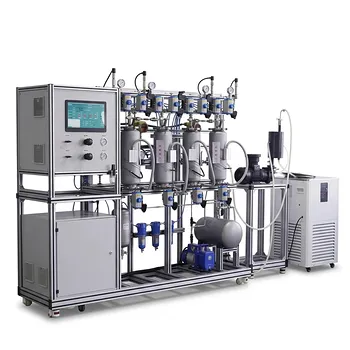
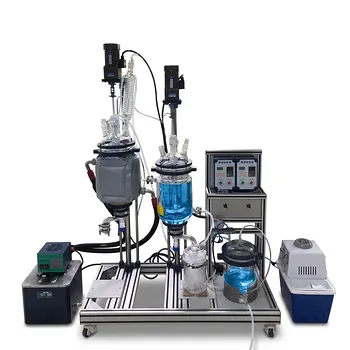
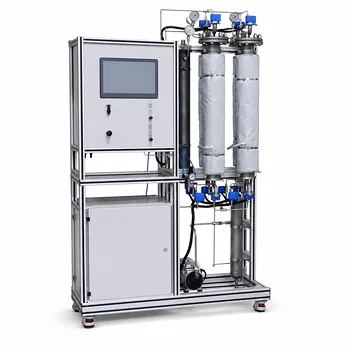
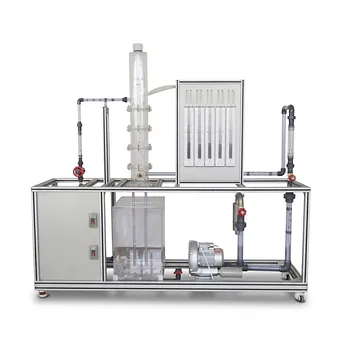
Precise thermodynamic predictions require robust, high-fidelity physical systems to validate them. LABPARK provides premium Educational and Vocational Unit Operations Pilot Plants in chemical engineering, bioprocess & biotech, and environmental & water treatment tailored for universities, research institutes, and enterprises.
Whether you need to demonstrate complex vapor-liquid equilibrium to students or generate scalable process data for industry, our pilot plants ensure maximum safety, precise control, and reliable operation. Ready to upgrade your facility? Contact us today to explore our tailored pilot plant solutions!
Related Products
- Multi-Component Gas Pressure Swing Adsorption Pilot Plant for Unit Operations Education
- Pressure Swing Adsorption Educational Unit Operations Pilot Plant
- Educational Pressure Swing Adsorption Ethylene Capture Unit Operations Pilot Plant
- Bench Scale Dual Column Gas Separation and Capture Educational Pilot Plant
- Potassium Salt Thermal Dissolution and Crystallization Separation Educational Unit Operations Pilot Plant
People Also Ask
- How does Pressure Swing Adsorption (PSA) technology operate? Optimize gas separation with pilot plants.
- How is the direction and driving force of mass transfer determined in a gas absorption unit operations pilot plant?
- How do two-film & penetration theories apply to gas absorption pilot plant teaching? Key pedagogical insights.
- How does partial pressure behavior influence gas absorption pilot plants? Master Mass Transfer
- What are the limitations of Henry's Law in gas absorption pilot plants? Avoid critical lab errors.