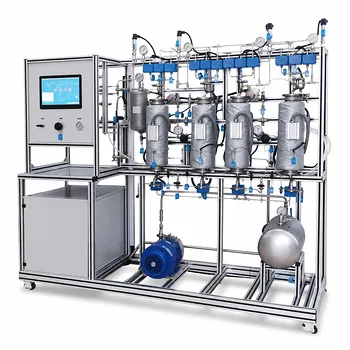
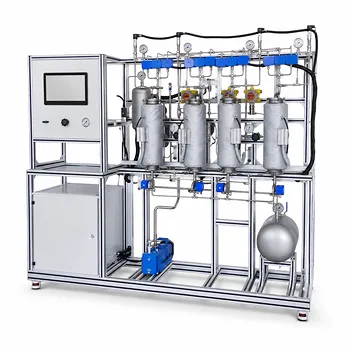
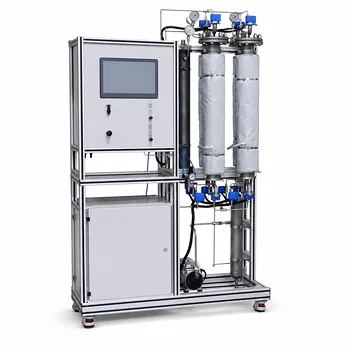
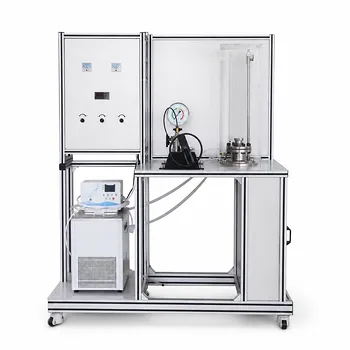
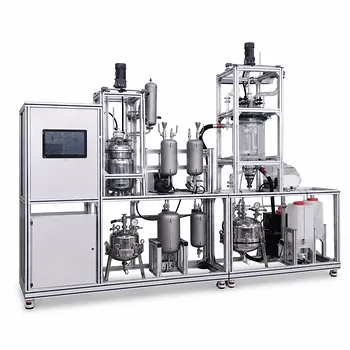
The answer lies in the unique physics of carbon dioxide itself. Supercritical CO2 extraction is profoundly suitable for bioprocess and pharmaceutical pilot plants because it solves a critical trilemma: it operates at a low, biomolecule-friendly temperature, merges high density with high diffusivity for rapid, efficient mass transfer, and is a non-toxic, non-flammable, residue-free solvent. This combination makes it the definitive platform for safely processing sensitive, high-value compounds while teaching essential green chemistry and process scale-up principles.
Bioprocess and pharmaceutical development demands a solvent that is gentle on the product, fast in its work, and leaves no trace behind. Supercritical CO2 uniquely fulfills all three of these conditions, making it not just an alternative to organic solvents, but a transformative unit operation for any modern pilot plant focused on sustainability and product purity.
The Physics of Preservation: Why Temperature Matters
The primary value of a pilot plant is to bridge the gap between lab-scale discovery and industrial production. For bioprocesses, this bridge often collapses when a product is destroyed by heat. Supercritical CO2 eliminates this risk at its source.
A Critical Point Designed for Biology
The critical point of CO2 is remarkably accessible, sitting at a moderate temperature of approximately 31.1°C and a pressure of 7.38 MPa. This is not a random thermodynamic coincidence; it is an operational sweet spot. Because the process can run just above room temperature, it biologically compatible for even the most fragile molecules.
Protecting the “Untouchable” Compounds
Pharmaceutical actives, antibiotics, and delicate essential oils are prone to oxidation or thermal degradation. In a standard distillation unit, exposing these compounds to high heat destroys their efficacy. Supercritical CO2 extraction keeps the entire extraction environment cool, preserving the stereochemistry and bioactivity of the target compound. You extract the molecule exactly as nature created it.
The Speed of Gas, the Power of a Liquid: Mass Transfer Dynamics
A gentle extraction method is useless if it takes days to complete. The efficiency of supercritical CO2 lies in its dual physical character, which fundamentally intensifies the extraction rate.
The Solvent Trilemma
Traditional process chemistry faces a problem: liquid solvents have high density (good for solvation) but low diffusivity (slow penetration), while steam has high diffusivity but low density. Supercritical CO2 abolishes this compromise. It acts as a master key for mass transfer.
Diffusivity and Density in Perfect Balance
In its supercritical state, CO2 possesses a liquid-like density that provides high solvent power, yet simultaneously retains a gas-like viscosity and high diffusivity. This means the solvent penetrates the solid biological matrix rapidly, dissolves the target solute effectively, and transports it out of the matrix with minimal resistance. The result is faster extraction cycles and higher yields compared to sluggish traditional liquid-solid extraction methods.
The Closed-Loop Future: Safety, Sustainability, and Zero Residue
A pilot plant is a training ground for future engineers. Using organic solvents like dichloromethane in this environment introduces carcinogenic, toxic, and flammable risks. Supercritical CO2 redefines the safety baseline.
Eliminating Toxic Legacies
Chlorinated solvents leave trace residues that require complex analytical chemistry to validate removal. In contrast, CO2 is a "self-cleaning" solvent. By simply depressurizing the separator, the CO2 gasifies and completely disengages from the extract, leaving a pristine product with zero toxic solvent residues. For pharmaceutical applications, this is a regulatory game-changer.
Operational Safety in a Training Environment
From an educational standpoint, CO2 is inherently safe. It is non-flammable, non-explosive, and chemically inert. This intrinsic safety profile allows students to operate heavy industrial equipment without the imminent danger of fires or toxic spills. It also demonstrates a closed-loop recycling system where gaseous CO2 is condensed and pumped back, eliminating volatile organic compound (VOC) emissions and the need for expensive solvent disposal.
Understanding the Trade-offs of Supercritical CO2
While supercritical CO2 is a superior solvent for many bioprocess applications, objective evaluation demands that we recognize its limitations. It is not a universal replacement for all solvent systems.
The High-Pressure Barrier to Entry
The most significant trade-off is capital cost. Operating at 7.38 MPa and above requires robust, high-pressure-rated vessels, pumps, and piping. The initial investment for a pilot-scale unit is substantially higher than a simple glass-lined stirred tank. This becomes a strategic choice: pay for the equipment upfront, or pay continuously for solvent disposal, safety mitigation, and thermal degradation.
The Polarity Limitation
CO2 is a linear, non-polar molecule. In its pure form, it is an excellent solvent for lipids, waxes, and non-polar compounds but a poor solvent for polar molecules. Extracting highly polar alkaloids or glycosides requires the metered addition of a co-solvent (like ethanol). This adds complexity to the phase equilibrium and separation stages downstream.
Energy and Compressor Logistics
While the solvent is green, the process loop requires energy to compress and thermally cycle the CO2. The efficiency of the condenser and pump directly dictates the overall lifecycle energy footprint. A poorly designed pilot plant can suffer from CO2 leaks and compressor downtime, negating some of the environmental benefits.
Making the Right Choice for Your Pilot Plant
Your decision to implement supercritical CO2 extraction should be dictated by the specific values and goals of your bioprocess program.
- If your primary focus is product purity and regulatory compliance: Supercritical CO2 is the non-negotiable standard. The physical guarantee of a residue-free end product eliminates the risk of regulatory rejection.
- If your primary focus is processing heat-sensitive antibiotics or biologics: You need scCO2 immediately. Low-temperature operation prevents thermal degradation, ensuring you are extracting active compounds, not destroying them.
- If your primary focus is demonstrating green engineering and sustainability metrics: scCO2 is unmatched. The closed-loop, zero-VOC process transforms your pilot plant into a benchmark model for the circular economy and process intensification.
- If your primary focus is educational safety and minimizing liability: Replace organic solvents with CO2. The non-toxic, non-flammable nature of CO2 creates the safest possible training environment for hands-on unit operations learning.
By adopting supercritical CO2, you are not just buying an extractor; you are integrating a versatile platform that bridges the gap between fundamental thermodynamics and industrial pharmaceutical reality.
Summary Table:
| Key Feature | Supercritical CO2 Advantage | Practical Benefit for Pilot Plants |
|---|---|---|
| Operating Temperature | Low critical temperature (~31.1°C) | Prevents thermal degradation of sensitive bio-compounds |
| Mass Transfer Dynamics | Liquid-like density & gas-like diffusivity | Faster extraction cycles and higher product yields |
| Safety & Purity | Non-toxic, non-flammable, self-cleaning | Safest training environment with zero chemical residue |
| Sustainability | Closed-loop gas recycling system | Minimizes VOC emissions and solvent disposal costs |
Elevate Your Research and Training with LABPARK
At LABPARK, we help universities, research institutes, and enterprises bridge the gap between laboratory scale and industrial reality. We design and deliver high-performance Educational and Vocational Unit Operations Pilot Plants specializing in chemical engineering, bioprocess & biotech, and environmental & water treatment.
Our advanced pilot plants—engineered for safety, reliability, and precision—provide students and researchers with hands-on experience in green technologies like supercritical extraction.
Ready to upgrade your department's capabilities? Contact our expert team today to discuss your customized pilot plant solution!
Related Products
- Carbon Dioxide Capture and Utilization Educational Pilot Plant for Unit Operations
- Bench Scale Carbon Dioxide Capture Educational Unit Operations Pilot Plant
- Carbon Dioxide Absorption and Desorption Educational Pilot Plant for Carbon Capture Studies
- Carbon Dioxide Adsorption and Capture Educational Unit Operations Pilot Plant
- Supercritical High-Gravity Flash Evaporation Educational Unit Operations Pilot Plant
People Also Ask
- What are the differences between post- and pre-combustion carbon capture training pilot plants?
- How can pilot plants show tail gas vs flue gas CO2 capture differences? Key educational insights.
- What unit operations are critical for CCUS training pilot plants? Build hands-on engineering expertise.
- How do temperature variations affect CO2 transport models in pilot plants? Model vs Reality
- How does operating pressure influence the transition between absorption and desorption in a CO2 pilot plant?