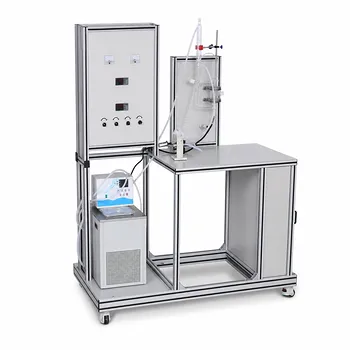
The bottom line is simple: for non-ideal mixtures, software alone is a map that often lies. Physical validation in a unit operations laboratory gives you the real terrain. Without it, you risk scaling up a process based on solubility curves or boiling points that simply do not exist in the real world.
Non-ideal binary mixtures like water-acetone defy easy prediction because their interactions create peaks, azeotropes, and phase splits that thermodynamic models regularly misplace. Physical pilot plant experiments are the only reliable way to capture the true phase behavior, preventing catastrophic failures in extraction, crystallization, and distillation design.
The Unpredictable Nature of Non-Ideal Mixtures
When Molecule Interactions Defy Simple Models
Ideal solutions behave like perfect dance partners—predictable and linear. Non-ideal mixtures do not. In systems like water-acetone, strong hydrogen bonding and polarity changes cause solubility and vapor pressure to swing wildly with composition.
A solute can peak in solubility at a 70% acetone fraction, a point no simple theory can pinpoint. Thermodynamic calculations capture the qualitative trend but routinely shift the peak or overstate the magnitude. You get a false sense of security from a plot that looks right but is dangerously wrong.
Why Software Calculations Hit a Wall
Simulation tools rely on activity coefficient models (like NRTL or UNIQUAC) fitted to limited data. Those models are built on idealized assumptions—perfect mixing, no local composition gradients, and steady-state conditions.
Real pilot plants reveal where those assumptions break. Temperature fluctuations, imperfect agitation, and trace impurities all alter phase equilibria. A physical distillation run exposes whether your simulation’s predicted relative volatility actually holds when heat transfer and fluid dynamics enter the picture.
From Academic Curiosity to Process-Design Imperative
Detecting the Hidden Azeotropes and Phase Splits
Water-acetone is miscible in all proportions at room temperature, but add a solute or change the temperature, and you may suddenly face a two-phase liquid region. Software frequently misses these splits or misplaces the binodal curve.
Running a physical extraction or crystallization in a unit ops lab lets you visually confirm single-phase versus two-phase mixtures. This direct observation is critical for designing a purification sequence. A missed phase split at scale can lead to emulsion layers, rag layers, and equipment fouling that bring the entire downstream process to a halt.
Avoiding the Chain Reaction of Operational Failures
A solubility curve that is off by 10% does more than hurt yield on paper. It can crystallize product inside a transfer line, plug a heat exchanger, or cause a packed column to flood. These failures are not theoretical—they are costly, time-consuming, and often dangerous.
Physical pilot testing provides the empirical data to size columns, specify heat loads, and set operating windows. When you observe actual vapor-liquid equilibria under your process conditions, you know the exact temperature limit before an azeotrope pinches, or before a monomer begins to polymerize prematurely.
Understanding the Trade-offs of Physical Validation
The Investment Required
Pilot plant work demands equipment, time, and material. It is far easier to run a simulation overnight than to schedule a distillation column. The trade-off is speed versus certainty.
However, for a non-ideal system with a safety, yield, or purity risk, the upfront cost is dwarfed by the expense of failed scale-up. The key is to use physical validation as a targeted tool—not to replace every simulation, but to verify the critical separation steps where models show the highest sensitivity.
Scaling Lab Data to the Plant Floor
Pilot-scale data are not perfect either. Fluid dynamics and heat transfer patterns change with scale. The value lies in isolating the thermodynamic truth—the phase behavior.
Once you have validated the actual azeotrope composition or the genuine solubility peak, you can anchor your models there. This hybrid approach gives you the best of both worlds: thermodynamic fidelity from the lab, and the predictive power of scaled-up simulations for equipment sizing.
Making the Right Choice for Your Process Goal
Your next move depends on what you are trying to achieve. The rule of thumb is: the more non-ideal the mixture, the less you can trust an unvalidated model.
- If your primary focus is fast, safe scale-up of a production process: Validate the solubility peak and azeotrope experimentally before finalizing equipment specifications. That single run can prevent a million-dollar mistake.
- If your primary focus is creating a robust extraction or crystallization protocol: Use a pilot plant to map the actual phase envelope under your exact temperature and mixing conditions. This data will protect you from yield loss and fouling.
- If your primary focus is teaching or demonstrating non-ideal behavior: A unit ops experiment turns an abstract model into a visceral memory. Seeing a column fail to split due to an unpredicted azeotrope teaches more than any textbook curve.
In the end, a pilot plant is your truth detector. For a non-ideal pair like water-acetone, that piece of empirical reality is not a luxury—it is the foundation of a process you can trust.
Summary Table:
| Feature / Aspect | Software Simulations (NRTL/UNIQUAC) | Physical Validation (Pilot Plants) |
|---|---|---|
| Data Accuracy | Theoretical approximation; risks shifting peaks/azeotropes | Captures real phase behavior, solubility peaks & anomalies |
| Risk of Failure | High; misses local gradients, impurities, and phase splits | Low; visually confirms binodal curves & phase splits |
| Operational Insight | Limited to ideal fluid dynamic assumptions | Exposes fouling, column flooding, and heat transfer limits |
| Value for Scale-Up | Generates quick maps (may contain errors) | Anchors simulation models with verified empirical baselines |
Bridge the Gap Between Simulation and Reality with LABPARK
Don't let theoretical thermodynamic models compromise your process design or curriculum. LABPARK provides state-of-the-art Educational and Vocational Unit Operations Pilot Plants in chemical engineering, bioprocess & biotech, and environmental & water treatment.
We help universities, research institutes, and enterprises achieve absolute process certainty through hands-on validation:
- For Academics & Researchers: Turn abstract thermodynamic equations into visual, measurable realities for students and research teams.
- For Industry Enterprises: Validate complex separations like water-acetone mixtures at pilot scale to eliminate million-dollar scale-up mistakes.
Ready to elevate your laboratory capabilities? Contact LABPARK today to discuss your pilot plant requirements!
Related Products
- Binary System Vapor Liquid Equilibrium Data Determination Educational Unit Operations Pilot Plant
- Multi-Functional Membrane Separation Educational Pilot Plant for Unit Operations Lab
- Multi-Modal Distillation Unit Operations Training Pilot Plant
- Quantitative Dosing and Liquid Flow Control Educational Unit Operations Pilot Plant
- Dual-Mode Rectification Pilot Plant for Practical Training Unit Operations
People Also Ask
- How can pilot plants assist in validating VLE models? Bridge theory and physical reality.
- Why Collect Isothermal vs. Isobaric VLE Data? Key Pilot Unit Advantages
- How Do Equations of State Predict VLE in Pilot Plants? Optimize Your Separation Design
- How do intermolecular forces and molecular kinetic energy govern gas liquefaction and vaporization? Explore VLE pilot plants
- For VLE Experiments: Fugacity vs. Activity Coefficient Method Selection Criteria