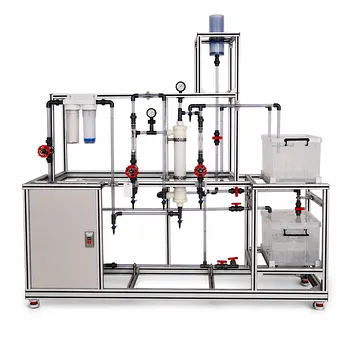
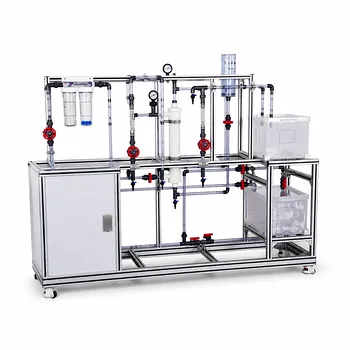
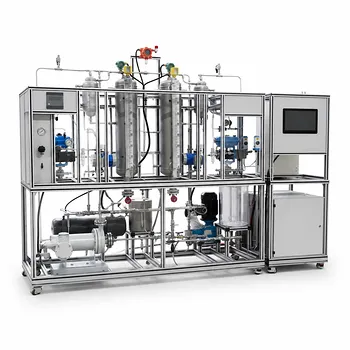
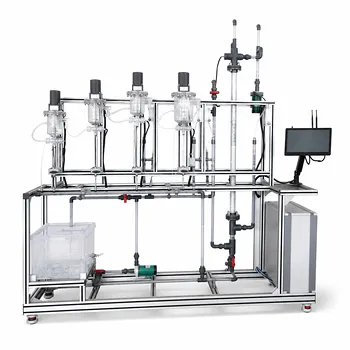
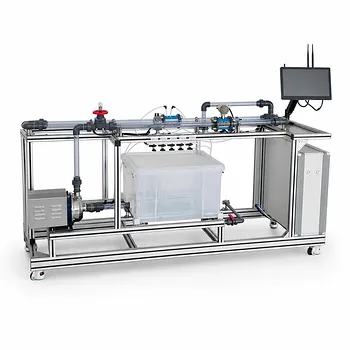
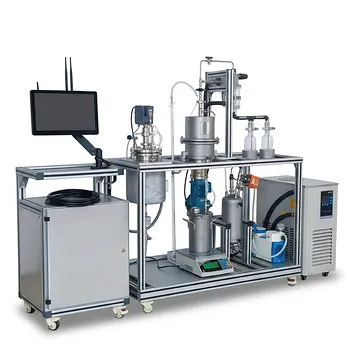
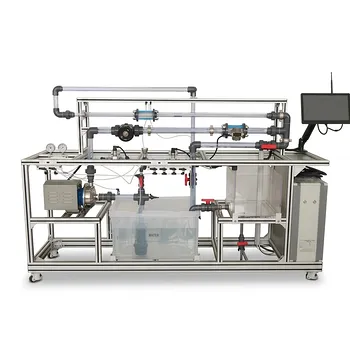
If you’re teaching membrane fouling control, crossflow filtration isn’t just a helpful option—it’s the tool that turns an abstract problem into a visible, teachable principle.
In a water treatment pilot plant, crossflow filtration is preferred because it inherently demonstrates how fouling can be controlled, not just that it happens. By directing the feed stream tangentially across the membrane surface, the system continuously sweeps retained particles away, maintaining a stable flux and letting students directly observe the engineering strategy that underpins most industrial membrane processes. Dead‑end mode, by contrast, quickly buries the learning opportunity under an uncontrollable cake layer.
A pilot plant running crossflow transforms the lesson from “fouling is inevitable” to “fouling is a manageable variable.” The shear forces generated by tangential flow provide a live demonstration of hydrodynamic foulant removal, turning a batch problem into a continuous, scalable teaching moment.
The Flaw in Dead‑End Filtration as a Teaching Tool
The Cake Builds, and the Lesson Ends
In dead‑end filtration, the entire feed flows perpendicularly through the membrane.
Particles accumulate rapidly, forming an ever‑thickening filter cake that drives up hydraulic resistance.
Under a constant driving pressure, the flux plummets—often within minutes—masking intrinsic membrane performance and cutting short any meaningful investigation of fouling dynamics.
A Batch Mindset for a Continuous Problem
Dead‑end operation is inherently a batch process: once the cake reaches a critical thickness, you must stop to clean or replace the membrane.
Water treatment plants, however, are designed for continuous, high‑throughput operation.
Teaching with dead‑end alone risks imprinting a stop‑start mentality that doesn’t prepare students for the demands of real‑world scale‑up.
How Crossflow Filtration Unlocks Fouling Control Education
Tangential Flow Creates a “Self‑Cleaning” Demonstration
In crossflow, the feed solution recirculates at high velocity parallel to the membrane surface.
The shear stress generated by this tangential motion actively scours accumulated solids from the membrane wall.
Instead of a static cake that simply grows, students see a dynamic equilibrium where fouling is continuously suppressed, keeping flux higher and far more stable over time.
Concentration Polarization Becomes Observable
Beyond particle accumulation, crossflow makes a subtler phenomenon tangible: concentration polarization.
When rejected solutes build up near the membrane, flux becomes limited by back‑diffusion—a concept students can manipulate by changing crossflow velocity.
This links fluid dynamics directly to membrane performance, turning an equation on a slide into a live, adjustable variable.
Recirculation Loops Simulate Real Industrial Scenarios
Most pilot‑scale crossflow systems use a feed‑and‑bleed recirculation loop, where concentrated retentate returns to the feed tank.
This allows progressive concentration of the feed stream, mimicking processes like membrane bioreactor biomass thickening or RO brine management.
Students learn to balance recovery rate, pumping cost, and fouling propensity—a genuine design trade‑off they will face at full scale.
Beyond Theory: Why Crossflow Prepares Students for Scale‑Up
Direct Translation to Industrial Systems
A crossflow pilot plant operates on the same fundamental principles as a full‑scale MBR or spiral‑wound RO installation.
The relationships they observe between crossflow velocity, transmembrane pressure, and stable flux transfer directly to process design and troubleshooting.
Teaching in crossflow means every hour of pilot time is an hour of real‑world engineering insight.
Extended Run Times Enable Long‑Term Fouling Studies
Because crossflow prevents rapid, catastrophic cake buildup, pilot runs can stretch for hours or even days without an acute collapse in performance.
This allows students to witness gradual fouling mechanisms—pore narrowing, biofilm development, scaling—and to test cleaning strategies mid‑campaign.
Such long‑duration experiments are impossible with dead‑end, yet they mirror how industrial plants monitor and manage membrane health.
Understanding the Trade‑offs of Crossflow in a Teaching Environment
Energy Consumption is Higher
Maintaining high crossflow velocities demands a significant recirculation pump, adding energy cost.
In a pilot plant, this isn’t a flaw; it’s a valuable lesson that fouling control is an optimization problem, not a free solution, forcing a discussion on the true cost of clean water.
Complexity Can Mask Fundamentals
A crossflow rig introduces flow meters, pressure transducers, back‑pressure valves, and recirculation loops.
Without careful framing, students can get lost in the plumbing before grasping the core fouling mechanism.
The most effective curricula first let students watch a rapid cake form in dead‑end mode, then immediately contrast that with the stabilizing effect of crossflow.
Not All Fouling Disappears
Crossflow drastically reduces cake accumulation, but it does not eliminate all fouling.
Slow pore blocking or adhesive biofilms can still develop over time, and flux will gradually decline.
This reality sets the stage for teaching cleaning‑in‑place (CIP) protocols and helps students understand that industrial membrane operation is about managing fouling, not eradicating it.
Making the Right Choice for Your Pilot Plant Curriculum
The ultimate goal in a water treatment pilot plant is not to prove that fouling exists—it’s to equip future engineers with the instincts to outsmart it. Use crossflow as the centerpiece of that education.
- If your primary focus is demonstrating the core mechanism of fouling: Start with a dead‑end experiment to instantly visualize cake formation, then immediately switch to crossflow to illustrate how shear forces solve that very problem.
- If your primary focus is training operators for industrial water plants: Run long‑duration crossflow trials while varying crossflow velocity, recovery rate, and backflush cycles. Let students feel the cause‑and‑effect relationship between operating parameters and membrane lifetime.
- If your primary focus is maximizing pilot plant availability: Crossflow’s reduced cleaning frequency keeps the unit online for more student groups, converting the pilot plant from a maintenance headache into a high‑throughput teaching asset.
By anchoring your curriculum in crossflow filtration, you move beyond simply witnessing fouling and instead deliver a masterclass in scalable, sustainable water treatment design.
Summary Table:
| Feature | Dead-End Filtration | Crossflow Filtration |
|---|---|---|
| Flow Direction | Perpendicular to membrane | Tangential (parallel) to membrane |
| Fouling Behavior | Rapid cake buildup; blocks view | Dynamic equilibrium; fouling is managed |
| Process Mode | Batch (requires frequent stops) | Continuous (simulates real-world scale) |
| Teaching Value | Shows that fouling happens | Demonstrates how fouling is controlled |
| Run Duration | Short (minutes) | Extended (hours to days) |
Bring Industrial Reality to Your Lab with LABPARK
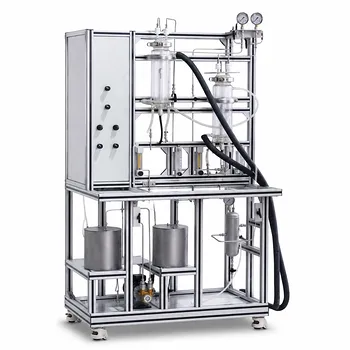
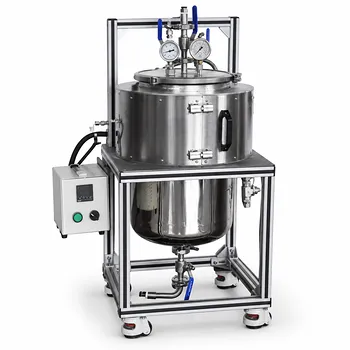
Are you looking to enhance your curriculum with hands-on membrane filtration systems? LABPARK provides advanced Educational and Vocational Unit Operations Pilot Plants in chemical engineering, bioprocess & biotech, and environmental & water treatment. Designed specifically for universities, research institutes, and enterprises, our pilot plants enable students to master real-world challenges like membrane fouling control, process optimization, and system scale-up.
Empower your students and researchers with the tools they need for engineering success. Contact LABPARK today to discover our custom pilot plant solutions!
Related Products
- Ultrafiltration Membrane Separation Educational Pilot Plant
- Multifunctional Membrane Separation Educational Pilot Plant with Ultrafiltration, Nanofiltration, Reverse Osmosis
- Hollow Fiber Ultrafiltration Membrane Separation Educational Pilot Plant
- Multi-Functional Membrane Separation Educational Pilot Plant for Unit Operations Lab
- Multi Functional Membrane Crystallization Educational Unit Operations Pilot Plant
People Also Ask
- Pervaporation vs. Vapor Permeation: Handling Suspended Solids in Membrane Pilot Plants
- How do PEI, PVDF, and PSU membranes compare in pilot plants? Find the best fit.
- How do membrane pilot plants demonstrate synthetic vs biological membrane advantages?
- Why Use a Membrane Separation Pilot Plant vs. Lab Testing? Avoid Costly Scale-Up Failures
- Isotropic vs. Anisotropic Membranes: How to Choose the Best Pilot Plant Modules