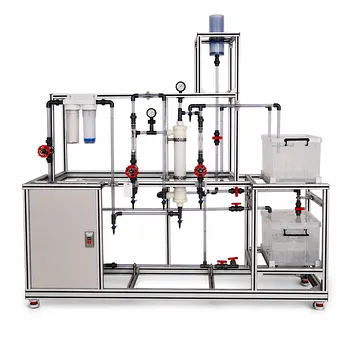
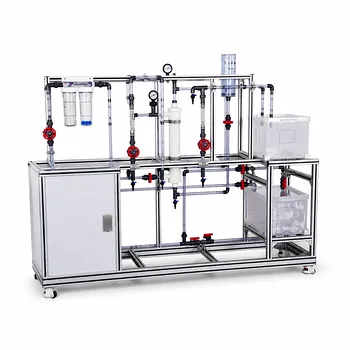
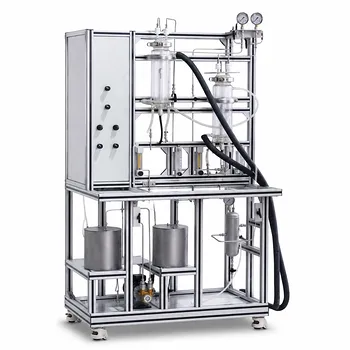
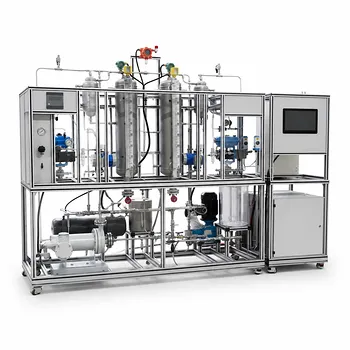
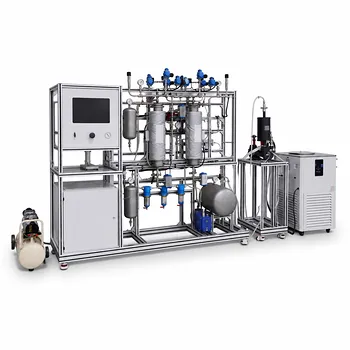
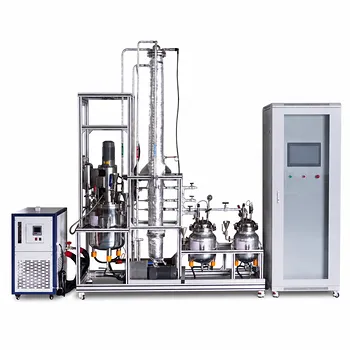
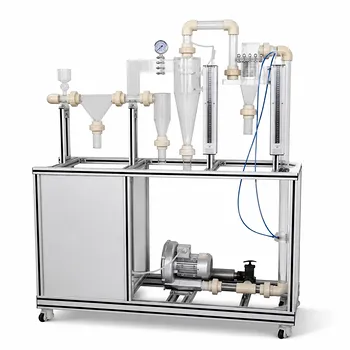
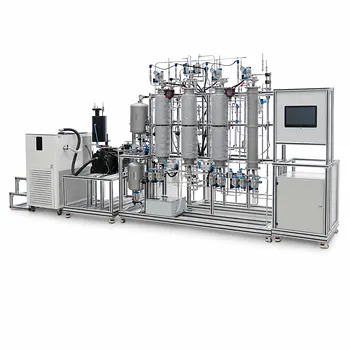
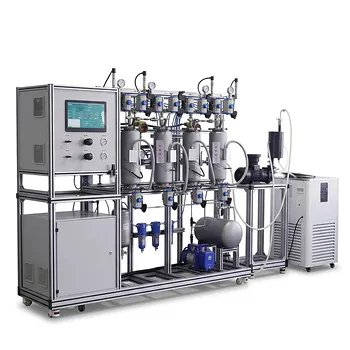
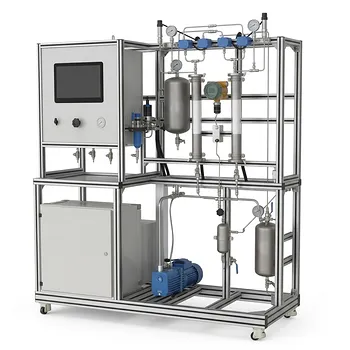
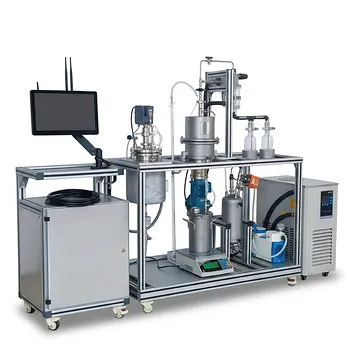
Bench-scale laboratory tests cannot replicate the complex, real-world feed streams, long-term degradation mechanisms, and dynamic process conditions that define commercial gas-separation performance. A single-component gas test on a flat‑sheet coupon can overstate membrane selectivity by a factor of 2 to 10, while trace lubricants, corrosion inhibitors, and unknown contaminants in an actual process stream can quietly foul or plasticize the membrane over weeks and months. A dedicated pilot plant exposes the full membrane module to representative mixed‑gas feeds for extended runs—typically one to six months—making it the only reliable way to project lifetime, efficiency, and total cost of ownership before scaling up.
Bench-scale testing screens materials, but only a pilot plant can validate a commercial process. Real feed complexity, long‑term creep and chemical attack, competitive sorption, and the interplay of pressure ratio with selectivity all remain invisible on the lab bench, making the pilot plant the essential bridge to a bankable industrial design.
The Limitations of Bench-Scale Testing
Unrealistic Feed Composition
Lab tests often use pure gases or simplified binary mixtures. In a real olefin/paraffin splitter or refinery purge stream, the gas carries trace lubricants, corrosion inhibitors, and uncharacterized heavy components that never appear in a cylinder. These trace species can permanently alter the membrane’s separation layer, reducing flux or selectivity in ways no short, clean test will reveal.
The Mixed‑Gas Selectivity Gap
Pure‑gas permeabilities are a poor predictor of actual performance. In competitive sorption, faster‑permeating gases swell the polymer, making it easier for slower gases to pass—a phenomenon called plasticization. Research shows that actual mixed‑gas selectivity can be overestimated by a factor of 2 to 10 when inferred from pure‑gas data. Bench‑scale measurements that ignore this gap cannot support a reliable commercial design.
Inability to Capture Long‑Term Aging
Commercial membranes must survive 3–5 years of continuous operation. The effects that dominate lifetime—membrane creep under pressure, physical aging of the glassy polymer, slow chemical degradation by reactive trace gases, and the gradual accumulation of non‑volatile foulants—operate on time scales of months, not hours. A one‑day lab experiment simply cannot detect a failure mode that takes 90 days to appear.
What a Dedicated Pilot Plant Provides
Authentic, Long‑Duration Exposure
A pilot plant runs continuously with the actual plant feed or a very close surrogate. Over one to six months, operators can observe the evolution of flux decline curves, selectivity drift, and physical changes in the module. This data is the foundation for a realistic membrane lifetime warranty and a defensible economic model.
Inline Mixed‑Gas Analytics
Unlike a static lab rig, a pilot plant is equipped with inline gas chromatographs, mass flow meters, and dew‑point sensors. It measures stage‑cut, recovery, and product purity simultaneously with the mixed‑gas feed that the commercial plant will see. This gives the true selectivity—the number that decides whether a propylene/propane membrane meets the threshold of 5 to 10 required for a hybrid distillation system.
Module‑Scale and Process Integration
From the start, the pilot plant tests the actual membrane form—hollow‑fiber bundles or spiral‑wound elements—with their real sealing materials, tubesheet adhesives, and pressure housings. It exposes those materials to the process gas and cyclic temperature/pressure changes. It also forces the team to think about flow configuration, pressure drop across the module, startup/shutdown sequences, and safety interlocks, all of which are invisible when only a flat‑film coupon sits in a cell.
Multi‑Stage Configuration and Recycle Loops
Single‑stage tests often face an unavoidable trade‑off between product purity and recovery. For example, a one‑stage membrane for CO₂ removal might lose too much methane. A two‑stage pilot plant with recycle can reduce methane loss to around 2.6% while holding product pressure. Only a pilot plant gives engineers the freedom to experiment with inter‑stage compression, recycle ratios, and the mass‑balance optimizations that turn a promising lab material into a commercially viable process.
Understanding the Pressure‑Ratio Limit
A critical, often overlooked, concept is that membrane enrichment is constrained by both selectivity and the feed‑to‑permeate pressure ratio. When the pressure ratio is low relative to selectivity, the system enters a pressure‑ratio‑limited regime where increasing selectivity beyond about 40 gives no additional enrichment. A pilot plant makes this behavior tangible: it lets researchers dial in different pressure ratios, measure the resulting permeate composition, and avoid the expensive mistake of over‑specifying a membrane whose high selectivity never translates into plant performance.
Understanding the Trade‑offs
Pilot plants are not without cost and commitment. They require a representative feed or a dedicated slip‑stream, skilled operators, and a budget for custom‑built skids with full instrumentation. A meaningful run often takes three to six months, delaying the final design freeze. However, skipping this step transfers the risk to the commercial unit, where a fouling or plasticization discovery can lead to a multi‑million‑dollar failure. Bench‑scale tests are therefore a necessary filter for materials, but never a substitute for the integrated, time‑bound reality check that only a pilot plant can deliver.
Making the Right Choice for Your Goal
What you choose to build and operate depends entirely on what you are trying to validate.
- If your primary focus is screening new polymer formulations: Start with pure‑gas permeability and simple selectivity measurements in a lab cell. This is fast, cheap, and useful for ranking materials.
- If your primary focus is generating reliable membrane lifetime and performance data for a commercial project: Invest in a dedicated pilot plant that runs the real mixed‑gas feed for at least one to six months. This is the only way to capture creep, plasticization, and trace‑contaminant effects.
- If your primary focus is optimizing a process flowsheet with recycle loops and multi‑stage cuts: A pilot plant with flexible valving and inline analytics is essential. Lab‑scale flat‑sheet tests cannot replicate the pressure drops, concentration polarisation, and stage‑wise mass balances of a full module cascade.
- If your primary focus is evaluating the total cost‑to‑performance ratio against competing technologies: Use pilot‑plant data on flux decline and replacement intervals to anchor your techno‑economic model. Bench‑scale numbers will almost always be overly optimistic and lead to wrong investment decisions.
A pilot plant is not a luxury; it is the most honest translator between a membrane scientist’s discovery and an engineer’s balance sheet.
Summary Table:
| Evaluation Metric | Lab Bench-Scale Testing | Dedicated Pilot Plant Testing |
|---|---|---|
| Feed Stream Composition | Pure gases or simple binary mixtures | Real, contaminant-heavy industrial feeds |
| Selectivity Accuracy | Overestimated by 2x to 10x | Real mixed-gas selectivity & competitive sorption |
| Test Duration & Aging | Hours to days (ignores creep/fouling) | 1 to 6 months (captures long-term degradation) |
| Module Form & Scale | Flat-sheet coupons | Full hollow-fiber/spiral-wound modules |
| System Configuration | Single-stage, no recycle loops | Multi-stage with recycle and pressure ratios |
Bridge the Gap from Lab to Industrial Scale-Up with LABPARK
Don't risk costly scale-up failures with over-optimistic bench-scale data. LABPARK provides state-of-the-art Educational and Vocational Unit Operations Pilot Plants in chemical engineering, bioprocess & biotech, and environmental & water treatment for universities, research institutes, and enterprises.
Our custom-engineered pilot systems empower you to accurately validate processes, study long-term membrane degradation, and train operators under realistic industrial conditions.
Contact LABPARK today to find the perfect pilot plant solution for your lab or facility!
Related Products
- Multifunctional Membrane Separation Educational Pilot Plant with Ultrafiltration, Nanofiltration, Reverse Osmosis
- Ultrafiltration Membrane Separation Educational Pilot Plant
- Multi-Functional Membrane Separation Educational Pilot Plant for Unit Operations Lab
- Hollow Fiber Ultrafiltration Membrane Separation Educational Pilot Plant
- Photocatalytic Membrane Separation and Degradation Unit Operations Pilot Plant
People Also Ask
- How do PEI, PVDF, and PSU membranes compare in pilot plants? Find the best fit.
- Pervaporation vs. Vapor Permeation: Handling Suspended Solids in Membrane Pilot Plants
- What are the trade-offs of polymer vs inorganic membranes in teaching pilot plants? Key laboratory comparison.
- What are the advantages of membrane separation in pilot plants? Efficient Organic Vapor Recovery
- How can operators optimize operating conditions and cleaning protocols in membrane separation pilot plants to mitigate fouling?