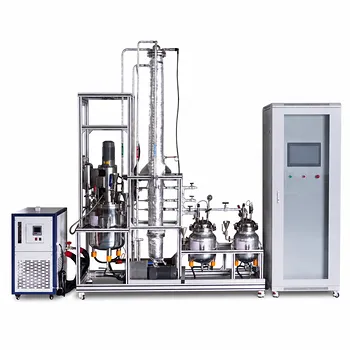
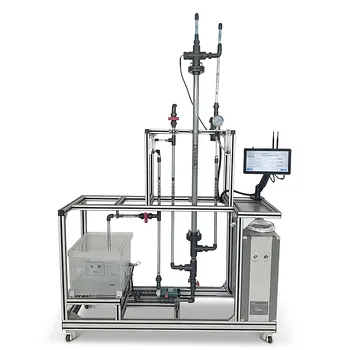
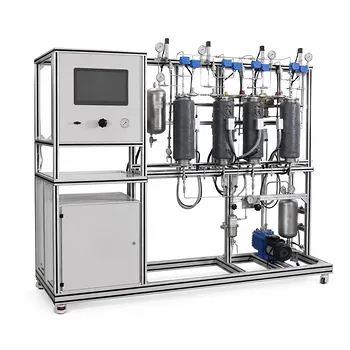
The steam-to-carbon ratio is the single most important lever for ensuring catalyst longevity, student safety, and meaningful experimental results in a carbon monoxide shift teaching pilot plant. Its precise control directly prevents the formation of carbon deposits that deactivate catalyst beds and block reactors. Without careful management of this ratio, the experiment quickly shifts from demonstrating a classic equilibrium reaction to a lesson in how catalysts fail.
The central insight for CO shift experiments is that steam does far more than push equilibrium toward hydrogen. It actively prevents the carbon deposition that chokes catalyst pores, alters temperature profiles, and transforms a reproducible teaching exercise into an unpredictable deactivation study. Controlling the steam-to-carbon ratio allows students to witness the kinetic competition between the beneficial water-gas shift and the harmful Boudouard reaction in real time.
The Chemistry Behind Carbon Formation
The CO shift reaction (CO + H₂O ⇌ CO₂ + H₂) is not the only equilibrium at play inside the reactor. When the steam-to-carbon (H₂O/CO) ratio falls too low, a parallel side reaction rapidly takes over.
The Boudouard Reaction as the Root of Deactivation
Carbon monoxide disproportionation, known as the Boudouard reaction (2CO ⇌ C + CO₂), becomes thermodynamically favorable when the water vapor concentration is insufficient. This reaction deposits solid carbon directly onto the catalyst surface.
These carbon deposits physically block the active metal sites where water-gas shift catalysis takes place. As the carbon layers grow, the catalyst’s ability to facilitate the desired reaction plummets, and the pressure drop across the reactor rises to dangerous levels.
How Steam Acts as a Decoking Agent
Excess steam does not merely dilute the reactants—it actively removes deposited carbon. The water-gas shift reaction itself runs in reverse on a carbon surface (C + H₂O → CO + H₂), gasifying the solid carbon and regenerating the catalyst.
By maintaining a sufficiently high H₂O/CO ratio, the rate of carbon gasification outpaces the rate of carbon deposition. This keeps the catalyst pore structure open and ensures the active sites remain accessible throughout the experiment. In teaching plants, visually demonstrating this self-cleaning effect transforms an abstract thermodynamic principle into an observable operational necessity.
Equilibrium, Selectivity, and Pedagogical Value
Controlling the steam-to-carbon ratio unlocks more than just catalyst protection. It is the primary knob for shaping conversion efficiency and creating teachable moments about reaction engineering.
Shifting the Thermodynamic Window
The CO shift reaction is reversible and exothermic, so a higher steam concentration pushes the equilibrium toward the product side. This stoichiometric excess of water vapor maximizes the conversion of carbon monoxide to carbon dioxide and hydrogen.
In a teaching pilot plant optimized around a ratio of approximately 4, students can measure how even small deviations from this setpoint can suppress hydrogen yield. The experiment becomes a direct illustration of Le Chatelier’s principle on a dynamic, flowing system rather than a static textbook example.
Avoiding Hot Spots and Temperature Runaways
Carbon deposits do not just block flow paths; they also disrupt heat transfer. Localized carbon accumulation can create insulating layers, leading to “hot spots” on the reactor tubes that alter the temperature profile and potentially damage equipment.
By controlling the steam ratio to prevent coking, students preserve the isothermal or near-isothermal conditions assumed in their kinetic models. This alignment between theory and practice is essential for extracting accurate rate constants and activation energies from their data.
Understanding the Trade-offs
An objective advisor must highlight that a higher steam-to-carbon ratio is not a blanket solution. There are operational and educational costs that students must learn to weigh.
Excessive steam increases the volumetric flow rate, which reduces the residence time of reactants in the catalyst bed. While thermodynamics favor higher conversion, the reduced contact time can actually decrease the per-pass conversion achieved, masking the true catalytic activity.
There is also a significant energy penalty. Vaporizing and superheating extra water consumes process heat, lowering the overall energy efficiency of the plant. In a teaching environment, this trade-off trains students to think beyond simple yield optimization and toward total process economics.
Applying This to Your Teaching Pilot Plant
The true value of a pilot plant lies in letting students explore the boundaries between stable operation and failure. You can structure experiments to make the steam-to-carbon ratio the central variable.
- If your primary focus is demonstrating catalyst deactivation: Run the reactor at an intentionally low ratio (but within safe pressure drop limits) and log the decline in CO conversion over time. Show how increasing steam later regenerates part of the activity.
- If your primary focus is maximizing hydrogen yield: Optimize the ratio to the point where diminishing returns from reduced residence time begin. Have students calculate the energy consumption per mole of hydrogen produced.
- If your primary focus is studying reaction kinetics: Keep the ratio high enough to completely suppress coking, ensuring that the measured reaction rates reflect only the intrinsic catalytic chemistry, not a parallel deactivation process.
Precise mass flow controllers and stable steam generators are non-negotiable tools in this pursuit. They enable the repeatable, stepwise changes in the H₂O/CO ratio that convert a simple bench-top reactor into a rigorous teaching instrument capable of revealing the subtle, critical competition between making product and destroying the catalyst itself.
Summary Table:
| Steam-to-Carbon Ratio | Catalyst Status | Reaction & Yield Impact | Operational Trade-offs |
|---|---|---|---|
| Low Ratio | Rapid coking (Boudouard reaction); deactivation | Reduced H₂ yield; high pressure drop | High risk of reactor damage & hot spots |
| Optimal Ratio (~4) | Continuous self-cleaning; active sites protected | Maximized conversion & predictable kinetics | Best balance for pedagogical demonstrations |
| Excessive Ratio | Fully protected; no carbon deposition | Decreased per-pass conversion (low residence time) | Significant energy penalty (water vaporization) |
Elevate Chemical Engineering Education with LABPARK
Teaching complex reaction kinetics like the carbon monoxide shift requires precise, reliable, and safe process controls. LABPARK provides premium Educational and Vocational Unit Operations Pilot Plants in chemical engineering, bioprocess & biotech, and environmental & water treatment.
Tailored for universities, research institutes, and enterprises, our systems feature highly accurate mass flow controllers and robust steam generators to give students hands-on experience with thermodynamic limits, catalyst regeneration, and process optimization.
Ready to enhance your department's practical training? Contact us today to discover our custom pilot plant solutions!
Related Products
- Multi-Stage Stirred Tanks in Series Residence Time Distribution and Mixing Performance Determination Educational Pilot Plant
- Residence Time Distribution and Reactor Flow Characteristics Determination Educational Pilot Plant
- Methane Cracking Educational Unit Operations Pilot Plant
- Fixed-Bed Chemical Reaction and Gas Dust Tar Removal Unit Operations Pilot Plant
- Multi Functional Catalytic Reaction and Reactor Evaluation Educational Unit Operations Pilot Plant
People Also Ask
- How does MRF model impeller rotation in CFD? Key Boundary Conditions Explained
- How can a CSTR pilot plant demonstrate reactor staging? Visualize volume savings.
- What parameters to monitor transitioning from Batch to CSTR? Master Pilot Plant Setup
- How does steady-state multiplicity affect the operation and safety of exothermic reactions within a CSTR pilot plant? - Guide
- Why is temperature regulation via a cooling jacket a critical feature in CSTR pilot plants used for laboratory training?