Knowledge Chemical Engineering Education Which unit operations pilot plant is suitable for teaching ammonia absorption? Choosing the Right Setup
Author avatar

Tech Team · LABPARK

Updated 1 month ago

Which unit operations pilot plant is suitable for teaching ammonia absorption? Choosing the Right Setup


The single most effective unit operation for teaching the industrial absorption of gaseous ammonia into water is a gas absorption column pilot plant, designed as either a packed or tray tower. This configuration directly replicates the dissolution of NH₃ into H₂O to produce ammonium hydroxide, allowing students to study mass transfer driving forces, thermal effects, and gas-liquid hydrodynamics in a controlled, semi-industrial setting.

A pilot-scale absorption column transforms the seemingly simple reaction NH₃ + H₂O ⇌ NH₄OH into a rich teaching platform. It enables precise observation of how equilibrium constraints, mass transfer resistances, and heat generation dictate process efficiency—insights that are impossible to grasp from theory alone.

Understanding the Absorption Process

The Critical Role of Mass Transfer

The formation of ammonium hydroxide is not just a chemical reaction; it is a mass-transfer-limited operation. Ammonia molecules must diffuse from the gas bulk into the liquid phase, where they dissolve and ionize.

In an absorption column, counter-current flow maximizes the concentration gradient throughout the height.

This gradient drives absorption, and students can vary gas or liquid flow rates to see how the overall mass transfer coefficient responds.

Managing the Exothermic Reaction and Temperature Profiles

The dissolution of ammonia in water is strongly exothermic. As the liquid temperature rises, ammonia solubility falls sharply, reducing absorption capacity.

A pilot plant fitted with thermocouples at multiple points shows how a temperature bulge develops inside the column.

Students learn that controlling this heat release—through inter-stage cooling or recirculation—is essential to maintain high product concentration and avoid ammonia slip.

Optimizing Gas-Liquid Flow Ratios

The L/G ratio determines how much water is available to absorb the gas. Too low a liquid rate causes poor recovery; too high dilutes the product.

Pilot plant runs with measurable concentration profiles teach the operating line and equilibrium curve graphically.

Adjusting flow rates quickly illustrates the trade-off between product strength and capture efficiency, a core design decision in any absorption process.

Choosing Between Packed and Tray Column Designs

Packed Columns for High Interfacial Area

A packed column uses random or structured packing to create a large surface area for gas-liquid contact. This design is excellent for demonstrating continuous mass transfer and low pressure drops.

It is particularly effective when teaching how packing type, wettability, and liquid distribution affect performance.

Most small-scale teaching plants favour packed columns because they are simpler to construct and offer rapid visualization of liquid dispersion.

Tray Columns for Controlled Stage-Wise Contact

Tray columns enforce discrete contact stages, making them ideal for illustrating theoretical plate concepts and stage efficiency.

Sieve or bubble-cap trays let students observe frothing, weeping, and entrainment firsthand—phenomena that directly influence absorption.

While mechanically more complex, a tray column strongly reinforces equilibrium-stage design methods used in larger industrial plants.

Understanding the Trade-offs and Pitfalls

Temperature Sensitivity Overrides Equilibrium

Ammonia-water equilibrium is extremely sensitive to temperature. Without adequate heat removal, the column may appear to “stop” absorbing gas simply because the liquid has warmed beyond the saturation limit.

Students may misinterpret this as a mass transfer problem when it is actually a thermodynamic limitation.

Any pilot plant must therefore integrate heat exchangers or cooling jackets, otherwise the lab exercise risks producing misleading data.

Scalability and Operational Range

A teaching-scale column operates at lower gas and liquid loads than industrial units. Channeling, end effects, and measurement noise can dominate results if not properly accounted for.

While packed beds scale reasonably with height, tray efficiencies change rapidly at small diameters.

This means the pilot plant is best used to teach process principles and trends, not to generate precise design correlations for commercial scale-up.

Making the Right Choice for Your Teaching Goal

Your specific learning objectives should dictate the pilot plant configuration. Balance the need for fundamental clarity with the desire to mimic industrial reality.

  • If your primary focus is mass transfer fundamentals: Choose a packed column with multiple sampling points; it gives a clear continuous profile and is easy to operate and modify.
  • If your primary focus is temperature control and heat management: Opt for a column with integrated cooling coils or inter-stage liquid coolers, and ensure you have real-time temperature logging at several heights.
  • If your primary focus is equipment design and stage-wise operation: Select a tray column (sieve or bubble-cap) to teach flooding, weeping, and the concept of Murphree efficiency.
  • If your primary focus is a complete production sequence: Consider placing the absorption column downstream of an ammonia gas supply (cylinder or vaporizer) and upstream of a storage tank, so students handle the entire operational loop.

A well-instrumented absorption pilot plant does more than produce a bottle of ammonium hydroxide—it gives students the ability to see, measure, and control the invisible trade-offs that define every industrial absorption process.

Summary Table:

Column Type Key Feature Teaching Focus
Packed Column High continuous interfacial area & low pressure drop Continuous mass transfer, liquid dispersion, and packing wettability
Tray Column Discrete contact stages (sieve or bubble-cap) Theoretical plates, stage efficiency, and hydrodynamic limits (flooding/weeping)

Bring Industrial Scale to Your Lab with LABPARK

Ready to elevate your practical training? LABPARK designs and supplies premium Educational and Vocational Unit Operations Pilot Plants in chemical engineering, bioprocess & biotech, and environmental & water treatment for universities, research institutes, and enterprises.

Equip your students and researchers with the tools to master mass transfer, heat management, and fluid dynamics firsthand. Contact us today to find the perfect pilot plant setup for your curriculum!

Related Products

People Also Ask

Related Products

Absorption and Desorption Educational Unit Operations Pilot Plant

Absorption and Desorption Educational Unit Operations Pilot Plant

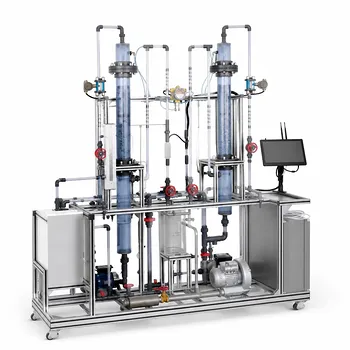
Dual packed column absorption and desorption pilot plant for chemical engineering education, offering real-time mass transfer coefficient measurement, durable mobile frame, industrial touch-screen interface, and customizable design for varied laboratory curricula, enabling hands-on study of gas absorption and stripping.

Dual-Mode Gas Absorption and Desorption Unit Operations Training Pilot Plant

Dual-Mode Gas Absorption and Desorption Unit Operations Training Pilot Plant

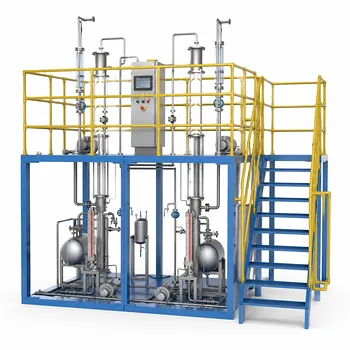
Industrial-scale pilot plant for gas absorption and desorption training in chemical engineering. Features dual-mode operation with real and simulated materials, transparent columns for flow visualization, and customizable design. Supports independent or combined loops for hands-on unit operations experiments.

Alkaline Membrane Water Electrolysis Educational Pilot Plant Unit Operations Training System

Alkaline Membrane Water Electrolysis Educational Pilot Plant Unit Operations Training System

Hands-on educational pilot plant for alkaline membrane water electrolysis hydrogen production, integrating unit operations training with industrial PLC control, real-time data logging, customizable design, durable 316L stainless steel construction, explosion-proof safety, and modern 5G connectivity for university laboratories.

Packed Bed Absorption Educational Unit Operations Pilot Plant

Packed Bed Absorption Educational Unit Operations Pilot Plant

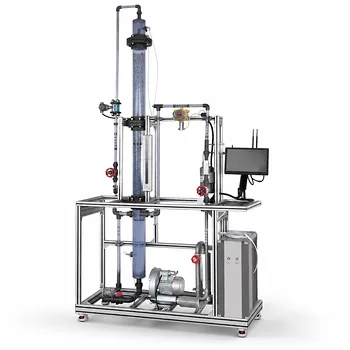
Study gas-liquid absorption, pressure drop, flooding, and mass transfer coefficients with this pilot plant. Transparent packed column, industrial touchscreen, real-time sensor data, automated analysis. Investigate two-phase flow, loading points, column efficiency. Comprehensive data logging and assessment software included.

Multimodal Absorption and Desorption Pilot Plant for Unit Operations Training

Multimodal Absorption and Desorption Pilot Plant for Unit Operations Training

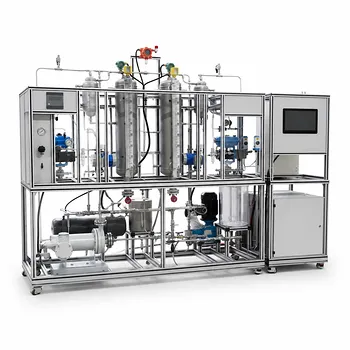
Multimodal absorption and desorption pilot plant for higher education labs. Bridges theory and industrial practice with transparent packed columns, three operational modes (real-material, simulated, semi-physical), and SCADA control. Students explore mass transfer, column hydraulics, and process control. Customizable.

Steam Methane Reforming Hydrogen Production and Purification Educational Pilot Plant

Steam Methane Reforming Hydrogen Production and Purification Educational Pilot Plant

This bench-scale educational pilot plant combines steam methane reforming with hydrogen purification, offering safe, hands-on unit operations training for university engineering laboratories. Its customizable design and high-precision monitoring enable real-time study of catalysis, phase separation, and process dynamics.

Electrolytic Hydrogen Production Educational Unit Operations Pilot Plant

Electrolytic Hydrogen Production Educational Unit Operations Pilot Plant

Bench-scale electrolytic hydrogen production pilot plant designed for university engineering labs. Provides hands-on training in water electrolysis, gas-liquid separation, and process safety. Fully customizable system with digital PID control, corrosion-resistant components, and hydrogen gas detector. Ideal for chemical engineering curricula.

Multi-Functional Special Distillation Educational Pilot Plant

Multi-Functional Special Distillation Educational Pilot Plant

Versatile multi-functional special distillation pilot plant for chemical engineering education. Supports continuous, vacuum, azeotropic, reactive, extractive distillation. Transparent glass columns enable real-time visual observation of hydrodynamics and separation processes.

Pressure Swing Adsorption Educational Unit Operations Pilot Plant

Pressure Swing Adsorption Educational Unit Operations Pilot Plant

Integrated bench-scale pressure swing adsorption pilot plant for hands-on teaching of gas-solid separation, mass transfer, and process optimization using nitrogen-oxygen model, featuring dual-column design, industrial touchscreen control, digital assessment suite, and customizable hardware and software configurations for educational laboratories.

Continuous Batch Extractive Distillation Educational Pilot Plant

Continuous Batch Extractive Distillation Educational Pilot Plant

Versatile pilot plant for continuous, batch, and extractive distillation training. High-borosilicate glass column for visualizing hydraulics, 15.6-inch touchscreen with data logging, precise reflux ratio control 1-99, and durable corrosion-resistant frame. Ideal for chemical engineering education and process research.

Bio-fermentation Ethanol Production Practical Training Unit Operations Pilot Plant

Bio-fermentation Ethanol Production Practical Training Unit Operations Pilot Plant

Bio-fermentation ethanol production pilot plant for hands-on training in unit operations: fermentation, solid-liquid filtration, membrane separation, and distillation. Bridges theory with industrial practice using industrial-grade components, customizable for university labs. Hybrid automated and manual control for comprehensive learning.

Bench Scale Dual Column Gas Separation and Capture Educational Pilot Plant

Bench Scale Dual Column Gas Separation and Capture Educational Pilot Plant

This dual-column educational pilot plant provides hands-on teaching of gas adsorption, separation, and capture processes. It features stainless steel columns, regeneration up to 400°C, and a 15.6-inch touchscreen PLC for TSA and PSA studies in chemical engineering curricula, process simulation.

Natural Product Extraction Unit Operations Training Pilot Plant

Natural Product Extraction Unit Operations Training Pilot Plant

Integrated natural product extraction pilot plant for chemical engineering training bridges theory and industrial practice with modular extraction and evaporation/concentration units, hybrid touchscreen and manual control, realistic process simulation, and self-contained softened water and vacuum utilities.

100L Continuous Loop Hydrogenation Educational Unit Operations Pilot Plant

100L Continuous Loop Hydrogenation Educational Unit Operations Pilot Plant

This 100L continuous loop hydrogenation pilot plant is designed for chemical engineering education, featuring 316 stainless steel construction, advanced gas-liquid mass transfer components, explosion-proof safety systems, and a 15.6-inch touchscreen with 5G connectivity, cloud data logging, bridging theory and industry.

Carbon Dioxide Absorption and Desorption Educational Pilot Plant for Carbon Capture Studies

Carbon Dioxide Absorption and Desorption Educational Pilot Plant for Carbon Capture Studies

Explore carbon dioxide absorption and desorption with this educational pilot plant. Transparent columns visualize mass transfer; electric heating simulates industrial solvent regeneration; touchscreen interface enables data monitoring. Ideal for chemical engineering, bridging theory and practice.

Water Electrolysis Hydrogen Production and Storage Educational Pilot Plant

Water Electrolysis Hydrogen Production and Storage Educational Pilot Plant

Integrated pilot-scale training system for higher education engineering labs. Features AWE/PEM electrolysis, adjustable DC power, PLC controls, gas-liquid separation, and pressurized hydrogen storage. Hands-on learning in green hydrogen, process control, and safety, ideal for chemical and energy departments.

Crude Benzene Hydrogenation Educational Unit Operations Pilot Plant

Crude Benzene Hydrogenation Educational Unit Operations Pilot Plant

Advanced pilot plant for higher education, enabling hands-on study of crude benzene hydrogenation and gas-liquid catalytic reactions. Triple-stage reactor system with precision flow and temperature control, AI-driven PID, remote monitoring, and comprehensive safety interlocks. Customizable for curriculum integration.

Carbon Dioxide Hydrogen Methanol Synthesis Educational Unit Operations Pilot Plant

Carbon Dioxide Hydrogen Methanol Synthesis Educational Unit Operations Pilot Plant

Hands-on educational pilot plant for methanol synthesis from carbon dioxide and hydrogen. Enables practical study of high-pressure catalysis, unit operations, and process control. Features real-time data acquisition, safety systems, and customizable experiment modules for undergraduate and graduate chemical engineering laboratories.

Methanol Synthesis and Catalyst Performance Evaluation Educational Unit Operations Pilot Plant

Methanol Synthesis and Catalyst Performance Evaluation Educational Unit Operations Pilot Plant

Bench-scale methanol synthesis and catalyst evaluation educational pilot plant for chemical engineering labs to study catalytic kinetics, high-pressure operations, process control, and unit operations under realistic conditions with industrial safety features, precision gas delivery, data acquisition, and intelligent monitoring.

Green Anhydrous Ethanol Refining Practical Training Pilot Plant

Green Anhydrous Ethanol Refining Practical Training Pilot Plant

Advanced integrated pilot plant for university labs demonstrating extractive distillation to produce high-purity absolute ethanol from crude feedstock, featuring multi-column continuous operation, closed-loop solvent recycling, and customizable controls for hands-on engineering education, ideal for chemical engineering training and research.


Leave Your Message