The catalyst surface sees a different world than the bulk fluid.
You must switch from a homogeneous to a heterogeneous plug-flow model when significant interfacial gradients develop—meaning the temperature and reactant concentration at the catalyst particle surface ((T_s), (C_s)) deviate substantially from the bulk fluid values ((T), (C)). This occurs primarily when reaction rates are fast enough to create mass-transfer limitations or when highly exothermic or endothermic reactions generate steep temperature differences across the stagnant film surrounding each pellet. In such situations, equating the two phases leads to erroneous kinetic parameters and failed scale‑up.
The Surface Need & The Deep Need
You’re asking when to use the heterogeneous model, but what you truly need is to avoid transport‑disguised kinetics in your pilot‑plant data. The rule is straightforward: adopt the heterogeneous framework anytime the overall reaction rate is limited by interfacial heat or mass transfer rather than by the intrinsic catalytic chemistry. This preserves the fidelity of your rate constants and ensures your reactor model mirrors the gradients present in the real hardware.
Framing the Two Modeling Philosophies
Pseudohomogeneous Model: The Equality Assumption
The pseudohomogeneous (or homogeneous) plug‑flow model treats the fluid phase and the solid catalyst as a single, uniform pseudophase.
It assumes (T = T_s) and (C = C_s) throughout the reactor—meaning no transport resistance exists between the bulk gas and the catalyst surface.
This simplification drastically reduces computational effort.
It is valid when the reaction is intrinsically slow relative to the rates of external heat and mass transfer.
Heterogeneous Plug-Flow Model: Decoupling Bulk and Surface
A heterogeneous model writes separate conservation equations for the fluid phase and the solid catalyst phase.
Interfacial mass transfer is described by a mass transfer coefficient ((k_g)) and heat transfer by a heat transfer coefficient ((h_f)).
These coefficients capture the resistance in the stagnant boundary layer that surrounds each catalyst pellet.
When that resistance becomes rate‑limiting, the concentration that the catalyst “sees” ((C_s)) can be far lower than the bulk concentration, forcing you to abandon the homogeneous idealization.
When Interfacial Gradients Make the Call
High Reaction Rates and Mass‑Transfer Starvation
A fast intrinsic reaction can consume reactants more quickly than diffusion can replenish the catalyst surface.
The result is a pronounced drop from (C) in the bulk to (C_s) at the pellet exterior.
In a pilot plant, this condition often arises when working with small, highly active particles or when operating at elevated temperatures that boost the kinetic rate constant.
A pseudohomogeneous model would assign the overall rate to a bulk‑average concentration, systematically underpredicting the true kinetic constant extracted from the data.
Strong Thermal Effects and the Temperature Gap
For strongly exothermic reactions, the catalyst surface can become significantly hotter than the surrounding fluid.
Even a few degrees of difference can shift the measured rate and selectivity, especially for reactions with high activation energies.
The heterogeneous model accounts for this by solving the interfacial energy balance alongside the mass balance.
In advanced labs running pilot‑scale oxidations or hydrogenations, neglecting the (\Delta T) across the film leads to apparent activation energies that are lower than the true values—a classic transport‑disguise.
Pilot‑Plant Scale and the Danger of Transport‑Disguised Kinetics
Pilot reactors are the bridge between micro‑kinetics and commercial design.
If you fit a homogeneous model to data that actually contains diffusional fingerprints, the kinetic parameters become equipment‑specific and cannot be trusted for scale‑up.
Heterogeneous plug‑flow models explicitly separate intrinsic chemistry from transport, allowing you to regress true rate constants and activation energies.
Supplementary references highlight that when internal pore diffusion is also limiting, the pellet’s effectiveness factor (\eta) drops below unity, making a heterogeneous framework essential to capture both the external film gradient and the intraparticle concentration profile.
Understanding the Trade‑offs
No model offers perfect accuracy without cost.
- Computational load: Heterogeneous models require solving coupled partial differential equations for the fluid and solid phases, often demanding numerical methods that are absent from simple spreadsheet tools.
- Parameter demand: Reliable (k_g) and (h_f) correlations (e.g., from the Sherwood and Nusselt numbers) must be available for the specific packing, flow regime, and particle geometry. Uncertainty in these parameters propagates directly into the kinetic estimates.
- Model‑experiment mismatch: In some pilot plants, the reactor may operate in a region where gradients exist at the inlet but relax downstream. Using a fully heterogeneous model everywhere adds complexity without proportional gain, whereas a zoned approach can balance accuracy and simplicity.
The real pitfall, though, is presuming homogeneity when gradients are present. That false economy often costs far more than the added computational effort in the form of failed pilot campaigns and misleading rate equations.
Making the Right Choice for Your Reaction Engineering Lab
Your selection hinges on the specific goal of the pilot‑plant exercise. Use the following guide to decide.
- If your primary focus is extracting intrinsic kinetic parameters: Apply the heterogeneous plug‑flow model immediately. It decouples transport from chemistry so the fitted rate constants are true to the catalyst, not an artifact of the lab‑scale fluid dynamics.
- If your primary focus is screening catalyst formulations under process‑intended conditions: Operate the pilot plant in a regime where external gradients are deliberately minimized (high flow rates, small particles) to allow a pseudohomogeneous simplification, then validate with a heterogeneous check.
- If your primary focus is teaching or demonstrating reactor engineering concepts: Use the heterogeneous model to create vivid, measurable contrasts—showing students how a few degrees of (\Delta T) can invert selectivity trends—and pivot to the homogeneous model only after the concept of film resistance is mastered.
- If your primary focus is scaling‑up to a commercial fixed‑bed reactor: Start with a heterogeneous model that captures radial and axial gradients. This gives you the effectiveness‑factor map needed to size the reactor and predict hot‑spot behavior, preventing costly surprises at production scale.
The moment you suspect that the catalyst surface no longer feels the same environment as the bulk, trust the heterogeneous plug‑flow model—it is the difference between a pilot plant that teaches you about your chemistry and one that merely records local fluid mechanics.
Summary Table:
| Feature | Pseudohomogeneous Model | Heterogeneous Model |
|---|---|---|
| Phase Assumption | Fluid & solid treated as a single phase ($T=T_s$, $C=C_s$) | Decoupled fluid & solid phases ($T \neq T_s$, $C \neq C_s$) |
| Interfacial Gradients | Ignored (assumes zero transport resistance) | Explicitly modeled using transfer coefficients ($k_g$, $h_f$) |
| Best Used When | Reactions are intrinsically slow; low thermal effects | Reactions are fast; strong exothermic/endothermic effects |
| Primary Risk | Disguises kinetics, leading to failed scale-up | Higher computational load and parameter demand |
Optimize Your Reaction Engineering Labs with LABPARK
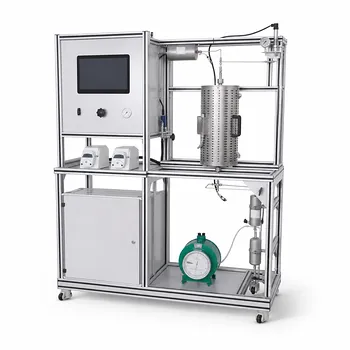
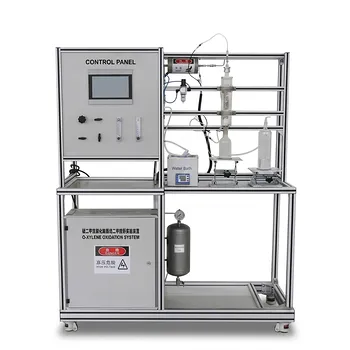
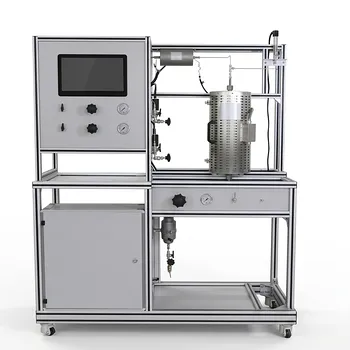
Are you looking to bridge the gap between academic theory and industrial scale-up? LABPARK provides state-of-the-art Educational and Vocational Unit Operations Pilot Plants in chemical engineering, bioprocess & biotech, and environmental & water treatment. Tailored for universities, research institutes, and progressive enterprises, our catalytic reactor pilot plants are engineered to deliver precise, transport-resolved kinetic data.
Don't let transport-disguised kinetics compromise your research or curriculum. Contact our application specialists today to find the ideal pilot plant configuration for your laboratory!
Related Products
- Fixed Bed Gas Solid Catalytic Reaction Educational Pilot Plant
- Micro-Scale Gas-Solid Catalytic Reaction Educational Pilot Plant
- Internal Circulation Gradient Free Catalytic Reaction Educational Pilot Plant
- Fluidized Bed Gas Solid Catalytic Reaction Educational Pilot Plant
- Multi Functional Catalytic Reaction and Reactor Evaluation Educational Unit Operations Pilot Plant
People Also Ask
- How do reactor pilot plants safely study gas-solid reactions? Master kinetics with thermal & flow control.
- How does the Mears criterion evaluate transport resistance? Key Guide to Intrinsic Kinetics
- Why is a multibed configuration necessary for exothermic reactions? Optimize your pilot plant trajectory.
- Fluidized vs. Fixed Bed Reactors: Comparing Heat & Complexity in Pilot Plants
- How is the friction factor determined for fixed-bed pilot plants? Select the best pressure drop correlation.