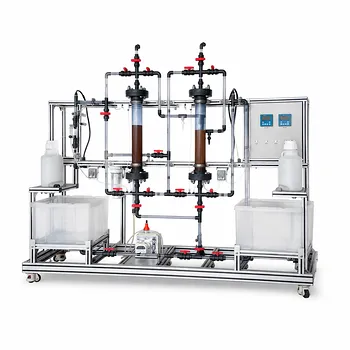
Organic polymer membranes deliver affordability and versatility, while inorganic membranes provide unmatched durability for extreme conditions. When using membrane filtration pilot plants for vocational training or research, the fundamental comparison centers on material resilience and cost. Organic membranes—made from polymers like polysulfone, PVDF, or PTFE—dominate standard teaching in microfiltration, ultrafiltration, nanofiltration, and reverse osmosis because they are inexpensive and widely available. Inorganic membranes, built from ceramics, metals, or zeolites, shine in demonstrations requiring high temperature tolerance, aggressive chemical exposure, or aggressive clean-in-place (CIP) testing, though they command a much higher initial price.
The true educational power of a pilot plant emerges when it includes both membrane types, forcing students and researchers to directly confront how material properties govern operating windows, cleaning protocols, and total cost of ownership.
Understanding the Material Fundamentals
The Nature of Organic Polymer Membranes
Organic membranes are fabricated from synthetic polymers such as polyethylene, polypropylene, PTFE, PVDF, and polysulfone. These materials are selected for their low manufacturing cost, ease of shaping into flat sheets, spiral-wound modules, or hollow fibers, and their broad chemical versatility.
For training purposes, polymer modules let students run standard pressure-driven separations under mild conditions. However, most natural polymer variants face a thermal ceiling, typically requiring operation below 45–50°C. Even engineered polymers like polyvinyl alcohol (PVA) are usually capped around 90°C, and general polymeric systems rarely exceed 100–150°C.
Chemical resistance is another instructive limitation. Polymer membranes can swell, degrade, or lose selectivity when exposed to harsh organic solvents or extreme pH environments. This makes them ideal for teaching the consequences of chemical incompatibility in a controlled, low-risk setting.
The Architecture of Inorganic Membranes
Inorganic membranes rely on ceramic, metallic, zeolite, or amorphous silica layers supported on sintered tubes. Their defining characteristic is exceptional stability: they withstand temperatures from 250°C for zeolite or silica variants up to 1000°C for some ceramic reactor membranes. They also resist swelling in aggressive neutral organic solvents like DMF, NMP, or DMSO.
This resilience makes inorganic membranes the material of choice for simulating harsh industrial environments. Zeolite membranes offer superb selectivity and flux but are sensitive to acids, typically constraining operation to a pH range of 6–8. Microporous silica membranes, by contrast, can tolerate pH values as low as 2–3, expanding their utility in pharmaceutical stream demonstrations.
However, this performance comes with a bulky price tag. Manufacturing involves complex multilayer coating, high-temperature sintering, and costly support materials. The result is a significantly higher capital investment and a more brittle module that demands careful handling.
How Material Properties Shape Pilot Plant Applications
Standard Filtration Training with Polymers
For most vocational training and undergraduate research, polymer membranes are the practical starting point. Their low cost allows facilities to stock multiple module types, and their forgiving nature under normal lab conditions minimizes the risk of accidental damage. Students learn the core principles of crossflow filtration, concentration polarization, and flux decline without worrying about the extreme failure modes seen in industry.
Extreme Environment Demonstrations with Inorganics
When the curriculum shifts to advanced process engineering, inorganic modules become essential. A pilot plant equipped with ceramic or metal membranes can safely expose students to high-temperature separations, reactive chemical feeds, and aggressive CIP cycles that would destroy a polymer membrane within minutes. This hands-on encounter teaches why certain industries—petrochemicals, pharmaceuticals, nuclear—invest heavily in inorganic solutions despite the cost.
The Critical Role of Cleaning-in-Place (CIP) Studies
A pilot plant housing both membrane types becomes a living laboratory for CIP protocol design. Trainees can systematically test the same cleaning chemicals on both materials and observe the outcomes: polymer membranes may lose integrity after repeated contact with strong acids or oxidizers, while inorganics maintain performance. These experiments cement the connection between material science and process safety.
Understanding the Trade-offs
Capital Cost vs. Operational Resilience
Organic membranes win on upfront expenditure—they are cheap to manufacture, replace, and scale. Inorganic membranes impose a steep initial investment but reduce the frequency of replacement and extend operating windows, lowering long-term risk in severe applications. A pilot plant that includes both teaches the economic balance that defines industrial membrane selection.
Mechanical Handling and Brittleness
Inorganic membranes deliver superior compressive and chemical strength, but they are brittle. Dropping a ceramic tube can shatter it—a lesson in material handling that vocational students quickly internalize. Polymer modules, being more ductile and lighter, forgive rougher treatment, highlighting the trade-off between robustness and fragility.
Lifetime and Fouling Management
Polymer membranes are prone to irreversible fouling and chemical degradation if the operating envelope is violated. Inorganic surfaces are intrinsically more fouling-resistant and can often be regenerated with harsher cleaning agents, extending their service life. By comparing flux recovery after identical foulant challenges, researchers gain quantitative insight into how material choice affects lifetime operating costs.
Designing a Pilot Plant for Your Educational Objectives
The ideal membrane pilot plant is not about choosing one material over the other—it is about creating a system where material trade-offs become visible, measurable, and instructive. Your specific goals determine the optimal configuration.
- If your primary focus is cost-effective training in standard industrial separations: Start with a broad set of polymer modules (MF, UF, NF, RO) and incrementally introduce one or two inorganic modules to illustrate the limits of organic materials under chemical or thermal stress.
- If your primary focus is demonstrating extreme industrial conditions: Invest in a ceramic or silica-based inorganic module for high-temperature or solvent-rich feeds, and use a polymer module as a sacrificial baseline to quantify the damage caused by bypassing material limits.
- If your primary focus is research on novel membrane durability: Operate both types side-by-side under identical aggressive conditions, using the data to map failure mechanisms, compare CIP efficacy, and generate cost-benefit models that mirror real-world engineering decisions.
Let your pilot plant be the teacher—where every pressure drop, chemical rinse, and thermal cycle turns abstract material science into practical, unforgettable engineering judgment.
Summary Table:
| Feature | Organic Polymer Membranes | Inorganic Membranes |
|---|---|---|
| Common Materials | PVDF, PTFE, Polysulfone, Polypropylene | Ceramics, Zeolites, Metals, Silica |
| Temperature Limit | Typically < 50°C (Max 150°C for engineered polymers) | 250°C up to 1000°C |
| Chemical Resistance | Limited (prone to swelling/degradation in solvents) | High (resists aggressive solvents & extreme pH) |
| Capital Cost | Low (cost-effective to replace & scale) | High (significant initial investment) |
| Best For | Standard filtration training (MF, UF, NF, RO) | Extreme environment simulations & CIP testing |
Build the Ultimate Membrane Testing Lab with LABPARK
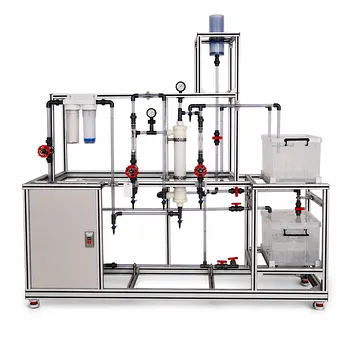
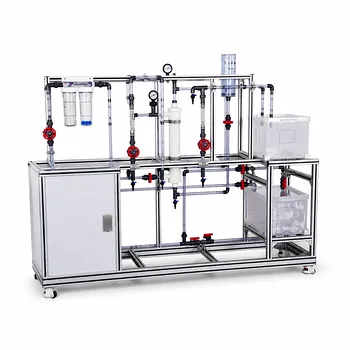
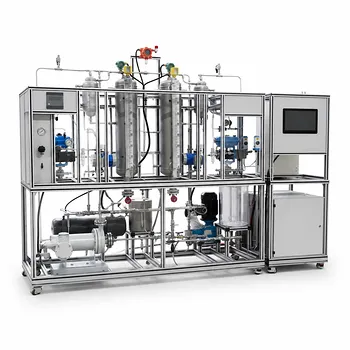
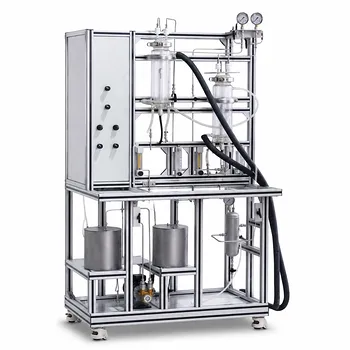
Equip your lab with the tools to demonstrate real-world industrial tradeoffs. LABPARK designs and manufactures premium Educational and Vocational Unit Operations Pilot Plants in chemical engineering, bioprocess & biotech, and environmental & water treatment.
Whether you are a university, research institute, or enterprise, our pilot plants are built to handle both organic polymer and inorganic ceramic membranes side-by-side, giving your students and researchers hands-on experience with material limits, CIP protocols, and process optimization.
Ready to elevate your training capabilities? Contact LABPARK today to customize a pilot plant tailored to your curriculum!
Related Products
- Ultrafiltration Membrane Separation Educational Pilot Plant
- Hollow Fiber Ultrafiltration Membrane Separation Educational Pilot Plant
- Multifunctional Membrane Separation Educational Pilot Plant with Ultrafiltration, Nanofiltration, Reverse Osmosis
- Multi-Functional Membrane Separation Educational Pilot Plant for Unit Operations Lab
- Multi Functional Membrane Crystallization Educational Unit Operations Pilot Plant
People Also Ask
- Pervaporation vs. Vapor Permeation: Handling Suspended Solids in Membrane Pilot Plants
- How do PEI, PVDF, and PSU membranes compare in pilot plants? Find the best fit.
- How do membrane pilot plants demonstrate synthetic vs biological membrane advantages?
- Why Use a Membrane Separation Pilot Plant vs. Lab Testing? Avoid Costly Scale-Up Failures
- Isotropic vs. Anisotropic Membranes: How to Choose the Best Pilot Plant Modules