Your ability to accurately determine the effective diffusion coefficient in a gas-phase catalytic pilot plant hinges on correctly identifying which transport mechanism—Knudsen or molecular diffusion—is dominant inside the porous pellet. Get this wrong, and your calculated diffusivity will not reflect the true mass-transfer resistance, leading to flawed reactor models and misinterpreted kinetic data. The distinction forces you to choose the appropriate mathematical framework: a wall-collision-limited model for narrow pores (Knudsen) or a bulk gas-collision model for wide pores (molecular diffusion), with a combined resistance model for the transitional zone in between.
The core insight: The ratio of the catalyst’s pore diameter to the mean free path of the gas molecules acts as a master switch. It determines whether the effective diffusivity is governed by molecule–wall collisions (Knudsen), molecule–molecule collisions (molecular), or a series resistance of both. In a pilot plant, this choice directly impacts how you interpret flux data and scale up the reactor.
The Fundamental Distinction: Pore Size vs. Mean Free Path
The Controlling Ratio
The entire classification starts with a simple comparison. You compare the mean free path of your gas molecules ((\lambda)) to the catalyst’s average pore radius ((r_k)).
When the pore radius is much smaller than the mean free path ((2r_k / \lambda \ll 1)), a molecule is more likely to hit a wall than another molecule. This is the Knudsen regime.
When the pore radius is much larger than the mean free path ((2r_k / \lambda \gg 1)), molecule–molecule collisions dominate. This is the molecular (bulk) diffusion regime.
Why This Distinction Matters in the Lab
In a pilot plant, you control temperature and pressure. Changing either alters the mean free path of the gas, which can push the same catalyst from one diffusion regime to another.
A student may unknowingly collect data in the transition region while using a model that assumes pure molecular diffusion. That mismatch will produce an effective diffusivity that is artificially low and cannot be scaled up correctly. Recognizing the active regime stops this error at the source.
How the Effective Diffusivity Calculation Changes
The Knudsen Regime
When pores are narrow, the Knudsen diffusion coefficient ((D_K)) depends only on the pore radius and the square root of the temperature-to-molecular-weight ratio ((T/M)).
To convert this to an effective Knudsen diffusivity ((D_{Ake})), you must account for the pellet’s internal geometry. You multiply (D_K) by the void fraction and divide by the tortuosity. This gives you the true, geometry-corrected transport rate inside the pellet.
The Molecular Regime
In wider pores, bulk molecular diffusion obeys the Stefan-Maxwell relations. Here, collisions between different gas species and concentration gradients drive the flux.
The effective molecular diffusivity ((D_{Ae})) is again the bulk binary diffusion coefficient but corrected by the same pellet void fraction and tortuosity. The physics, however, are fundamentally different: walls are now just a geometric obstacle, not the primary site of momentum exchange.
The Transition Regime: When Both Mechanisms Contribute
Many real catalysts, especially those with a broad pore size distribution, operate where both Knudsen and molecular diffusion contribute. You cannot pick just one equation.
The accepted approach is to treat the two as series resistances. This is often captured by the additive formulation:
[ \frac{1}{D_e} = \frac{1}{D_{Ae}} + \frac{1}{D_{Ake}} ]
Where (D_e) is the final effective diffusivity. This is the practical expression of the Mason and Evans model for the transition zone. Using a simple average or picking the larger coefficient will overestimate the flux and misrepresent the catalyst’s true performance.
Practical Implications for Pilot Plant Data Interpretation
Your Measured Flux Tells You About Pore Architecture
When you run a steady-state diffusion experiment on a single pellet, the raw flux is a result of the local pore-size landscape. If your analysis assumes molecular diffusion but the pellet operates in the Knudsen regime, you will deduce an unrealistically high tortuosity or an incorrect pore radius.
By correctly identifying the regime, you can decouple geometric factors (tortuosity, voidage) from the physics of molecular collisions. This makes your pilot plant data a direct probe of catalyst structure, not a confused amalgam of unknowns.
Pressure Dependence as a Diagnostic Tool
In a pure molecular regime, effective diffusivity is independent of absolute pressure. In a Knudsen regime, it is also independent of pressure (since (D_K) depends only on pore size and gas properties). However, the transition regime shows a pressure-dependent effective diffusivity.
If your pilot plant experiments reveal that the measured (D_e) changes with pressure, you are in the transition zone. You must apply the combined resistance model. Ignoring this pressure sensitivity will make your measured diffusivity an artifact of your operating conditions, useless for design at other pressures.
A Common Pitfall: Restricted Diffusion
When Molecular Size Matches Pore Size
The above regimes assume the diffusing molecule is infinitely small compared to the pore. In zeolites, MOFs, or tight mesopores, the molecular diameter approaches the pore diameter.
This introduces two additional factors: the equilibrium partition factor ((K_p)) and the drag coefficient ((K_r)). These reduce the effective diffusivity further because the molecule’s center cannot access the entire pore volume, and the wall exerts a strong hydrodynamic drag.
Impact on Your Pilot Plant Models
If you ignore restricted diffusion when it is present, you will overestimate the diffusion rate and predict breakthrough times that are far too short. In a pilot plant testing catalyst longevity or conversion, this leads to an optimistic yet incorrect image of catalyst efficiency. Always analyze the ratio of molecular diameter to pore diameter before settling on a classic Knudsen or molecular model.
Measuring Effective Diffusivity: The Wicke-Kallenbach Method
The Standard Pilot Plant Experiment
The most direct way to determine the effective diffusivity is through a steady-state Wicke-Kallenbach diffusion cell. You seal a porous pellet between two gas streams at identical temperature and pressure but different compositions.
You measure the net flux of each species across the pellet. Because there is no total pressure gradient, you avoid viscous flow artifacts and isolate pure diffusion.
From Flux to Diffusivity Model Choice
The raw flux data is combined with the pellet dimensions to calculate a raw effective diffusivity. The numerical value you get will only make physical sense if you have already identified the correct transport mechanism.
If you invert the flux using a molecular diffusion formula for a Knudsen-limited pellet, the result will conflict with all theoretical predictions. The correct interpretation requires you to select the right model—Knudsen, molecular, or combined—before you extract the diffusivity. That model determines whether the number you hold in your hand reflects pore radius, tortuosity, or both.
Understanding the Trade-offs
The Cost of Model Simplicity
- Single-regime models are easy to teach and quick to apply. The risk is entirely on you: if your catalyst’s pore size distribution crosses the threshold, your “effective diffusivity” will be a function of the pilot plant conditions, not a true pellet property.
- The combined-resistance model captures reality far better but requires you to know or assume the relative contributions of Knudsen and molecular flow. Estimating these from pore size distributions adds another layer of uncertainty.
- Restricted diffusion corrections bring your calculations closest to the truth in tight pores, but they require precise molecular and pore size data that are not always available from simple pilot plant runs.
The Wicke-Kallenbach Blind Spot
This steady-state method is elegant, but it gives you a single lumped effective diffusivity for the pellet. It cannot directly separate Knudsen from molecular contributions unless you run experiments at multiple pressures or with different gas pairings. Without that extra effort, you are left with a number that is correct only at your operating conditions—a dangerous foundation for scale-up.
Making the Right Choice for Your Pilot Plant Application
Your goal dictates how deeply you must investigate the Knudsen–molecular distinction. Here is how to match your approach to your objective:
- If your primary focus is teaching mass-transfer fundamentals: Use well-characterized catalysts with either very narrow or very wide pores so you can isolate one regime. This makes the governing equations directly testable and avoids student confusion.
- If your primary focus is generating intrinsic kinetic data: You must decouple diffusion from reaction. Run Wicke-Kallenbach tests across a range of pressures to identify the active regime. Apply the combined resistance model if any pressure sensitivity appears, or your apparent activation energy may be corrupted by diffusion.
- If your primary focus is scale-up design for industrial catalysts: Never assume a single regime. Characterize the pore size distribution and use the Mason–Evans additive approach. Check for restricted diffusion if the reactant molecular diameter is larger than 5–10% of the average pore size. Your pilot plant diffusivity must be pressure- and molecule-independent to be portable to a larger reactor.
- If your primary focus is screening catalyst formulations rapidly: You can use a simplified Knudsen or molecular model, but keep the gas pressure, temperature, and composition identical between screening runs. This ensures the relative diffusivity ranking of catalysts remains meaningful, even if the absolute value is regime-biased.
By actively interrogating which diffusion mechanism dominates under your pilot plant conditions, you transform a textbook nuance into a practical calibration tool—one that ensures the effective diffusivity you calculate is a true catalyst property, not an artifact of the lab bench.
Summary Table:
| Diffusion Regime | Controlling Condition | Key Governing Relationship | Pressure Dependence |
|---|---|---|---|
| Knudsen | Pore radius $\ll$ Mean free path ($2r_k/\lambda \ll 1$) | $D_K \propto d_{pore} \sqrt{T/M}$ | Independent (None) |
| Molecular | Pore radius $\gg$ Mean free path ($2r_k/\lambda \gg 1$) | Stefan-Maxwell / Bulk Binary ($D_{AB}$) | Inversely Proportional ($1/P$) |
| Transition | Pore radius $\approx$ Mean free path | Series resistance: $1/D_e = 1/D_{Ae} + 1/D_{Ake}$ | Pressure-dependent |
Optimize Your Chemical Engineering Lab with LABPARK
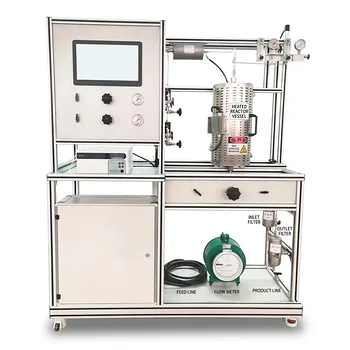
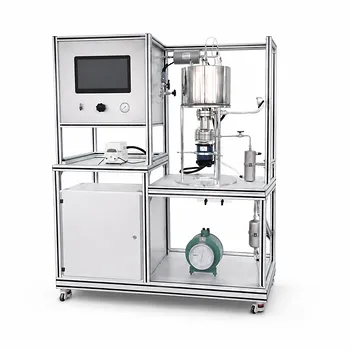
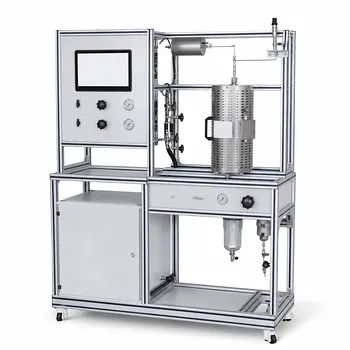
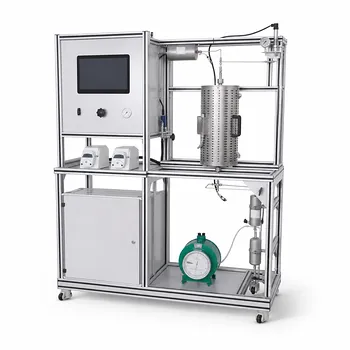
Accurate mass-transfer and diffusion modeling is critical for scaling up chemical processes. LABPARK provides premium Educational and Vocational Unit Operations Pilot Plants across chemical engineering, bioprocess & biotech, and environmental & water treatment.
Designed specifically for universities, research institutes, and enterprises, our pilot plants empower your students and researchers to master complex transport phenomena, kinetics, and reactor operations with high-fidelity, real-world data.
Ready to elevate your lab's research and training capabilities? Contact our experts today to explore our custom pilot plant solutions!
Related Products
- Micro-Scale Gas-Solid Catalytic Reaction Educational Pilot Plant
- Fixed Bed Gas Solid Catalytic Reaction Educational Pilot Plant
- Fluidized Bed Gas Solid Catalytic Reaction Educational Pilot Plant
- Fixed-Bed Chemical Reaction and Gas Dust Tar Removal Unit Operations Pilot Plant
- Gas Phase Mixing and Residence Time Distribution Determination Educational Unit Operations Pilot Plant
People Also Ask
- Fluidized vs. Fixed Bed Reactors: Comparing Heat & Complexity in Pilot Plants
- Why is a multibed configuration necessary for exothermic reactions? Optimize your pilot plant trajectory.
- Why is thermal management a major challenge in methane oxidative coupling? Reactor Solutions for Pilot Plants
- How does the Mears criterion evaluate transport resistance? Key Guide to Intrinsic Kinetics
- How do reactor pilot plants safely study gas-solid reactions? Master kinetics with thermal & flow control.