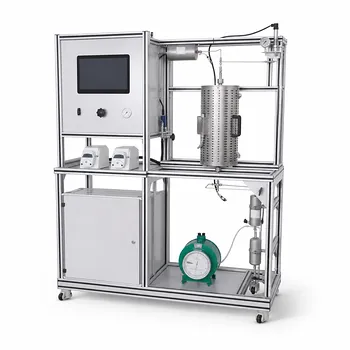
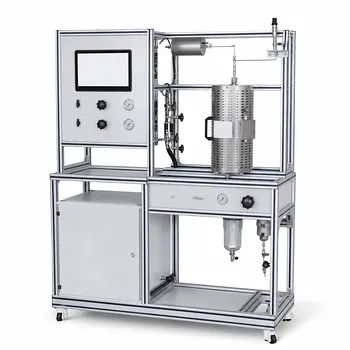
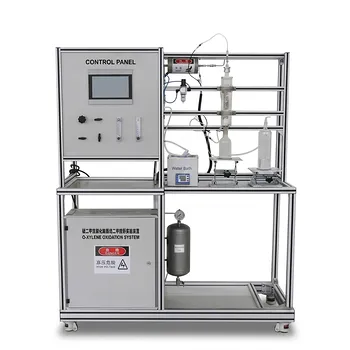
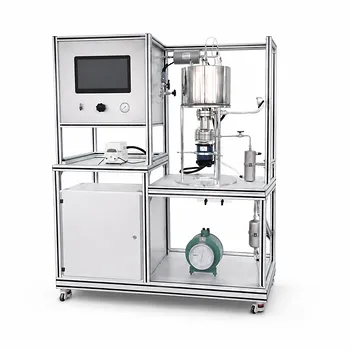
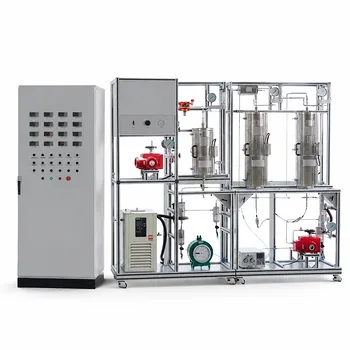
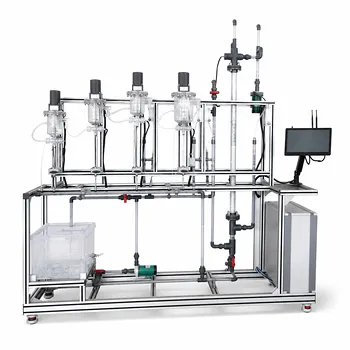
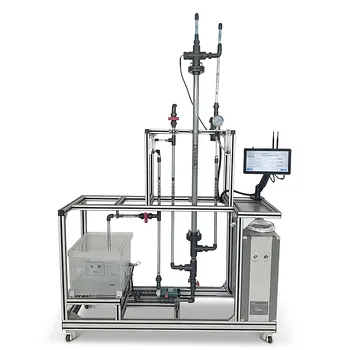
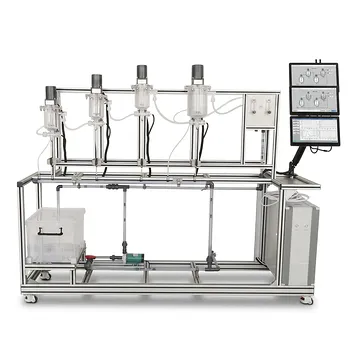
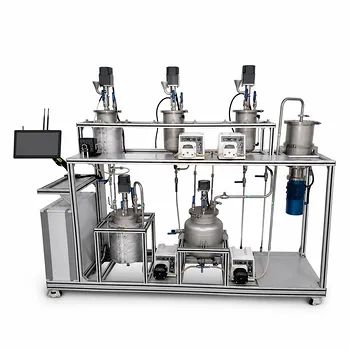
The answer lies in leveraging the pilot plant’s inherent heat integration to make abstract stability theory visible. Instructors can do this by operating the fixed-bed reactor in its autothermal mode—where the hot product stream preheats the cold feed—and then systematically varying the inlet temperature or flow rate while continuously monitoring axial temperature profiles. This controlled experimentation causes the reactor to move through its multiple steady states, producing clear, tangible signatures like sudden temperature jumps (ignition), dramatic drops (extinction), and pronounced hysteresis loops. It transforms the mathematical risk of multiple steady states into a physical event students can see, measure, and ultimately prevent.
The core insight is that an autothermal pilot plant is a living stability diagram. By adjusting a single input (such as feed temperature) and tracking the catalyst bed’s thermal response, instructors demonstrate that the same operating conditions can yield two distinct, stable temperature profiles—and a dangerous, unstable one in between. This hands-on demonstration bridges the gap between nonlinear reactor theory and the safe industrial operation of exothermic processes.
How Autothermal Operation Creates Multiple Steady States
An autothermal fixed-bed reactor recycles reaction heat to preheat the feed, creating a powerful thermal feedback loop. This coupling between the exothermic reaction and the heat exchanger is what gives rise to potentially three steady-state solutions for a single set of operating conditions.
The Heat Balance Underpinning Multiplicity
Plotting the reactor’s heat production (a sigmoidal curve due to the Arrhenius temperature dependence) against the heat removal line (dictated by heat exchange and sensible heat) on a conversion-temperature diagram reveals the possible intersections.
Those intersections are the steady states. Because of the shape, you can get three: a low-temperature, low-conversion stable state; an unstable intermediate state; and a high-temperature, high-conversion stable state.
Why the Intermediate State Is the Danger Zone
The intermediate intersection is mathematically unstable—any tiny disturbance will push the reactor toward either the upper or lower stable state. In a pilot plant, this means that just as the instructor crosses a critical threshold, the system does not gradually adjust; it snaps to a completely different thermal profile. That snap is what students need to feel and understand.
A Step-by-Step Demonstration Using the Pilot Plant
The goal is to guide the reactor through its ignition-extinction hysteresis loop, exposing all three states.
Varying Inlet Temperature to Map the Hysteresis Loop
Start with the reactor stabilized at a low inlet temperature, in the lower stable state (low conversion, modest bed temperatures). Then, slowly ramp the inlet temperature up in small steps, allowing the bed to reach a new steady state each time.
At a critical ignition point, the exit temperature will jump discontinuously to a much higher value—the reactor has ignited to the upper stable state. Continue recording. Then, slowly decrease the inlet temperature. The reactor will not return at the same point; it will stay in the high state until reaching a lower extinction point, where the temperature plummets back down. The difference between these two transition points forms the hysteresis loop, directly demonstrating the existence of multiple steady states for the same inlet temperature range.
Using Multi-Point Temperature Sensors to Visualize the Three Profiles
Equip the pilot plant with thermocouples spaced along the catalyst bed. As you near the ignition point, students can observe the temperature profile begin to distort, with a sharp front forming near the reactor entrance. This is the signature of the unstable intermediate state trying to exist before the system snaps. Once ignited, the entire profile shifts to a high-temperature plateau, often with a severe peak right at the inlet due to backward heat conduction. This spatially resolved data transforms the abstract idea of “three steady-state profiles” into a clear, visual story.
Triggering Extinction and Thermal Runaway on Command
To make the risk tangible, demonstrate a thermal runaway. While operating near the ignition threshold, introduce a deliberately small perturbation—a brief, slight increase in feed concentration or inlet temperature. The reactor will not return to its original state; instead, it will ignite and race to the high-temperature stable state, potentially damaging the catalyst if not controlled. Similarly, a small cooling perturbation near the extinction point can cause the reaction to “blow out” and crash to the lower state. These exercises imprint the lesson that operating limits are absolute, not gradual.
Connecting the Demonstration to Fundamental Theory
The pilot plant is not just a showpiece; it is a direct validation of reactor stability criteria.
The Heat Production–Exchange Diagram Becomes Physical
Before the lab, instructors can draw the classic sigmoidal production line and straight heat exchange line. During the experiment, each new steady-state temperature the students record literally maps one intersection on that theoretical diagram. The abrupt jump from the lower to the upper intersection is the physical manifestation of bypassing the unstable intermediate state.
Applying Stability Criteria like Inoue’s Criterion
For advanced courses, the data collected (feed, coolant, and bed temperatures) can be used to calculate the dimensionless group βγ/(1+β) and compare it to the critical bounding function. When the group exceeds the boundary, multiplicity is predicted—and the pilot plant will have demonstrably exhibited it. This closes the loop between the abstract Inoue’s criterion (or other slope conditions) and the real reactor’s behavior, cementing the concept of parametric sensitivity versus true state multiplicity.
Understanding the Trade-offs and Pitfalls in Demonstration
A pilot plant is a powerful teacher, but instructors must be aware of its limitations.
Distinguishing Parametric Sensitivity from Multiplicity
A common student misconception is equating a large temperature response with instability. The pilot plant must clearly show the difference: parametric sensitivity causes a large but reversible spike—remove the upset, and the reactor returns to baseline. True multiplicity of steady states leads to a permanent transition to a different stable operating point; recovery requires crossing the extinction threshold. Use a separate experiment with a short, aborted disturbance to illustrate the reversible case before demonstrating the irreversible ignition.
Managing Safety and Catalyst Integrity
The ignition state, especially with strongly exothermic reactions, can generate temperature peaks that sinter catalyst or exceed reactor design limits. The demonstration must be designed with a safety margin—choose a reaction with a manageable heat release, use a diluted catalyst, or limit the maximum inlet temperature. Never allow a student experiment to intentionally dwell at the unstable intermediate point, as it will inevitably snap unpredictably.
Recognizing the Influence of Axial Mixing
In an ideal plug-flow model, the three steady states are profiled along the reactor length. In a real pilot plant, even slight back-mixing or heat conduction can modify the shape of the hysteresis loop and shift the ignition and extinction temperatures. Acknowledge this discrepancy and use it to discuss how industrial reactor designs incorporate safety factors to account for such non-idealities.
Making the Right Choice for Your Educational Goal
- If your primary focus is teaching fundamental reactor stability: Structure the lab around the slow inlet temperature ramp to map the entire hysteresis loop, and have students overlay the data on a theoretical heat production/removal plot.
- If your primary focus is safety and process control: Emphasize the ignition and extinction perturbations, demonstrating how tiny, unforeseen changes can trigger catastrophic runaway or blowout, and then challenge students to design a control strategy that prevents crossing the bifurcation point.
- If your primary focus is reactor design and scale-up: Use the multi-point temperature data to identify the severe inlet temperature peak characteristic of the high steady state, and discuss how this dangerous thermal stress dictates material selection and catalyst packing limits in industrial autothermal units.
The fixed-bed pilot plant is the ultimate bridge between the elegant mathematics of bifurcation theory and the unforgiving reality of exothermic reactor operation—master it in the lab, and your students will never forget the critical line between a controlled reaction and a runaway.
Summary Table:
| Steady State | Temperature & Conversion | Stability | Student Takeaway |
|---|---|---|---|
| Lower State | Low temp, low conversion | Stable | Baseline operating conditions |
| Intermediate State | Mid temp, mid conversion | Unstable | The danger zone; triggers sudden thermal transitions |
| Upper State | High temp, high conversion | Stable | High efficiency but carries risks of catalyst damage |
Bring complex chemical engineering theory to life with LABPARK. We provide advanced Educational and Vocational Unit Operations Pilot Plants in chemical engineering, bioprocess & biotech, and environmental & water treatment for universities, research institutes, and enterprises. Empower your students and researchers to master reactor stability, autothermal operations, and process safety hands-on. Contact us today to request a quote or customize your pilot plant!
Related Products
- Fixed Bed Gas Solid Catalytic Reaction Educational Pilot Plant
- Fixed-Bed Chemical Reaction and Gas Dust Tar Removal Unit Operations Pilot Plant
- Multi Functional Catalytic Reaction and Reactor Evaluation Educational Unit Operations Pilot Plant
- Ethylbenzene Dehydrogenation Educational Unit Operations Pilot Plant
- Educational Unit Operations Pilot Plant for Intraparticle Diffusion Effective Factor Measurement
People Also Ask
- How do reactor pilot plants safely study gas-solid reactions? Master kinetics with thermal & flow control.
- How does the Mears criterion evaluate transport resistance? Key Guide to Intrinsic Kinetics
- Fluidized vs. Fixed Bed Reactors: Comparing Heat & Complexity in Pilot Plants
- Why is a multibed configuration necessary for exothermic reactions? Optimize your pilot plant trajectory.
- How is the friction factor determined for fixed-bed pilot plants? Select the best pressure drop correlation.