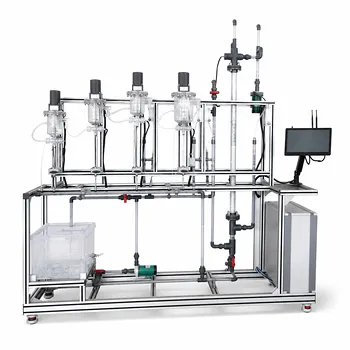
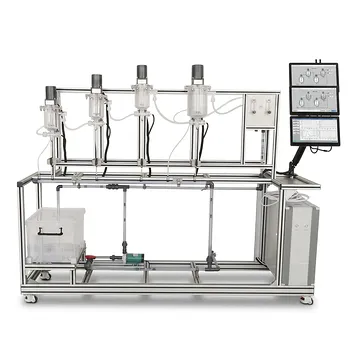
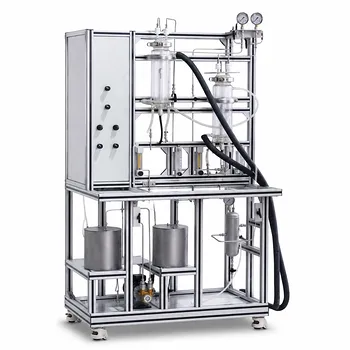
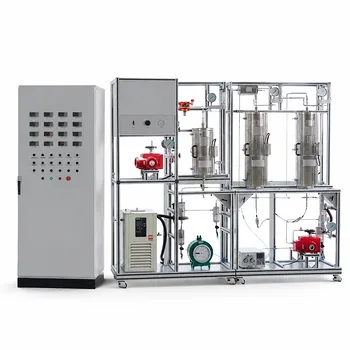
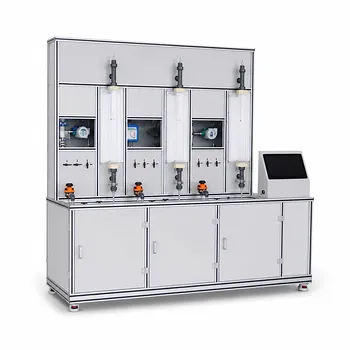
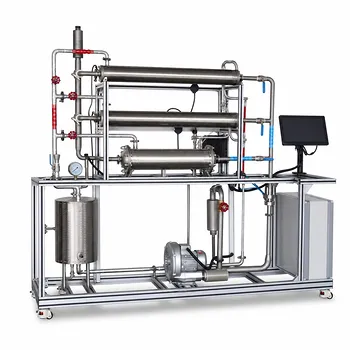
The mixer is not a neutral player. When teaching reactor design with a unit operations pilot plant, the impact of mixing on conversion is dictated entirely by the reaction order. For a first-order reaction, macro‑mixing and micro‑mixing produce the exact same conversion; the fluid’s mixing history is irrelevant. But when the order deviates from unity, micro‑mixing either penalizes or boosts conversion relative to a purely macro‑mixed state.
The relationship between mixing and conversion is not a one-size-fits-all rule — it is a direct expression of the reaction’s sensitivity to local concentration. In a pilot plant, this insight lets students see why a perfect residence time distribution can still deliver unexpected results if the wrong mixing mechanism dominates.
The Two Faces of Mixing in a Reactor
Before dissecting the role of reaction order, it’s essential to separate the two mixing mechanisms that a student can independently probe in a pilot plant.
Macro‑Mixing Governs the Residence Time Distribution
Macro‑mixing describes the large‑scale movement of fluid elements. It controls how long different parcels of material spend inside the reactor — the residence time distribution (RTD).
In a tubular reactor, the Peclet number ((Pe)) quantifies this spread. As (Pe \to \infty) the flow approaches ideal plug flow; as (Pe \to 0) it degrades to complete backmixing, identical to an ideal CSTR. This distribution alone can dramatically influence conversion, especially for reactions whose rate depends strongly on concentration.
Micro‑Mixing Controls the Local Concentration Environment
Micro‑mixing is the molecular‑scale blending that determines the actual concentration a reactant “sees” at the reaction site. Even if two streams share an identical RTD, poor micro‑mixing leaves the reactants segregated at the microscopic level.
A pilot plant equipped with split‑and‑recombine mixers or variable‑energy agitators lets students change the degree of micro‑mixing independently. By holding flow rates constant, they can observe how micro‑mixing alters conversion without changing the RTD — a revelation that clarifies why reactor design is never just about residence time.
Reaction Order: The Amplifier That Dictates the Outcome
Why does the same mixing strategy help one reaction and hurt another? The answer lies in how the instantaneous reaction rate responds to the local concentration fluctuations that micro‑mixing eliminates.
First‑Order Reactions: The Forgiving Kinetics
A first‑order reaction has a rate that is linear with concentration. Because the rate is a straight line through the origin, the average rate over a distribution of concentrations equals the rate at the average concentration.
This mathematical property makes the reaction completely indifferent to micro‑mixing. Whether reactants are perfectly blended or remain in tight clumps, the overall conversion depends only on the RTD — the amount of time each fluid element stays in the system. For the student, this means that a simple residence time measurement can perfectly predict reactor performance.
Higher‑Order Reactions ((n > 1)): Why Micro‑Mixing Hurts Conversion
Second‑order kinetics are convex upward. When reactant pockets remain segregated (good macro‑mixing but poor micro‑mixing), some regions maintain unusually high local concentrations. Because the rate rises steeply with concentration, these rich zones react much faster than a well‑mixed average, boosting overall conversion.
Introducing intense micro‑mixing destroys these high‑concentration hotspots. The reactants are diluted down to the mean concentration, and the reaction proceeds at that lower, uniform rate. For any (n > 1), micro‑mixing reduces the average rate and lowers conversion compared to a macro‑mixed baseline.
Sub‑Linear Kinetics ((n < 1)): The Unique Advantage of Micro‑Mixing
Reactions with order less than one exhibit a concave rate‑concentration curve. Here, high‑concentration pockets contribute less than proportionally to the overall rate, while the reaction is disproportionately efficient at lower concentrations.
In this regime, poorly mixed fluid (macro‑mixing without micro‑mixing) wastes the concentrated regions because the rate does not scale fast enough. Micro‑mixing, by smoothing out concentration spikes, raises the average reaction rate and increases conversion. It is the only case where blending at the molecular scale actively favours the reaction, a counterintuitive result that a pilot‑scale experiment can bring to life.
Teaching the Concept with a Pilot Plant
A well‑instrumented unit operations pilot plant turns these abstract kinetic rules into tangible, testable lessons.
Validate RTD Independence for First‑Order Systems
Students can inject a tracer to measure the RTD of a tubular reactor, then run a first‑order reaction (e.g., a dye decay or a known hydrolysis) at the same flow conditions. They will find that conversion matches the prediction from the batch kinetics and the RTD — no fitting parameters or mixing corrections are needed. This experiment anchors the concept that mixing history vanishes for linear kinetics.
Demonstrate the Penalty of Poor Micro‑Mixing for Second‑Order Reactions
Using a reaction like the ammonium persulfate‑potassium iodide system, students can fix the mean residence time and vary only the feed‑mixing configuration. A simple tee‑junction injection (poor micro‑mixing) gives one conversion, while a static mixer or an impeller‑agitated pre‑mixer (good micro‑mixing) gives a measurably lower conversion. This direct comparison proves that a well‑macro‑mixed reactor can still underperform if the local blending is too good — a lesson that reshapes how they think about “optimization”.
Connect to Reactor Sequencing and Backmixing
The principles extend naturally to CSTR sequences. For a second‑order reaction (( \alpha > 1)), the optimal volume strategy to minimize total reactor volume is an increasing‑size cascade — a smaller first reactor that operates at higher concentration, followed by a larger vessel. Pilot plants with rearrangeable CSTR battery setups let students physically test this theorem, measuring stage‑by‑stage conversion and discovering that macro‑mixing (the number of tanks) and micro‑mixing (the local agitation in each tank) work together to set the final outcome.
Understanding the Trade‑offs
No demonstration is without its pitfalls, and isolating mixing effects demands careful experimental design.
Perfect separation of macro‑ and micro‑mixing is almost impossible. Altering the agitator speed to improve micro‑mixing also changes the overall RTD (e.g., by inducing backmixing). Students must learn to use baffles, static mixers, or feed injection location to vary micro‑mixing while holding the RTD nearly constant — a subtle art that teaches the reality of process control.
Pilot‑scale reactors rarely approach ideal extremes. Mass transfer limitations, wall effects, and incomplete baffling blur the theoretical lines. Students who measure a smaller-than-expected penalty for second‑order micro‑mixing are not failing; they are confronting the difference between idealized models and industrial hardware.
The cost of mixing energy is a real design variable. For a sub‑linear reaction, micro‑mixing raises conversion, but at the expense of higher power input and possibly added equipment complexity. A pilot plant lets students weigh this economic trade‑off in real time, recording not just conversion but also power draw and pressure drop.
Making the Right Choice for Your Teaching Goal
The pedagogy of mixing‑kinetics interaction must be tuned to the learning objective. Tailor the pilot‑plant experiment to what you want your students to internalize.
- If your primary focus is to cement fundamental kinetics: Use a simple tubular or single CSTR setup. Run a first‑order reaction to show RTD‑based prediction works perfectly, then a second‑order reaction to demonstrate the micro‑mixing penalty. The contrast is unforgettable.
- If your primary focus is on reactor design and scale‑up: Employ a multi‑CSTR battery. Let students optimize the tank sizes for a second‑order reaction and measure how bypassing a small first tank (poor macro‑mixing) destroys conversion. This links mixing theory directly to equipment sizing.
- If your primary focus is on advanced transport phenomena: Incorporate optical probes or local sampling to map concentration variance. Show that for a reaction with (n<1), increasing micro‑mixing does indeed lift conversion, even when the RTD appears unchanged — a direct observation that cements the concave‑rate concept.
- If your primary focus is on safety and selectivity: Use parallel or series reactions in a venturi loop or spray tower pilot unit. Demonstrate how micron‑scale mixing control steers product distribution, reinforcing that mixing history is a chemical design variable, not just a fluid dynamic nuisance.
The unit operations pilot plant transforms the abstract kinetic criterion of reaction order into a visual, measurable decision variable. Once students see that the same mixer can be a hero for one reaction and a villain for another, they never forget that design must start with chemistry, not hardware.
Summary Table:
| Reaction Order | Kinetics Type | Micro-mixing Impact | Key Mechanism |
|---|---|---|---|
| n = 1 (First-order) | Linear | No Impact | Conversion depends solely on RTD; fluid history is irrelevant. |
| n > 1 (Higher-order) | Convex | Decreases Conversion | Dilutes high-concentration pockets that boost local reaction rates. |
| n < 1 (Sub-linear) | Concave | Increases Conversion | Smoothens concentration spikes, raising the overall average rate. |
Bring Reactor Design Theory to Life with LABPARK
Help your students and researchers bridge the gap between kinetic theory and real-world process engineering. LABPARK provides premium Educational and Vocational Unit Operations Pilot Plants in chemical engineering, bioprocess & biotech, and environmental & water treatment. Designed specifically for universities, research institutes, and enterprises, our pilot systems enable hands-on exploration of complex transport phenomena, mixing kinetics, and reactor scaling.
Ready to upgrade your laboratory with robust, industrial-grade training systems? Contact us today to request a custom configuration!
Related Products
- Multi Functional Catalytic Reaction and Reactor Evaluation Educational Unit Operations Pilot Plant
- Residence Time Distribution and Reactor Flow Characteristics Determination Educational Pilot Plant
- 100L Continuous Loop Hydrogenation Educational Unit Operations Pilot Plant
- Tubular Reactor Flow Characteristics Determination Educational Unit Operations Pilot Plant
- Multi-Stage Stirred Tanks in Series Residence Time Distribution and Mixing Performance Determination Educational Pilot Plant
People Also Ask
- What reaction engineering principles are shown in a catalytic reactor pilot plant? SO2 Oxidation Guide
- Why is FTIR integration in catalytic pilot plants important? Real-Time Student Insights
- How to analyze active metal distribution & identify catalyst poisoning in pilot plants? Expert Diagnostic Guide
- How do temperature limits and WHSV influence catalytic reactor optimization? Scale-Up Guide
- Why is XPS Critical for Catalytic Reactor Pilot Plants? Optimize Catalyst Performance