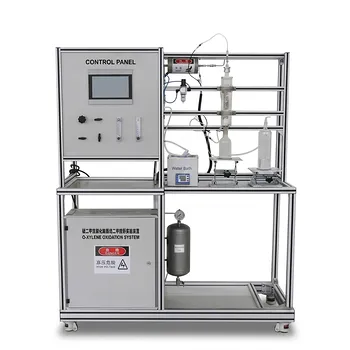
Catalytic reactors live and die by their surfaces. For students and researchers operating pilot plants, surface-sensitive techniques like X-ray Photoelectron Spectroscopy (XPS) are not optional add-ons — they are essential. XPS provides a direct, quantitative window into the topmost atomic layers of a catalyst, revealing the exact composition and chemical state that govern activity, selectivity, and stability. Without it, you’re engineering blind, relying on bulk averages that tell you nothing about the reactive front line of your process.
Bulk analysis tells you what a catalyst is; XPS tells you what it is doing at the surface. In pilot plant unit operations, where industrial conditions like feed impurities and recycling loops come into play, this surface-level fingerprint is the difference between empirical guesswork and rigorous, fundamental understanding.
The Surface is the Reactor
A catalyst’s performance is determined by the atoms that reaction molecules actually see. Bulk composition is often a remote indicator of what happens at the gas-solid or liquid-solid interface.
Why Surface Sensitivity Matters
In XPS, emitted photoelectrons travel only a mean free path of 10 to 30 Å before losing their energy-specific signal. This means the technique inherently samples only the top 1 to 3 atomic layers. That’s precisely where adsorption, reaction, and deactivation occur. Bulk-sensitive methods average over hundreds of nanometers, drowning out the subtle surface chemistry that makes or breaks a catalytic cycle.
The Chemical State Story
XPS does more than list elements. It reveals chemical shifts — subtle changes in binding energy that directly indicate oxidation states. A shift in the Pd 3d peak, for example, can distinguish metallic palladium from palladium oxide. In a pilot plant, knowing whether your active metal is in its reduced, active form or has been unintentionally oxidized during regeneration is actionable intelligence.
Why Pilot Plants Demand Surface-Specific Insight
Lab-scale tests often use pure feeds and idealized conditions. Real-world catalytic reactors face a messier reality.
Replicating Real Contamination
Pilot plants exist to simulate industrial environments, complete with recycling streams and trace feed impurities like sulfur compounds or metals. These poisons can accumulate selectively on the catalyst surface, creating a thin deactivated skin that a bulk analysis would completely miss. XPS directly spots these surface poisons, quantifying their accumulation before reactor performance tanks.
Diagnosis, Not Post-Mortem
When a pilot-plant campaign shows unexpected deactivation, you need a diagnostic tool, not just a post-mortem. XPS surveys the surface for qualitative element detection of poisons — even at trace levels — and identifies if the active sites have changed oxidation state. This allows you to distinguish between physical blockage (coking) and chemical poisoning, guiding the correct mitigation strategy: feed purification or regeneration protocol adjustment.
Decoding Catalyst Deactivation with XPS
Deactivation is the silent profit-killer in catalytic processes. Surface analysis turns it into a solvable puzzle.
Poisoning at the Atomic Scale
A monolayer of sulfur atoms can quench a nickel catalyst almost completely. XPS detects this overlayer instantly because the technique’s escape depth is comparable to the poison layer’s thickness. You see a strong S 2p signal long before the bulk concentration would be measurable, enabling early intervention.
Tracking Regeneration Efficiency
During oxidative regeneration, the surface’s oxidation state fluctuates. XPS monitors the ratio of metallic to oxidized species directly. If your regeneration leaves behind a persistent oxide that is less active, you’ll see it in the chemical shift — and adjust time, temperature, or gas composition accordingly.
Educating Through Practical Surface Science
For students, the pilot plant is the ultimate classroom. XPS connects textbook theory to real hardware.
From Ultrahigh Vacuum to Reactor Performance
Operating an XPS system demands Ultrahigh Vacuum (UHV) — typically 10⁻⁹ torr or better — because at a moderate vacuum of 10⁻⁶ torr, enough gas molecules strike the surface to form a contaminating monolayer in about one second. Teaching students this principle instills a visceral appreciation for surface contamination control, a lesson that pays dividends when they later design reactor clean-up systems or handle pyrophoric catalysts.
Bridging Theory and Operation
When a student sees a correlation between a measured Cr(VI) reduction on an HDS catalyst and improved desulfurization activity in the pilot reactor, abstract concepts of oxidation state and catalyst activation become concrete. This hands-on, analytical-to-operational link is the hallmark of a world-class chemical engineering curriculum.
Understanding the Trade-offs and Limitations
XPS is powerful, but not a magic wand. Using it effectively means respecting its boundaries.
The Ex-Situ Constraint
XPS is inherently an ex situ technique. The sample moves from the reactor to a UHV chamber. This can alter surface species that are unstable in air or vacuum. You must design experiments to minimize air exposure — often using transfer vessels — and interpret results with the understanding that the vacuum environment may desorb weakly bound intermediates.
Sampling and Averaging
XPS probes a relatively small area (typically a few hundred microns across). Catalyst surfaces can be heterogeneous. A single spot may not represent the entire bed. Multiple-point analysis and comparison with other techniques (like Raman or in situ IR) are essential to build a full picture.
The Information Depth is a Double-Edged Sword
The top 1–3 atomic layers are exactly what you want — until they aren’t. If a thick, porous coke overlayer buries the active phase, XPS may only see the coke, not the catalyst underneath. In those cases, depth profiling or complementary bulk methods become necessary.
Applying XPS Insights to Your Pilot Plant Work
Whether you’re diagnosing a problem or training the next generation, XPS can be integrated directly into your workflow.
- If your primary focus is diagnosing catalyst deactivation: Use XPS to identify trace surface poisons and oxidation state changes, then correlate them with feed impurities or regeneration cycles so you can pinpoint the root cause and implement a targeted fix.
- If your primary focus is optimizing catalyst activation or pretreatment: Verify the surface chemical state of your active metal before and after reduction or calcination—seeing that metallic Pd or Pt at the surface ensures you are starting with the intended active phase.
- If your primary focus is engineering education in unit operations: Embed XPS analysis into pilot plant curricula to teach the critical relationship between surface science, vacuum technology, and macroscopic reactor performance, turning data from the spectrometer into teachable moments about contamination control and reaction engineering.
When you make the catalyst surface visible, pilot plant operation evolves from a black-box process into a fundamentally understood and precisely controlled engineering practice.
Summary Table:
| Feature of XPS | Impact on Pilot Plant Operations | Key Insight |
|---|---|---|
| Surface Sensitivity (1-3 atomic layers) | Detects trace surface poisons before bulk changes occur. | Prevents bulk averages from masking active site behavior. |
| Chemical State Identification | Distinguishes active metallic phases from inactive oxidized states. | Verifies success of catalyst reduction and activation. |
| Deactivation Diagnosis | Differentiates between physical coking and chemical poisoning. | Directs exact mitigation (feed purification vs. regeneration). |
Equip Your Lab for Advanced Chemical Engineering Education & Research
Are you looking to bridge the gap between surface science theory and real-world reactor operations?
LABPARK provides premium Educational and Vocational Unit Operations Pilot Plants in chemical engineering, bioprocess & biotech, and environmental & water treatment. Specifically designed for universities, research institutes, and enterprises, our pilot plants enable hands-on learning and precise experimental control to master catalyst behavior, deactivation, and regeneration.
Ready to elevate your academic curriculum or research capabilities? Contact LABPARK today to explore our tailored pilot plant solutions!
Related Products
- Multi Functional Catalytic Reaction and Reactor Evaluation Educational Unit Operations Pilot Plant
- Methanol Synthesis and Catalyst Performance Evaluation Educational Unit Operations Pilot Plant
- Fixed-Bed Chemical Reaction and Gas Dust Tar Removal Unit Operations Pilot Plant
- Crude Benzene Hydrogenation Educational Unit Operations Pilot Plant
- Ethylbenzene Dehydrogenation Educational Unit Operations Pilot Plant
People Also Ask
- What reaction engineering principles are shown in a catalytic reactor pilot plant? SO2 Oxidation Guide
- Why is FTIR integration in catalytic pilot plants important? Real-Time Student Insights
- How to analyze active metal distribution & identify catalyst poisoning in pilot plants? Expert Diagnostic Guide
- How do temperature limits and WHSV influence catalytic reactor optimization? Scale-Up Guide
- What operational insights do catalyst pellet concentration profiles provide? Optimize Reactor Yield