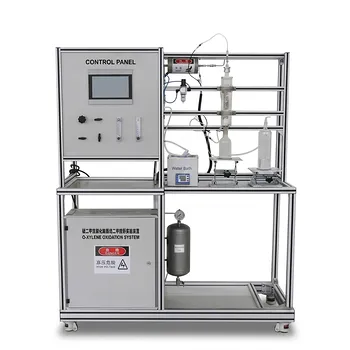
The contact process is a textbook reaction for a reason. It immediately demonstrates the core tension that defines reaction engineering: the delicate interplay between reaction kinetics and thermodynamic equilibrium. In a unit operations pilot plant, the oxidation of sulfur dioxide ($2SO_2 + O_2 \rightleftharpoons 2SO_3$) gives you a hands-on platform to explore multi-bed reactor staging, optimal temperature profiling, catalyst poisoning, pressure effects, and advanced process intensification – all in one compact, measurable system.
The reversible, exothermic nature of this reaction forces you to abandon the idea of a single ideal operating point. A pilot plant using the contact process reveals that high conversion is not a state, but a dynamic path – a carefully choreographed journey through multiple catalyst beds, intercooling stages, and even interstage product removal, teaching the core principles of industrial reactor design.
The Core Challenge: Balancing Kinetics and Thermodynamics
The oxidation of SO₂ is exothermic ($\Delta H \approx -98\ \text{kJ/mol}$) and accompanied by a decrease in the number of moles. Le Chatelier’s principle tells us that low temperature and high pressure favor the formation of SO₃. But reality pushes back.
Why You Can’t Just Lower the Temperature
At low temperatures, the reaction rate becomes impractically slow. The vanadium pentoxide catalyst needs sufficient thermal energy to activate, typically requiring a minimum operating temperature of 400–450°C (around 680–720 K) in the first bed. Below this range, the pilot plant would show virtually no conversion, even though the equilibrium constant is highly favorable. You learn that thermodynamic favorability is useless without acceptable kinetics.
The Adiabatic Temperature Rise Trap
Because the reaction is exothermic, the gas temperature rises as it travels through a single catalyst bed. Without heat removal, the temperature increase pushes the equilibrium backward, limiting the conversion in one pass to only 60–70%. In the pilot plant, you can measure this temperature profile directly, plotting how conversion stalls as the bed exit temperature climbs.
Demonstrating the Multi-Bed Reactor with Interstage Cooling
The solution, which the pilot plant makes visually and quantitatively clear, is to break the reaction into multiple adiabatic stages and cool the gas between them.
Staging for Stepwise Conversion
A typical configuration uses four catalyst beds. After the first bed, where the temperature rises to 600°C or more, the gas passes through a heat exchanger (or is quenched with cooler air). This interstage cooling drops the temperature back into the range where equilibrium becomes favorable again (often 380–420°C). Each subsequent bed then continues pushing the conversion upward. In the pilot plant, you can experimentally map how the optimal temperature profile – starting high to activate kinetics and stepping lower toward the outlet – yields an overall conversion of 97–99%.
Visualizing the Equilibrium Constraint
By sampling the gas after each bed and measuring SO₂ concentration, students can calculate the equilibrium constant ($K_p$) at each stage. Comparing the actual conversion to the theoretical equilibrium limit at each outlet temperature teaches a fundamental lesson: you can never exceed equilibrium in a single pass, but you can repeatedly approach it under steadily more favorable conditions.
Catalyst Selection and Poisoning: The Purity Imperative
While the pilot plant allows you to test different catalysts, it exposes a critical industrial choice: activity versus robustness.
Platinum’s Superior Activity, Ruined by Impurity
Platinum catalysts are highly active for SO₂ oxidation, but the pilot plant can be used to deliberately introduce trace impurities like arsenic into the feed. You’ll watch the conversion collapse over time, demonstrating the concept of catalyst poisoning. This drives home why industrial processes invest so heavily in upstream gas purification – a unit operation that is inseparable from reactor design.
Vanadium Pentoxide: The Industrial Workhorse
Switching to a vanadium pentoxide ($V_2O_5$) catalyst reveals a more forgiving, though slightly less active, profile. The pilot plant becomes a testbed for comparing activity, selectivity, and deactivation kinetics, showing why $V_2O_5$ dominates commercial plants despite higher required temperatures.
Pressure Effects and Residence Time Control
The reduction in gas volume means pressure matters, and the pilot plant lets you quantify exactly how much.
Leveraging Le Chatelier’s Principle
Increasing the system pressure shifts the equilibrium toward SO₃. In a pilot unit equipped with a back-pressure regulator, you can demonstrate this effect directly. While atmospheric operation yields good conversion, a modest pressure increase (e.g., 2–5 bar) visibly improves it. You also learn the practical trade-off: compression cost and vessel thickness often limit how much pressure you can exploit.
Space Velocity as a Design Knob
The pilot plant’s flow controller allows you to adjust space velocity (GHSV). Too high, and the gas doesn’t spend enough time in contact with the catalyst – conversion drops. Too low, and throughput plummets. You can measure residence time ($\tau$) and watch how it affects both conversion and pressure drop, which rises with the square of the flow rate. This is where reactor debottlenecking principles come alive: maybe a switch to a more active catalyst lets you increase throughput at the same conversion.
Beyond Equilibrium: The Double Absorption Process
The most striking advanced demonstration comes from simulating the double absorption configuration.
Removing Product to Defy Equilibrium
Standard equilibrium limits apply when products remain in the reaction mixture. But the pilot plant can mimic industrial plants by absorbing the SO₃ in concentrated sulfuric acid after the third bed. By removing the product, the reaction mixture now sees a lower partial pressure of SO₃, shifting the equilibrium in the remaining converter stage dramatically. The resulting overall conversion can exceed 99.7%. This hands-on lesson in process intensification shows that the reactor is not an isolated box – it’s part of an integrated system where separation steps drive reaction performance.
Understanding the Trade-offs
No single knob turns in isolation. The pilot plant forces you to navigate real-world conflicts.
Reaction Rate vs. Conversion Per Pass
Higher inlet temperatures (e.g., 450°C) give a fast initial reaction but limit the equilibrium conversion in that bed. Lower inlet temperatures give a higher theoretical maximum but can starve the catalyst of the energy needed to light off. The art of the temperature profile is finding the descending curve that keeps the reaction rate just high enough while locking in the most favorable equilibrium at the outlet.
Catalyst Activity vs. Poisoning Susceptibility
A more active catalyst (like platinum) delivers higher space velocity for a given conversion, but only if the feed is ultra-pure. The capital and operating cost of feed purification must be weighed against the catalyst’s lifetime and replacement cost.
Throughput vs. Pressure Drop
Pushing higher flow rates increases production capacity but builds a larger pressure drop across the packed beds. Beyond a certain point, you risk catalyst fluidization or excessive energy loss. The pilot plant lets you test alternative configurations – radial flow, parallel beds – to break this trade-off.
Temperature vs. Equipment Complexity
Adding intercoolers between beds improves conversion but increases capital cost and control complexity. The pilot plant shows the diminishing returns: the jump from one bed to four is transformative; pushing to six yields only marginal gains.
Making the Right Choice for Your Study Goal
The configuration you prioritize in the pilot plant should match the concept you need to understand most deeply.
- If your primary focus is the kinetic–thermodynamic trade-off: Manipulate the inlet temperature to each bed and measure exit conversion. Map the optimum temperature progression line against the equilibrium curve.
- If your primary focus is catalyst deactivation and feed purity: Deliberately dope the feed with a known poison and track the decline in conversion over time. Compare $V_2O_5$ and a platinum-based catalyst under identical conditions.
- If your primary focus is maximizing single-pass conversion: Implement all four beds with intercooling and optimize the intermediate temperatures. Then add pressure control to see the combined effect.
- If your primary focus is process intensification: Simulate double absorption by installing a mid-process SO₃ scrubber. Quantify how product removal shatters the conventional equilibrium ceiling.
Every data point from thermocouples, pressure taps, and gas analyzers in that pilot plant converges on a single, empowering truth: industrial conversion is not a static number but a dynamic, engineerable path forged from the raw materials of kinetics, equilibrium, and mass transport.
Summary Table:
| Reaction Engineering Principle | Demonstration in Pilot Plant | Key Industrial Lesson |
|---|---|---|
| Kinetics vs. Thermodynamics | Monitoring conversion at varying inlet temperatures (400–600°C) | Highly favorable equilibrium at low temperatures is useless without acceptable kinetic rates. |
| Multi-Bed Staging | Implementing 4 adiabatic catalyst beds with interstage cooling | Intercooling steps the reaction path back into favorable equilibrium zones to maximize conversion. |
| Catalyst Poisoning & Activity | Comparing Pt vs. $V_2O_5$ catalysts under feed impurities | High-activity catalysts like Pt require expensive feed purification to prevent rapid deactivation. |
| Pressure & Space Velocity (GHSV) | Manipulating back-pressure (2–5 bar) and gas flow rates | Increasing pressure shifts equilibrium favorably, but is limited by compression costs and pressure drop. |
| Process Intensification | Simulating double absorption by scrubbing $SO_3$ between stages | Removing the reaction product bypasses thermodynamic limits, pushing overall conversion past 99.7%. |
Bring Industrial Reactor Design to Life in Your Lab
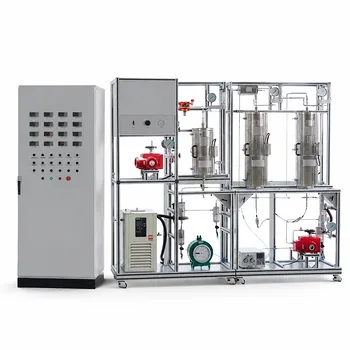
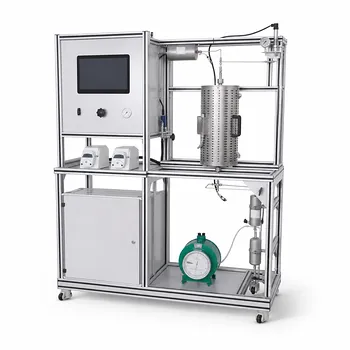
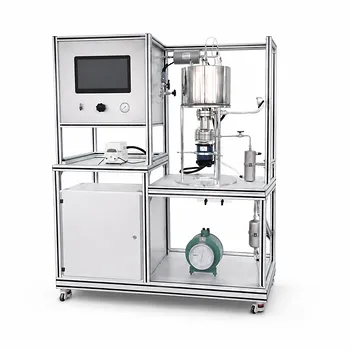
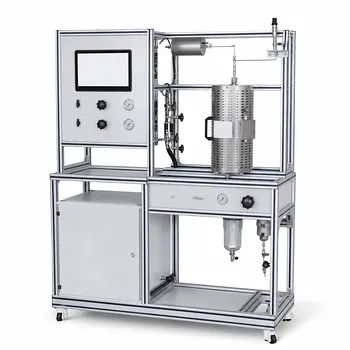
Teaching complex chemical engineering principles requires hands-on tools that bridge the gap between theory and practice. LABPARK provides premium Educational and Vocational Unit Operations Pilot Plants in chemical engineering, bioprocess & biotech, and environmental & water treatment for universities, research institutes, and enterprises.
Our advanced catalytic reactor pilot plants enable students and researchers to master thermodynamics, kinetics, and process intensification firsthand.
Ready to upgrade your department's training capabilities? Contact us today to explore our customizable pilot plant solutions!
Related Products
- Multi Functional Catalytic Reaction and Reactor Evaluation Educational Unit Operations Pilot Plant
- Fixed-Bed Chemical Reaction and Gas Dust Tar Removal Unit Operations Pilot Plant
- Methanol Synthesis and Catalyst Performance Evaluation Educational Unit Operations Pilot Plant
- Crude Benzene Hydrogenation Educational Unit Operations Pilot Plant
- Ethylbenzene Dehydrogenation Educational Unit Operations Pilot Plant
People Also Ask
- Why is FTIR integration in catalytic pilot plants important? Real-Time Student Insights
- How to analyze active metal distribution & identify catalyst poisoning in pilot plants? Expert Diagnostic Guide
- How do temperature limits and WHSV influence catalytic reactor optimization? Scale-Up Guide
- Why is XPS Critical for Catalytic Reactor Pilot Plants? Optimize Catalyst Performance
- What operational insights do catalyst pellet concentration profiles provide? Optimize Reactor Yield