Catalytic reactor simulation doesn’t have to be a monolithic computational beast. By adopting a nested iteration algorithm, you can decouple the fluid-phase dynamics from the intraparticle pellet balances, solving each subsystem with its own specialized numerical method and then reconciling them through iterative updates. This allows you to capture complex diffusion-reaction phenomena inside catalyst pellets without rewriting your entire reactor simulator.
The core insight: Nested iteration converts a tightly coupled, large-scale system into two modular blocks—an outer loop for macroscopic fluid balances and an inner loop for microscopic pellet balances. This partitioning brings simulation of pilot-plant reactors with strong diffusion limitations within practical reach, while preserving numerical stability and accuracy.
The Coupled Dynamics Challenge
A catalytic reactor in a pilot plant intertwines two very different scales of physics. Understanding the nature of this coupling is the first step to seeing why nested iteration is so powerful.
Fluid–Pellet Coupling in Pilot Reactors
The fluid phase transports reactants and products along the reactor length, obeying mass and energy balances that depend on local reaction rates.
Those local rates, however, are not just bulk properties. They are determined by what happens inside each catalyst pellet, where diffusion and reaction compete.
This creates a bidirectional dependency: the fluid composition dictates the boundary conditions for the pellet, and the pellet’s net reaction rate feeds back into the fluid balance. The system is fully coupled and non-linear.
Why Direct Solution Is Impractical
Solving the entire system simultaneously means discretizing both the reactor axis and the pellet radius, then tackling one enormous set of non-linear algebraic equations.
The computational cost scales poorly. A sufficiently fine grid inside each pellet, multiplied by hundreds of axial reactor nodes, leads to intractable memory and convergence problems.
Moreover, standard reactor simulation packages are not built to accommodate arbitrary intraparticle detail. A monolithic solution would require ground-up redevelopment, which is rarely feasible in a pilot-plant environment where rapid iteration on catalyst formulations is essential.
The Nested Iteration Framework
Nested iteration sidesteps these problems by treating the system as two loosely coupled subproblems. It is the architectural solution that makes modular simulation possible.
Outer Loop: Fluid Phase Balances
The outer loop solves the reactor-scale balances for concentration and temperature fields along the axial (and possibly radial) direction.
At each outer-loop iteration, the fluid solver treats the catalyst pellet as a “black box” that returns a local reaction rate for the given fluid conditions.
This means you can employ standard reactor modeling tools—plug-flow equations, dispersion models, or computational fluid dynamics (CFD)—and simply call a dedicated pellet subroutine at each spatial node.
Inner Loop: Catalyst Pellet Balances
The inner loop solves the local boundary value problem inside a single representative pellet, for a fixed set of surface concentrations and temperature inherited from the current fluid iteration.
These pellet-scale equations account for intraparticle diffusion, reaction kinetics, and heat transfer, yielding concentration and temperature profiles within the porous catalyst.
Crucially, the inner solver also computes the pellet’s effectiveness factor, which quantifies how much the overall rate deviates from what would be observed without diffusion limitations. This factor is the key information needed by the fluid solver.
Closing the Loop: Sensitivity and Convergence
After solving all inner pellets for the current outer-loop state, you must update the fluid guesses. The most robust approach is to calculate sensitivities—the derivative of the pellet’s net reaction rate with respect to changes in the fluid conditions.
These sensitivities inform a Newton-type iteration in the outer loop, accelerating convergence. Without sensitivity information, you risk slow or oscillatory convergence, especially when intraparticle transport strongly influences the bulk fluid.
The nested iteration repeats until the fluid variables stop changing significantly. The result is a self-consistent solution that respects both scales of physics.
Solving the Pellet-Scale Problem Efficiently
The inner solver’s speed and accuracy are critical, because it is called thousands of times during a reactor simulation. A brute-force finite difference approach can bog down the entire nested loop.
Boundary Value Problems and Effectiveness Factors
The catalyst pellet balance is a boundary value problem (BVP) involving non-linear differential equations. For a single reaction, you might have two coupled equations (mass and heat). For multiple reactions, the system grows.
The goal is to obtain the effectiveness factor without solving the full coupled reactor every time. Since the pellet operates at essentially steady state relative to the fluid, the BVP can be treated independently for a given set of external conditions.
Orthogonal Collocation as a Fast Inner Solver
Orthogonal collocation converts the differential equations into a set of algebraic equations by approximating profiles with high-order polynomials at carefully chosen interior collocation points.
This method achieves high accuracy with very few discretization points (often just 2–4 interior points for a spherical pellet), making the inner solution almost instantaneous.
Because it yields algebraic equations directly, orthogonal collocation integrates seamlessly with the outer Newton solver, providing not only the effectiveness factor but also the sensitivities needed for rapid overall convergence.
Understanding the Trade-offs
While nested iteration elegantly modularizes a difficult problem, no numerical strategy is without pitfalls. Being aware of these will save you from misleading results.
Convergence Pitfalls When Coupling Is Strong
If the pellet reaction rate varies sharply with surface concentration (e.g., near ignition/extinction), the inner and outer loops become tightly coupled. A small change in the fluid can cause a huge swing in the effectiveness factor.
In such cases, a simple successive substitution between loops may diverge. You must incorporate analytically derived or numerically approximated sensitivities to stabilize the outer Newton method.
Computational Overhead and Initialization Sensitivity
Although inner solves are cheap individually, they accumulate when the reactor has many spatial nodes and multiple species. The total cost can become significant for transient or spatially 2D/3D simulations.
Furthermore, a poor initial guess for the fluid profile can force the inner solver into unphysical territory, causing failure or lengthy recovery. A robust initialization strategy—such as simulating without diffusion first—often pays off.
Balancing Accuracy with Simplification
The nested iteration assumes that each pellet is locally representative and that pellet-scale dynamics are at pseudo–steady state. For very fast transients or when pellet deactivation occurs on the fluid time scale, this assumption may break down.
Likewise, if pellets of different sizes or ages coexist, you need multiple inner loops. The modularity remains, but the bookkeeping complexity grows. Always verify that the partitioning assumptions hold for your specific pilot-plant regime.
Making the Right Choice for Your Pilot-Plant Simulation
Your path forward depends on what you value most in a simulation—development speed, absolute accuracy, or integration with existing tools.
- If your primary focus is integrating with an existing reactor simulator: Embed an orthogonal collocation–based pellet subroutine inside your outer-loop code. This preserves your current workflow while adding intraparticle fidelity.
- If your primary focus is capturing strong diffusion–reaction coupling without convergence failures: Invest in a sensitivity-driven Newton iteration. Compute the effectiveness factor and its derivatives with respect to surface conditions to keep the outer loop stable.
- If your primary focus is rapid screening of catalyst formulations: Use the nested approach to quickly swap pellet sub-models. The decoupled structure lets you test different kinetic rate laws or pore structures without touching the reactor model.
- If your primary focus is high-fidelity pilot-plant validation: Combine the nested iteration with experimental data reconciliation. The modular design makes it straightforward to isolate whether discrepancies stem from fluid dynamics or pellet-level physics.
When you treat catalyst pellets as self-contained “rate sources” inside a fluid-loop wrapper, you turn a numerical headache into a manageable, modular simulation framework—letting you finally resolve the coupled dynamics that govern pilot-plant reactor performance.
Summary Table:
| Loop Level | Scale | Main Physical Focus | Key Numerical Method | Output Provided |
|---|---|---|---|---|
| Outer Loop | Macroscopic (Fluid Phase) | Axial/radial reactor-scale mass and energy transport | Newton-type iteration, PFR, CFD | Bulk concentration & temperature profiles |
| Inner Loop | Microscopic (Catalyst Pellet) | Intraparticle diffusion, heat transfer, and local kinetics | Orthogonal collocation (BVP solver) | Effectiveness factors & local sensitivities |
Bridge the Gap Between Simulation and Physical Validation with LABPARK
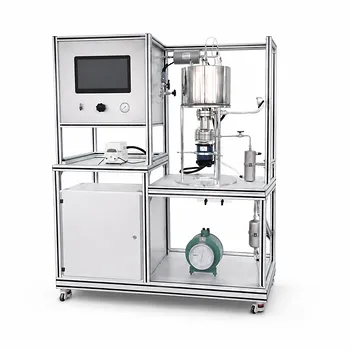
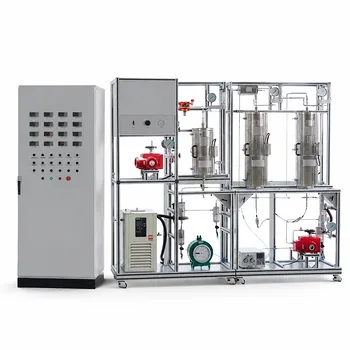
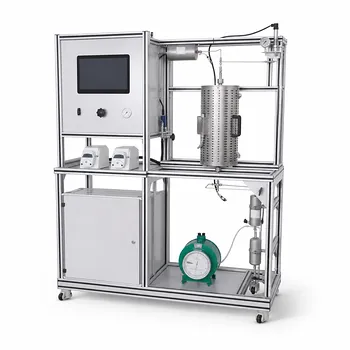
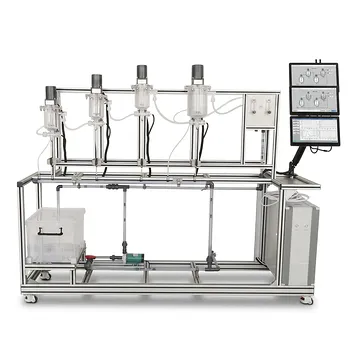
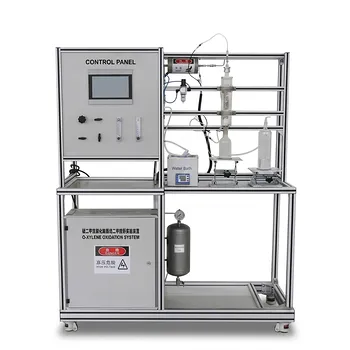
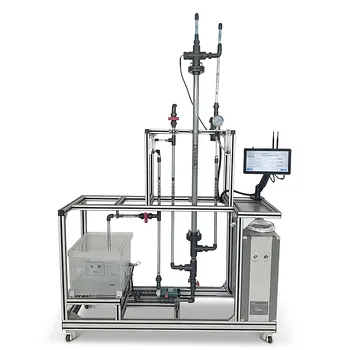
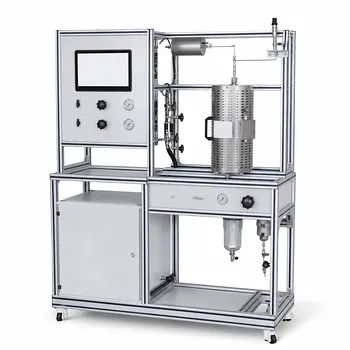
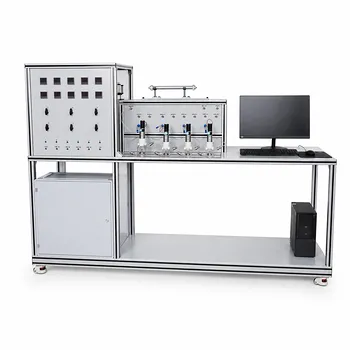
Transitioning from complex numerical models to real-world applications requires reliable, high-precision equipment. LABPARK provides state-of-the-art Educational and Vocational Unit Operations Pilot Plants in chemical engineering, bioprocess & biotech, and environmental & water treatment.
Tailored for universities, research institutes, and enterprises, our modular pilot plants enable you to validate catalytic reactor simulations and chemical processes under realistic, scalable conditions.
Ready to elevate your research and training capabilities? Contact LABPARK today to discuss your pilot plant requirements!
Related Products
- Multi Functional Catalytic Reaction and Reactor Evaluation Educational Unit Operations Pilot Plant
- Micro-Scale Gas-Solid Catalytic Reaction Educational Pilot Plant
- Internal Circulation Gradient Free Catalytic Reaction Educational Pilot Plant
- Fixed Bed Gas Solid Catalytic Reaction Educational Pilot Plant
- Fluidized Bed Gas Solid Catalytic Reaction Educational Pilot Plant
People Also Ask
- What reaction engineering principles are shown in a catalytic reactor pilot plant? SO2 Oxidation Guide
- Why is FTIR integration in catalytic pilot plants important? Real-Time Student Insights
- How to analyze active metal distribution & identify catalyst poisoning in pilot plants? Expert Diagnostic Guide
- How do temperature limits and WHSV influence catalytic reactor optimization? Scale-Up Guide
- What operational insights do catalyst pellet concentration profiles provide? Optimize Reactor Yield