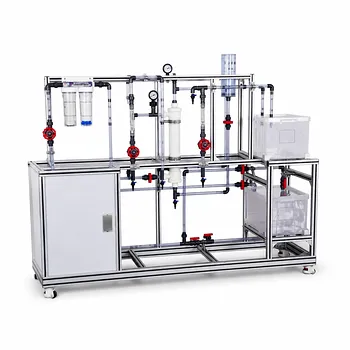
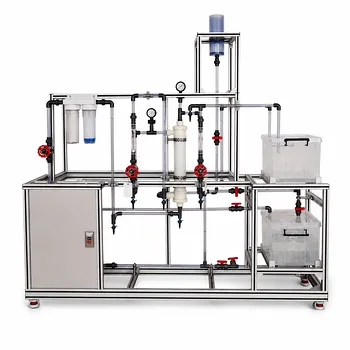
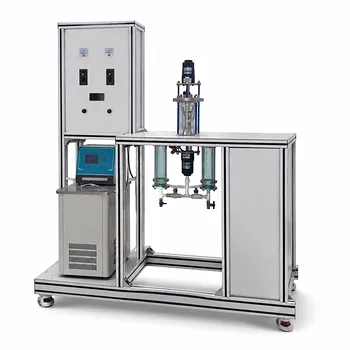
When equipping an educational electrodialysis pilot plant, the fundamental choice between homogeneous and heterogeneous membranes comes down to one structural factor: how the ion‑exchange material is distributed. In heterogeneous membranes, ion‑exchange resin particles are physically dispersed in an inert polymer binder, creating a discontinuous matrix that is tough but electrically inefficient. Homogeneous membranes, by contrast, carry their functional groups chemically bonded throughout a single continuous polymer phase, yielding superior electrochemical performance but often requiring mechanical reinforcement. The trade‑off defines what your students will observe—from energy consumption and product purity to the vivid demonstration of mass‑transport phenomena.
For an educational electrodialysis pilot plant, homogeneous membranes deliver the lowest electrical resistance and highest permselectivity, making them the benchmark for energy efficiency and high‑purity separations. Heterogeneous membranes trade some of that efficiency for outstanding mechanical durability and a tangible, particle‑based model of ion‑transfer physics, which is ideal for teaching fundamental mass‑transport and fabrication principles.
The Structural Divide: How the Membrane Matrix Defines Behavior
The way an ion‑exchange material is put together dictates every operational characteristic of the membrane. Understanding this structure‑performance link is the key to selecting the right membrane for a teaching pilot plant.
The Discontinuous Architecture of Heterogeneous Membranes
Heterogeneous membranes are built by grinding ion‑exchange resin into a fine powder and mixing it with a thermoplastic binder, such as polyethylene or polyvinylidene fluoride.
The blend is then hot‑pressed onto a reinforcing fabric, resulting in a thick, opaque sheet that is mechanically rugged.
Because ion transfer relies on the physical contact between dispersed resin particles, there is no continuous conductive pathway.
Cracks and gaps inevitably form at the interface between the resin and the inert binder, creating barriers that raise electrical resistance and lower the membrane’s ability to selectively transport counter‑ions.
The Continuous‑Phase Unity of Homogeneous Membranes
In a homogeneous membrane, ionic groups—such as sulfonic acid or quaternary amines—are chemically integrated into a single crosslinked polymer matrix, typically based on styrene‑divinylbenzene.
There is no separate binding phase; the entire material is a unified ion‑conductor.
This chemical continuity eliminates the inter‑particle contact resistance seen in heterogeneous types.
As a result, homogeneous membranes offer significantly lower electrical resistance and superior permselectivity, though they may need plasticizers or a reinforcing backing to compensate for the lack of an intrinsic mechanical support structure.
Performance Divergence: How Structure Drives Operational Differences
The structural contrast translates directly into measurable differences that students will see in the lab—from voltage readings to the purity of the separated streams.
Electrical Resistance and Energy Demand
Homogeneous membranes create a smooth, uninterrupted path for ions, cutting down the voltage required to drive a given current density.
Heterogeneous membranes present a tortuous, particle‑to‑particle route that increases stack resistance by up to several folds, raising the pilot plant’s power consumption.
For an educational setting, this means a homogeneous‑membrane stack will run cooler and with a lighter electrical load, while a heterogeneous stack makes the penalty of poor conduction vividly clear.
Permselectivity and Separation Purity
Permselectivity—the membrane’s ability to let counter‑ions pass while rejecting co‑ions—is a direct measure of separation quality.
Homogeneous membranes, with their dense, uniform gel phase, routinely achieve permselectivity above 95% because the charged groups are uniformly distributed at the molecular level.
Heterogeneous membranes suffer from regions where the inert binder provides no charge selectivity, leading to co‑ion leakage.
This lowers overall permselectivity and can degrade the purity of the product streams, a phenomenon students can quantify through conductivity or concentration measurements.
Mechanical Robustness and Handling
Heterogeneous membranes win on physical toughness. The thermoplastic binder and reinforcing fabric make them resistant to tearing, puncture, and dimensional swelling, even in concentrated solutions.
They are forgiving of rough handling by students and maintain their integrity over many start‑stop cycles.
Homogeneous membranes, being essentially a pure gel supported only by a thin fabric, are more prone to mechanical deformation.
Pilot plant operators must use careful handling and avoid extreme pressure gradients or rapid concentration swings that could crack or delaminate the membrane.
The Contrasting Hydraulic Permeability Under Concentration Gradients
A less obvious but critical difference emerges when the external salt concentration changes.
For a pilot plant that concentrates brines, this contrast can either stabilize or destabilize operation.
- Homogeneous membranes: As the external solution concentration rises, the gel phase progressively dehydrates. The water pathways shrink, and hydraulic permeability decreases, limiting unintended water transport.
- Heterogeneous membranes: Rising concentration causes the internal ion‑exchange resin particles to shrink. This enlarges the cracks and gaps between the resin domains and the inert binder, dramatically increasing hydraulic permeability and allowing more uncontrolled water passage.
Understanding the Trade‑offs for a Teaching Environment
No single membrane type is universally “better.” The optimal choice depends on what you want your students to learn and the operational envelope you plan to explore.
Efficiency vs. Durability
Homogeneous membranes give you textbook‑ideal performance: low voltage, high selectivity, and minimal energy waste.
But they demand disciplined assembly and careful maintenance, which can challenge novice operators.
Heterogeneous membranes let you run the same plant rougher and with less worry about breakage, at the cost of higher energy bills and lower product purity.
Concentration Range Restrictions
If your educational plan includes concentrating streams from brackish water all the way to near‑saturation, the permeability inversion matters.
Heterogeneous membranes become increasingly leaky to water at high salinity, potentially swamping your intended concentration effect. Homogeneous membranes, by shrinking their water channels, help maintain a tighter separation.
Teaching Opportunities
The very weaknesses of heterogeneous membranes can be turned into powerful demonstrations.
The observable jump in stack resistance, the measurable drop in selectivity, and the visible water‑flow changes when concentration varies all give students a direct, hands‑on understanding of ion‑transport fundamentals.
Homogeneous membranes offer a smoother, more modern process that mirrors current industry practice, making them the best platform for teaching energy‑efficiency optimization and high‑purity production.
Making the Right Choice for Your Educational Goals
Select the membrane type that aligns with your primary teaching objectives and the robustness your lab environment demands.
- If your primary focus is demonstrating energy efficiency and high‑purity separations: Choose homogeneous membranes. Their low resistance and exceptional permselectivity mirror modern industrial ED plants and let students measure industry‑standard performance metrics without confounding artifacts.
- If your primary focus is teaching the fundamental physics of ion transport and membrane fabrication: Choose heterogeneous membranes. The large electrical resistance, co‑ion leakage, and dramatic hydraulic‑permeability changes with concentration serve as a transparent physical model, helping students visualize contact resistance, selectivity loss, and swelling effects.
- If you plan to concentrate high‑salinity streams (e.g., brine from seawater experiments): Strongly consider homogeneous membranes. Their decreasing hydraulic permeability at high concentrations helps maintain a stable concentration gradient, whereas heterogeneous membranes’ increased water leakage can undermine separation experiments.
- If lab handling is a major concern and students will frequently assemble/disassemble the stack: Start with heterogeneous membranes. Their ruggedness reduces downtime and maintenance costs while still providing a valid, if less efficient, electrodialysis experience.
Your choice ultimately transforms a pilot plant from a simple demonstration into a deep, context‑rich learning environment that reveals precisely the electrochemical phenomena you intend to explore.
Summary Table:
| Feature | Homogeneous Membranes | Heterogeneous Membranes |
|---|---|---|
| Structure | Continuous chemical matrix (single polymer phase) | Dispersed resin particles in an inert polymer binder |
| Electrical Resistance | Low (highly energy-efficient) | High (higher stack resistance and power use) |
| Permselectivity | High (>95%, superior separation purity) | Lower (prone to co-ion leakage) |
| Durability & Handling | Delicate (sensitive to pressure and cracks) | Highly rugged (resistant to tearing and swelling) |
| Hydraulic Permeability | Decreases at high salt concentrations | Increases at high salt concentrations (water leakage) |
| Best For | Demonstrating modern industrial efficiency | Teaching ion-transport physics and rugged lab handling |
Equip Your Lab with Industry-Leading Pilot Plants
Are you looking to optimize your chemical engineering curriculum or research capabilities? LABPARK provides premium Educational and Vocational Unit Operations Pilot Plants in chemical engineering, bioprocess & biotech, and environmental & water treatment.
Designed specifically for universities, research institutes, and enterprises, our advanced systems offer hands-on training with cutting-edge membrane technologies. Contact LABPARK today to discuss your laboratory requirements and receive a customized solution for your institution.
Related Products
- Ion Exchange Water Purification Educational Pilot Plant for Engineering Unit Operations
- Alkaline Membrane Water Electrolysis Educational Pilot Plant Unit Operations Training System
- Hollow Fiber Ultrafiltration Membrane Separation Educational Pilot Plant
- Ultrafiltration Membrane Separation Educational Pilot Plant
- Multifunctional Membrane Separation Educational Pilot Plant with Ultrafiltration, Nanofiltration, Reverse Osmosis
People Also Ask
- How to Prevent Ion Exchange Channeling? Expert Solutions for Pilot Plants
- How does ion exchange work in water treatment pilot plants? Cost & process guide.
- What operational precautions should lab operators take for resin volume changes and air pockets? Key Guide
- How to use ion exchange pilot plants to verify alkalinity? A hands-on guide for engineering students.
- How can students use ion exchange pilot plants for column sizing? Master Wastewater Design