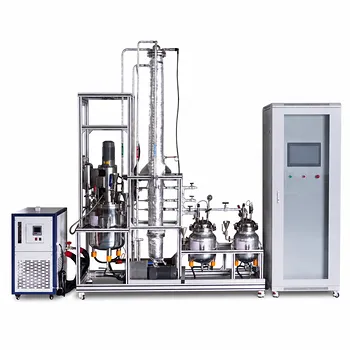
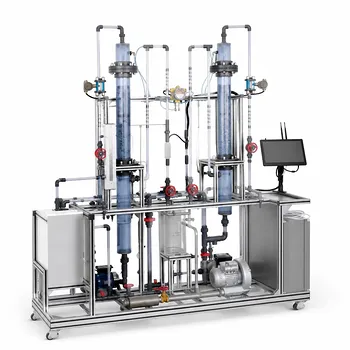
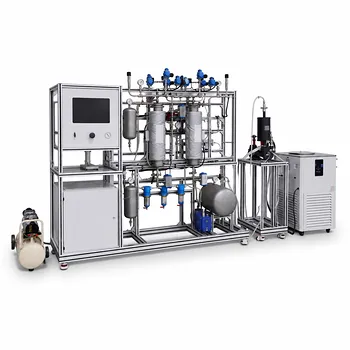
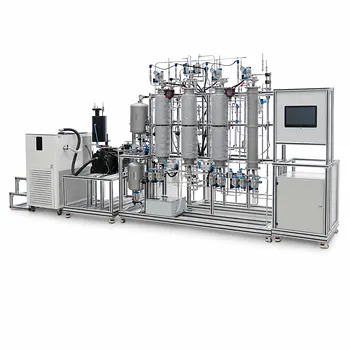
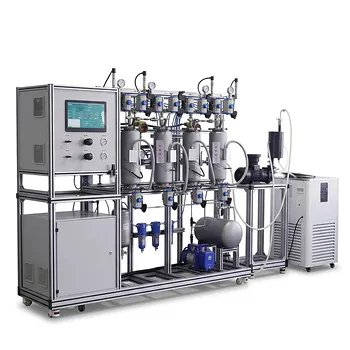
For solvent dehydration training, the clear choice is the plate-and-frame module.
Spiral-wound modules face severe performance limitations when separating water from solvents—the enormous volume of vaporous permeate clogs their narrow internal channels, and their glues and polymeric spacers rapidly degrade under the aggressive chemical and thermal conditions of dehydration. Plate modules eliminate these pressure-drop and stability problems, while costing less to install and maintain.
In solvent dehydration, spiral-wound modules suffer from high permeate-side pressure losses and poor chemical compatibility with glues and spacers. For educational pilot plants, plate-and-frame modules are preferred because they handle the high permeate vapor volumes, withstand harsh solvent environments, and provide a far more reliable, cost-effective platform for unit operations training.
Why Solvent Dehydration Pushes Spiral‑Wound Modules to Their Breaking Point
Dehydration—stripping water from an organic solvent—creates a process environment that is fundamentally hostile to the standard spiral‑wound design. Two technical hurdles make spiral‑wound modules impractical for this training duty.
The Vaporous Permeate Problem
In dehydration, the preferential removal of water produces a very large volume of low‑molecular‑weight vapor on the permeate side.
This contrasts sharply with organophilic separations, where the removed organic molecules are heavier and the permeate volume is much smaller.
Inside a spiral‑wound element, the permeate vapor must travel through a thin, net‑like spacer to reach the central collection tube.
When the permeate flow is enormous, that narrow channel creates destructive pressure losses—restricting throughput, increasing the load on the vacuum pump, and even collapsing the membrane envelope.
Plate‑and‑frame modules channel the permeate vapor through much shorter, wider, and more open pathways.
This design minimizes pressure drop, allowing the module to handle the high vapor loads of dehydration without the flow‑choking limitations inherent in a spirally wound envelope.
Chemical Stability of Spacers and Glues
Dehydration conditions are chemically demanding.
Elevated temperatures, aggressive solvents, and high water activity attack the feed‑side spacer nets and the specialty adhesives that seal a spiral‑wound module.
Standard polymeric spacers and glues can soften, swell, or delaminate, causing a sudden loss of selectivity or a complete leak.
Developing chemically resistant, dehydration‑grade spirals is possible, but expensive and often not economically viable for pilot‑scale training systems.
Plate modules avoid this vulnerability entirely.
Their flat‑sheet membranes are mechanically clamped, gasketed, or sealed in a way that does not rely on adhesives, and they often use metal or chemically inert frame materials that stand up to harsh solvents.
Why Plate Modules Excel in Educational Pilot Plants
Training plants are not just scaled‑down industrial units—they must be robust, easy to understand, and forgiving of student error. Plate‑and‑frame construction delivers on all three counts.
Low Pressure Loss and Reliable Operation
By giving the permeate vapor a direct, unrestricted path out of the membrane envelope, plate modules maintain stable transmembrane pressure and consistent flux.
This predictability is essential for a teaching tool: students can observe a direct cause‑and‑effect relationship between operating parameters and performance, without the confounding influence of internal pressure loss.
Less energy wasted in overcoming permeate‑side resistance also means a more energy‑efficient pilot—an important cost and sustainability lesson in itself.
Robustness for Student Use and Maintenance
Students in a vocational laboratory run varied, sometimes “dirty,” feed mixes and may inadvertently push the system beyond industrial norms.
Plate‑and‑frame modules shine here because they are easy to disassemble, inspect, and manually clean—no special tools required. Individual membrane sheets can be replaced without scrapping the entire module.
In contrast, a fouled or damaged spiral‑wound element is essentially a throw‑away item on this scale.
The plate module’s low‑fuss maintainability turns a mishap into a learning moment rather than a costly downtime event.
Cost-Effectiveness for Training Investments
The initial capital cost of a plate‑and‑frame pilot system is typically lower than a dehydration‑capable spiral‑wound alternative (which would require exotic adhesives and spacers).
Because plates allow membrane sheets to be swapped independently, the long‑term consumable costs are also reduced—only the failed membrane, not the entire module, is replaced.
For an educational institution measuring budget against instructional value, the plate module offers the most reliable return on investment.
Understanding the Trade‑offs
Choosing a plate‑and‑frame module is not a universal solution; it carries its own set of limitations that students should appreciate.
- Lower packing density: Plate modules offer 160–500 m² of membrane area per cubic meter, far below spiral‑wound (650–1,600 m²/m³) or hollow‑fiber (16,000+ m²/m³) alternatives. This makes them unsuitable for demonstrating how high‑area, compact industrial systems are designed.
- More complex frame assembly: Plate‑and‑frame systems have more individual parts to align, gasket, and torque. While that teaches mechanical basics, it can be a source of leaks if not assembled carefully.
- Not representative of large‑scale dehydration plants: Modern industrial dehydration often uses specially engineered spiral‑wound modules or membrane‑vapor separation hybrids. A purely plate‑and‑frame pilot may not fully replicate those flow regimes.
However, for the specific goal of teaching solvent dehydration in a hands‑on pilot plant, the plate module’s resilience and simplicity far outweigh its lower area density.
Making the Right Choice for Your Goal
Your ideal module geometry depends entirely on what you want your students to learn. Use these goal‑oriented guidelines to align hardware with teaching objectives.
- If your primary focus is demonstrating reliable solvent dehydration: Choose a plate‑and‑frame setup. Its low permeate‑side pressure drop and chemical stability ensure the plant runs predictably, day after day, even with student operators.
- If your primary focus is replicating industrial reverse osmosis or ultrafiltration: A spiral‑wound module is the standard. Its higher packing density and needle‑like permeate channels mirror real‑world RO/UF behavior, and the feed water for these processes is far less harsh than a hot solvent stream.
- If your primary focus is high‑efficiency water polishing or gas separation experiments: Opt for hollow‑fiber modules. Their extreme packing density teaches the trade‑offs of pretreat‑ment requirements and mass transfer limitations in self‑supporting membrane geometries.
- If your primary focus is teaching general unit operations with aggressive feeds: A plate‑and‑frame or tubular system will survive the widest range of fluids. The ability to open, clean, and replace individual membranes gives you the greatest experimental freedom.
Solvent dehydration places unique stress on membrane modules. For a training pilot plant, the plate‑and‑frame module isn’t just a safe choice—it’s the engineering‑sound one that turns process challenges into clear, teachable moments.
Summary Table:
| Feature | Plate-and-Frame Module | Spiral-Wound Module |
|---|---|---|
| Permeate Pressure Drop | Low (short, wide vapor paths prevent clogging) | High (narrow spacer channels restrict vapor flow) |
| Chemical Stability | High (gasketed/clamped, no adhesives used) | Low (glues and spacers degrade in hot solvents) |
| Maintenance & Cleaning | Easy disassembly and individual membrane replacement | Difficult (clogged/damaged modules must be discarded) |
| Best Academic Use | Solvent dehydration & aggressive fluid training | Standard water treatment (RO/UF) training |
Elevate Your Practical Training with LABPARK
Ready to equip your facility with robust, hands-on learning systems? LABPARK provides state-of-the-art Educational and Vocational Unit Operations Pilot Plants in chemical engineering, bioprocess & biotech, and environmental & water treatment.
Specially designed for universities, research institutes, and enterprises, our systems—including customizable membrane separation units—are engineered to withstand student operation while delivering clear, observable process data.
Contact us today to discover how LABPARK can bring reliable, industry-grade unit operations training to your laboratory!
Related Products
- Photocatalytic Membrane Separation and Degradation Unit Operations Pilot Plant
- Ultrafiltration Membrane Separation Educational Pilot Plant
- Multifunctional Membrane Separation Educational Pilot Plant with Ultrafiltration, Nanofiltration, Reverse Osmosis
- Multi-Functional Membrane Separation Educational Pilot Plant for Unit Operations Lab
- Hollow Fiber Ultrafiltration Membrane Separation Educational Pilot Plant
People Also Ask
- What are the key differences in membrane configurations? Choose the Right Unit Operations Pilot Plant
- How Do Pervaporation, Vapor, and Gas Permeation Differ in Pilot Plants? Key Comparison
- What are the structural & performance trade-offs of flat-sheet, spiral-wound, & hollow-fiber membrane modules?
- How do PEI, PVDF, and PSU membranes compare in pilot plants? Find the best fit.
- Pervaporation vs. Vapor Permeation: Handling Suspended Solids in Membrane Pilot Plants