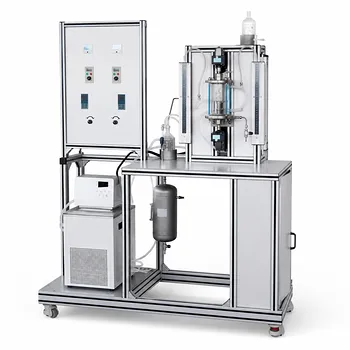
The decision rests on a clear understanding of your reaction's thermal behavior, kinetics, and mixing demands.
The primary differentiator is the method of agitation. A stirred-tank reactor uses a mechanical impeller, making it the versatile workhorse for reactions with significant heat generation or viscous fluids that require active, controlled mixing. A bubble column reactor achieves mixing solely through the buoyancy of rising gas bubbles, creating an elegantly simple, low-cost system ideal for slower reactions where mechanical agitation is unnecessary and the key transformation occurs in the liquid bulk.
The choice between a stirred-tank reactor and a bubble column reactor is not a matter of superiority, but of suitability. It boils down to whether your reaction's needs are economically met by the bubble column's passive mixing or require the stirred tank's active mechanical power for thermal control, mass transfer, and fluid handling.
Deconstructing the Reactor Types at Pilot Scale
Choosing the right configuration is a pivotal decision in a pilot plant, as it directly impacts scalability, safety, and the quality of data you can collect. The core difference is how each system introduces the energy needed for mass transfer and mixing.
The Stirred-Tank Reactor: Active Control and Versatility
This is the equivalent of an all-purpose kitchen mixer for chemical processes. A motor-driven impeller provides the energy to shear gas bubbles, disperse them into the liquid, and force bulk fluid circulation.
This mechanical power gives it a crucial advantage: it decouples mixing from gas throughput. You can precisely control the interfacial area for mass transfer, making it the default choice for exploring reactions with unknown kinetics or demanding physical properties.
- Unmatched Thermal Management: The high mixing intensity makes it ideal for highly exothermic or endothermic reactions. It can be effectively paired with cooling jackets, internal coils, or external heat exchangers, preventing dangerous hotspots.
- Processing Challenging Fluids: The mechanical agitator can handle high-viscosity liquids or slurries where a bubble column would fail to achieve proper blending.
- Defined Mixing Behavior: It approximates a Continuous Stirred-Tank Reactor (CSTR) pattern, characterized by active backmixing. This results in a uniform composition throughout the vessel, simplifying kinetic analysis.
The Bubble Column Reactor: Elegant Simplicity
Consider this a precision aerator. A gas stream, introduced through a distributor at the bottom, is the sole source of energy. As bubbles rise, they create liquid circulation patterns and interfacial area.
Its value proposition in a pilot plant is its mechanical simplicity and low cost. With no moving parts inside the vessel, it offers a low-maintenance solution when the process requirements are forgiving.
- Energy from Gas Flow: All mixing and mass transfer are directly tied to the superficial gas velocity. The power input per unit volume is a function of the gas flow rate and pressure drop, often analyzed using dimensionless numbers like the Froude and Galileo numbers.
- Plug-Flow Gas Dynamics: The gas phase moves through the liquid with less backmixing than in a stirred tank. This can be an advantage for reactions where a concentration gradient in the gas phase is beneficial.
- Simplicity as a Feature: The absence of seals, shafts, and motors reduces both capital expenditure and ongoing maintenance, a key advantage for long-duration pilot runs involving corrosive or sterile environments.
A Framework Based on Reaction Principles
Your choice must be grounded not just in the equipment's features, but in the fundamental nature of your gas-liquid reaction. This is where pilot plant data provides the most value for scale-up.
Matching Liquid Holdup to Reaction Speed
The absolute most critical conceptual tool is the Hatta number ($\sqrt{M}$), which maps a reaction's speed relative to mass transfer rate.
- For Slow Reactions ($\sqrt{M} < 0.3$): The reaction is so slow it occurs entirely in the bulk liquid, not the gas-liquid film. Your primary need is a large volume of liquid to provide sufficient residence time. Both stirred-tank and bubble column reactors excel here because they feature high liquid holdup (>70%). This makes them your primary candidates.
- For Fast Reactions ($\sqrt{M} > 3$): The reaction is instantaneous and happens inside the liquid film surrounding the bubble. Your need shifts from liquid volume to a massive interfacial area. For these, you would immediately eliminate bubble columns and stirred tanks in favor of packed columns or spray towers with low liquid holdup.
The Role of the Mass Transfer Coefficient (kLa)
For the intermediate-to-slow reactions where these two reactor types compete, the volumetric mass transfer coefficient ($k_La$) becomes a key performance indicator.
Empirical data from pilot-scale equipment shows a significant performance overlap:
- Stirred-Tank Reactors exhibit $k_La$ values in the moderate range of 0.03 to 0.3 s⁻¹.
- Bubble Columns operate in a similar range of 0.05 to 0.24 s⁻¹.
This overlap proves that for many mass-transfer-limited reactions, a bubble column can match a stirred tank’s performance without the mechanical complexity. A stirred tank is only essential if your required $k_La$ value nears the top of this range, which demands the higher power input from the impeller.
Understanding the Trade-offs
No configuration is flawless. A decision framework is useless without an honest look at the inherent compromises.
Mechanical Complexity vs. Operational Simplicity
The stirred tank's power comes at a literal cost. The motor, shaft, seals, and impeller blades significantly increase the initial investment and create maintenance demands. The rotating seal is a common failure point, especially at high pressures or with volatile fluids. In direct contrast, a bubble column's empty-vessel design eliminates these concerns, making it inherently more robust and easier to clean, a critical factor for contamination-free pilot plant campaigns.
Mixing Profiles and Fluid Limitations
The difference in mixing creates distinct conversion patterns. A stirred tank’s heavy backmixing can be a disadvantage if your goal is a high single-pass conversion, as the exit stream will have the same low concentration as the well-mixed tank volume. A bubble column’s plug-flow-like gas phase can offer a higher driving force for absorption. However, the bubble column’s Achilles' heel is viscosity. Its mixing mechanism is too weak to handle viscous fluids, causing severe channeling and stagnant zones. The mechanical thrust of a stirred tank is required for these systems.
What About Airlift Reactors?
For biological processes, an airlift reactor offers a middle ground. It retains the seal-less simplicity of a bubble column but introduces an internal draft tube. This structure directs bulk liquid circulation in a defined loop, offering more controlled mixing and higher oxygen transfer capabilities than a simple bubble column, albeit at a higher air pressure demand.
Making the Right Choice for Your Goal
Your final selection in a pilot plant environment must reflect your primary goal, whether it's providing flexibility for research, mimicking a specific production process, or teaching fundamental principles.
- If your primary focus is handling highly exothermic or viscous reactions: You must select the stirred-tank reactor. Its mechanical agitation and heat transfer surface area are non-negotiable requirements for safe and effective operation.
- If your primary focus is minimizing capital and maintenance for a long-term, slow reaction with low-viscosity fluids: The bubble column reactor is the tactically superior choice, offering equivalent mass transfer capacity with far less mechanical overhead.
- If your primary goal is fundamental research on liquid-phase kinetics for a slow reaction: A stirred-tank reactor is often preferred. Its well-mixed approximation simplifies the math, allowing you to isolate the intrinsic reaction rate without the complicating fluid dynamics of a bubble column.
- If your primary goal is teaching or piloting an autocatalytic or intermediate-selective process: Consider the mixing profile. Use a plug-flow configuration for maximizing an intermediate product (like a bubble column's gas phase) and a mixed-flow configuration (CSTR) to maximize a secondary product from reactant-product interaction.
The right pilot plant reactor is the one that most transparently reveals your process’s true economic and physical limits, preparing you for a successful move to production scale.
Summary Table:
| Feature | Stirred-Tank Reactor (STR) | Bubble Column Reactor (BCR) |
|---|---|---|
| Agitation Method | Active (Mechanical Impeller) | Passive (Buoyancy of Rising Gas) |
| Heat Control | Excellent (Jackets, internal coils) | Moderate |
| Fluid Capability | Handles high-viscosity & slurries | Low-viscosity only (avoids channeling) |
| Complexity & Cost | High (Moving parts, seals, motor) | Low (No moving parts, low maintenance) |
| $k_La$ Range | 0.03 to 0.3 s⁻¹ | 0.05 to 0.24 s⁻¹ |
Optimize Your Unit Operations with LABPARK
Selecting the right reactor configuration is critical for accurate scalability, reliable research, and effective hands-on learning. LABPARK provides premium Educational and Vocational Unit Operations Pilot Plants across chemical engineering, bioprocess & biotech, and environmental & water treatment.
Whether you are designing a curriculum for universities, conducting advanced research at institutes, or scaling up processes for enterprises, we deliver the precise pilot systems you need.
Ready to elevate your laboratory capabilities? Contact LABPARK today to discuss your pilot plant specifications!
Related Products
- Dual-Drive Stirred Gas-Liquid Mass Transfer Coefficient Determination Pilot Plant
- Micro-Scale Gas-Solid Catalytic Reaction Educational Pilot Plant
- Fixed Bed Gas Solid Catalytic Reaction Educational Pilot Plant
- Fluidized Bed Gas Solid Catalytic Reaction Educational Pilot Plant
- Fixed-Bed Chemical Reaction and Gas Dust Tar Removal Unit Operations Pilot Plant
People Also Ask
- How does temperature affect mass transfer rates in chemical engineering educational pilot plants?
- How do pilot plants study gas solubility in polymer melts at high pressures? Key Mass Transfer Insights
- How does column packing affect absorption intensification, and how is it evaluated experimentally?
- Why Compare Membrane-Reservoir Models with Pilot Plant Data? Ensure Successful Process Scale-Up
- How does k_La affect hydrogenation scale-up? Critical insights for pilot reactors.