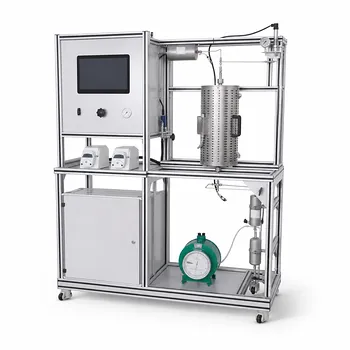
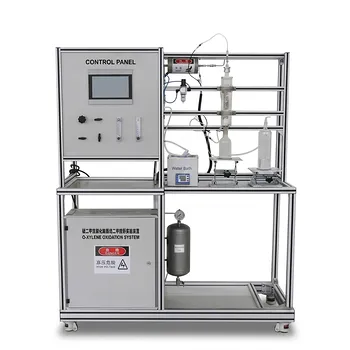
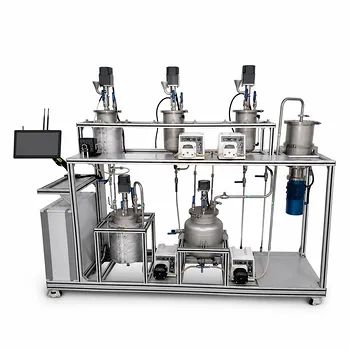
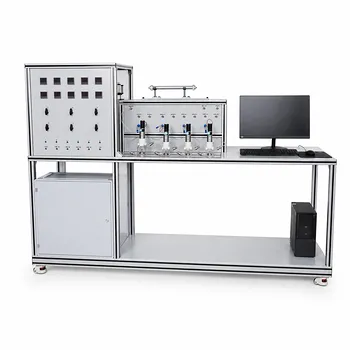
Precision temperature control is the make-or-break challenge in fixed-bed catalytic reactor pilot plants—especially when reactions veer toward extreme heat release or absorption. For highly endothermic reactions like steam reforming, the solution lies in aggressive external heating: mounting catalyst-filled tubes inside a high-flux furnace while keeping the tube diameter to 0.1 meters or less ensures rapid, uniform heat input. For highly exothermic reactions such as ammonia synthesis or nitration, the answer is multistage staging with intermediate cooling—either through external heat exchangers or direct injection of cold quench gas between catalyst beds—paired with jacketed walls or internal coils to remove heat and prevent runaway.
Managing temperature in pilot-scale fixed beds is not about eliminating heat effects, but about shaping the thermal profile so the reaction trajectory stays close to the optimum rate path. This means matching the heat‑transfer design to the reaction’s heat signature: supply heat fast for endothermic drops, and remove heat precisely for exothermic spikes—always with safety and catalyst integrity in mind.
The Dual Nature of Heat in Catalytic Reactors
Every fixed-bed catalytic reaction brings heat into play, but the direction and intensity differ dramatically. Understanding this split is the starting point for sound pilot plant design.
The Challenge of Rapid Temperature Drops in Endothermic Reactions
Highly endothermic reactions such as steam reforming absorb heat so quickly that the catalyst bed cools almost instantly. Without replenishment, the reaction rate collapses because the local temperature falls below the activation threshold. The heat must be driven into the catalyst at a pace that matches the reaction’s consumption.
The Runaway Risk in Exothermic Reactions
Exothermic reactions like ammonia synthesis, benzene alkylation, or nitration release vast amounts of energy. Left unchecked, hot spots can accelerate the reaction beyond control, causing catalyst sintering, undesired side products, or even thermal runaway with hazardous pressure build‑up. Pilot‑scale safety demands that heat removal be immediate and fail‑safe.
Mastering Endothermic Reactions: Maximizing Heat Input
For endothermic systems, the design philosophy is “heat the reacting mass as quickly and evenly as possible.” The primary reference’s advice gives the blueprint.
High‑Flux Furnaces and Narrow Tube Diameters
The most direct solution is to mount catalyst‑filled tubes inside a furnace that delivers an exceptionally high heat flux. Radiation and convection from the furnace walls rapidly raise the tube wall temperature. However, a large tube diameter would create a cold core where the reaction starves. By limiting the tube inner diameter to 0.1 meters or less, the temperature gradient from the wall to the center stays minimal, ensuring nearly uniform radial heating and full catalyst effectiveness.
Preheating Feed and Matching Heat Transfer Media
Supplementary strategies that reinforce the furnace design include preheating the feed gas so that the reactant mixture enters the bed already close to the activation temperature. In some pilot plants, heat transfer media such as thermal oil or molten salt circulate through jacketed tubes to smooth out temperature ripples, but the core principle remains: supply heat at a rate equal to or greater than what the reaction will consume, right at the point of consumption.
Taming Exothermic Reactions: Multistage Staging and Precision Cooling
Exothermic processes demand the opposite approach—removing heat in a controlled fashion. The primary reference highlights multibed reactors with intermediate cooling as the definitive strategy, and supplementary examples show how to make it work in practice.
The Power of Multibed Interstage Cooling
A single adiabatic bed for a strongly exothermic reaction would rapidly rise in temperature until it hits thermodynamic equilibrium, wasting catalyst potential. Splitting the reactor into several beds with interstage cooling breaks the temperature‑conversion trajectory into manageable steps. After each bed, the partially converted stream passes through an external heat exchanger or encounters a quench injection, lowering the temperature before entering the next bed. This keeps the reaction path close to the optimum rate locus, as an x‑T diagram analysis would reveal.
Quench Gas Injection: A Direct and Responsive Control
Direct injection of a cold feed component between beds provides the fastest thermal response. For example, in the gas‑phase alkylation of benzene, cold ethene is injected as a quench gas to instantly cool the reacting mixture before it enters the next catalyst bed. This method avoids the heat‑transfer‑lag of exchangers and can be tuned using a simple temperature‑to‑flow cascade control loop, a staple in pilot‑plant training.
Heat Removal via Jackets, Coils, and Specialized Media
For reactions that occur in a single bed but cannot tolerate hot spots, removing heat from the reactor wall and interior becomes essential. In nitration pilot plants—where benzene nitration releases ~134 kJ/mol and temperatures must stay below critical limits (e.g., 80 °C for dimethylnitrobenzene or 120 °C for dinitrotoluene to avoid decomposition)—reactors are equipped with external jackets and internal helical cooling coils. The coolant (cooling water, brine, or thermal oil) is circulated automatically based on temperature sensors, teaching operators how to spot and arrest a developing hot spot before it escalates.
For broader exothermic fixed beds, jacketed reactors filled with thermal oil, pressurized water, or molten salt serve as heat sinks. The process‑side heat transfer coefficient is often enhanced by the turbulence of gas bubbles in two‑phase systems, but the fundamental strategy remains: keep the heat‑transfer surface as close to the catalyst as possible and control the coolant flow meticulously.
Advanced Control: Feed Concentration and Temperature Manipulation
Temperature control is not solely a hardware game. Adjusting the feed concentration—for instance, the ammonia‑to‑air ratio in nitric acid production—modulates the total heat release. Similarly, fine‑tuning the feed inlet temperature using a bypass around the preheater lets operators nudge the reaction to a stable operating point. Pilot plants often implement cascade control loops (temperature‑to‑flow or temperature‑to‑bypass) to automate these adjustments, giving researchers a realistic feel for industrial thermal management.
Beyond Traditional Fixed-Beds: Alternative Pilot Plant Strategies
Some pilot‑scale challenges push the limits of conventional solutions. Supplementary references highlight two powerful extensions.
Microchannel Reactors for Isothermal Precision
When extremely tight temperature control is non‑negotiable, microchannel reactors embed catalyst‑loaded metal foams directly between micro‑heat‑exchanger panels. This intimate contact allows heat to be removed almost instantaneously. During CO preferential oxidation, which would otherwise see a temperature spike exceeding 100 °C under adiabatic conditions, the active cooling confines the temperature rise to ±20 °C. Pilot plants using this design can study isothermal kinetics safely and avoid runaway side reactions like unwanted hydrogen oxidation.
Using x‑T Diagrams to Optimize Staging
For processes like SO₂ oxidation or ammonia synthesis, an x‑T (conversion‑versus‑temperature) diagram becomes the pilot plant’s roadmap. By plotting the equilibrium curve and the locus of maximum reaction rates, designers can decide the optimal number of beds, catalyst distribution, and interstage cooling duty. This analytical tool converts thermal control from a guessing game into a quantitative exercise that students and researchers can replicate.
Understanding the Trade-offs
Every temperature control strategy brings compromises. A true technical advisor will lay them out plainly, because no single solution fits all.
- Narrow tubes (endothermic) increase pressure drop and capital cost. A 0.1‑m diameter furnace tube is expensive to fabricate and limits throughput. Scaling up from a pilot unit to a full‑scale plant may require a bundle of hundreds of tubes.
- Multibed reactors add complexity and footprint. Each interstage cooler or quench point introduces control valves, piping, and potential leak paths. The capital and maintenance expenses rise with the number of beds.
- Quench gas injection can dilute the reactant mixture. This may push downstream equilibrium unfavorably or require additional separation steps. In some chemistries, the quench gas itself can react, altering selectivity.
- Jacketed/coiled reactors in pilot scale may not reflect industrial thermal gradients. The wall‑cooling effect is exaggerated in small diameters, potentially giving a false sense of temperature uniformity that does not scale linearly to production units.
- Microchannel reactors, while exquisitely temperature‑controlled, have limited capacity and can foul easily. They are excellent for kinetic studies but may not represent the hydrodynamics of large fixed beds.
- Automated cascade control relies on sensor accuracy and actuator speed. A poorly calibrated thermocouple or a sticky valve can render the best cooling design useless, so pilot‑plant instrumentation must be maintained to research‑grade standards.
Making the Right Choice for Your Pilot Plant Goal
Your design must reflect the specific challenge you are trying to study or teach: kinetic data, process safety, scale‑up feasibility, or operator training.
- If your primary focus is endothermic kinetic studies: Choose a furnace‑heated reactor with a tube diameter no larger than 0.1 m, preheat the feed, and verify that wall temperatures stay uniform along the length.
- If your primary focus is exothermic selectivity and catalyst life: Opt for a multibed setup with interstage cooling and use an x‑T diagram to set the bed inlet conditions. Add quench injection if you need rapid transient response.
- If your primary focus is safety and runaway prevention (e.g., nitration): Design the reactor with both a jacket and internal coils, implement automated temperature‑to‑coolant loops, and install hard‑wired over‑temperature shutdowns. Train operators on the critical temperature limits and the feel of hot‑spot evolution.
- If your primary focus is isothermal kinetics in a micro‑scale setting: Consider a microchannel reactor with integrated heat‑exchange panels. Be aware that the heat‑transfer environment will not mimic traditional fixed beds, so use it for intrinsic kinetics and mechanistic studies.
- If your primary focus is scale‑up confidence: Combine pilot‑scale data with careful interpretation. The thermal profile in a jacketed small‑diameter tube may be flatter than at commercial scale; model that discrepancy explicitly when designing the production reactor.
Every fixed‑bed temperature challenge can be met with a clear, principle‑based strategy—and the right balance between heat flux, staging, and control will turn a potential runaway reactor into a predictable, productive pilot plant.
Summary Table:
| Reaction Type | Key Thermal Challenge | Primary Control Strategies |
|---|---|---|
| Highly Endothermic | Rapid temperature drop & reaction collapse | • Limit tube diameter to ≤ 0.1 m • High-flux furnaces • Feed preheating |
| Highly Exothermic | Hot spots, catalyst sintering, & thermal runaway | • Multistage staging with interstage cooling • Cold quench gas injection • Jacketed walls & internal cooling coils |
Optimize Your Reactor Designs with LABPARK
Managing complex thermal profiles in catalytic reactors requires precision-engineered equipment. LABPARK provides premium Educational and Vocational Unit Operations Pilot Plants in chemical engineering, bioprocess & biotech, and environmental & water treatment.
We empower universities, research institutes, and enterprises to:
- Achieve Industrial Realism: Train operators on safety systems, hot-spot mitigation, and cascade control loops.
- Ensure Precision Control: Access pilot plants designed with optimized heat-transfer interfaces for both endothermic and exothermic reactions.
- Accelerate Research: Obtain reliable kinetic and scale-up data using robust, research-grade instrumentation.
Ready to elevate your research and training capabilities? Contact us today to find the perfect pilot plant solution for your institution!
Related Products
- Fixed Bed Gas Solid Catalytic Reaction Educational Pilot Plant
- Fixed-Bed Chemical Reaction and Gas Dust Tar Removal Unit Operations Pilot Plant
- Multi Functional Catalytic Reaction and Reactor Evaluation Educational Unit Operations Pilot Plant
- Ethylbenzene Dehydrogenation Educational Unit Operations Pilot Plant
- Educational Unit Operations Pilot Plant for Intraparticle Diffusion Effective Factor Measurement
People Also Ask
- How do reactor pilot plants safely study gas-solid reactions? Master kinetics with thermal & flow control.
- How does the Mears criterion evaluate transport resistance? Key Guide to Intrinsic Kinetics
- Why is a multibed configuration necessary for exothermic reactions? Optimize your pilot plant trajectory.
- Fluidized vs. Fixed Bed Reactors: Comparing Heat & Complexity in Pilot Plants
- How is the friction factor determined for fixed-bed pilot plants? Select the best pressure drop correlation.