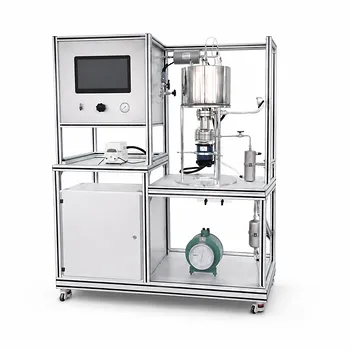
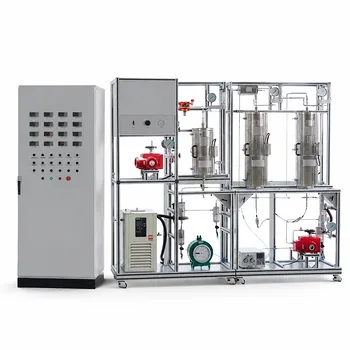
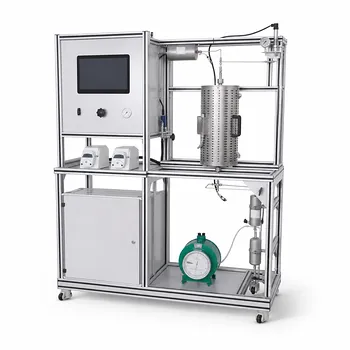
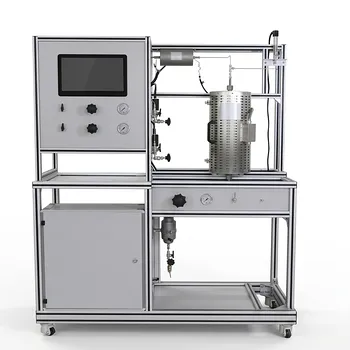
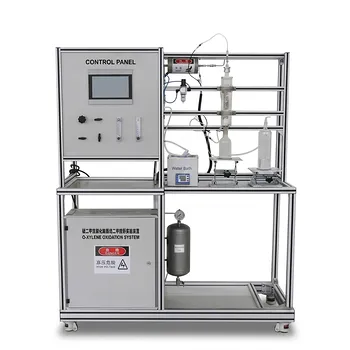
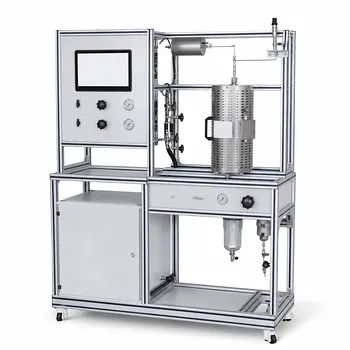
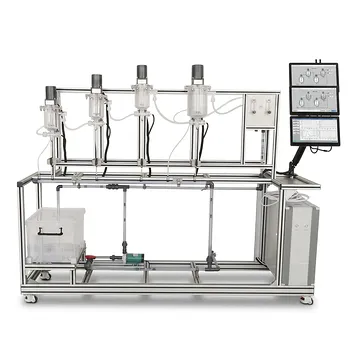
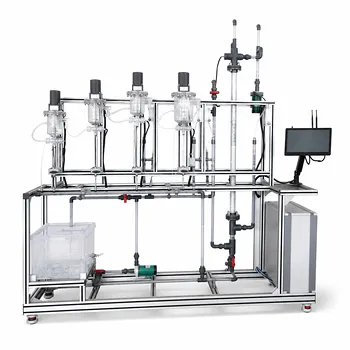
The key to managing heat in a catalytic reactor pilot plant is whether you can trust the fluid dynamics to do the work, or whether you must engineer a deliberate thermal profile. In slurry bed reactors, you remove heat entirely outside the vessel—using a pumped external loop with a specialized heat exchanger—because the violent motion of suspended catalyst particles would destroy any internal cooling surface. In a fixed-bed reactor, you protect the catalyst and control the reaction by dividing the bed into multiple, independently tempered stages, creating a teachable temperature profile that students can monitor and adjust in real time.
When designing a teaching pilot plant, the heat transfer strategy directly shapes the educational narrative. A slurry reactor teaches isothermal operation and external heat management, while a staged fixed-bed reactor reveals the consequence of radial temperature gradients and the need for zonal control. The choice determines which fundamental transport phenomenon your students will grapple with first-hand.
The Underlying Heat Transfer Divide
The difference in heat transfer management between slurry and fixed-bed units stems from their internal physics. A pilot plant must exaggerate these behaviors so students can measure and interpret them.
Why Slurry Reactors Achieve Near-Perfect Isothermality
Slurry reactors suspend fine catalyst particles (typically 10–150 μm) in a liquid. The combination of small particle size and vigorous backmixing creates an enormous heat transfer area and a homogeneous temperature.
The liquid acts as a thermal flywheel, absorbing exotherms instantly and distributing the heat uniformly. From a controls perspective, the entire vessel reads as a single, well-mixed temperature node. This makes the reactor an ideal platform for teaching reaction kinetics under isothermal assumption.
Why Fixed-Bed Reactors Generate Steep Thermal Gradients
Fixed-bed reactors use larger catalyst pellets (1–5 mm) packed in a tube or vessel. The packing resists radial heat transport, and the catalyst support itself is often a thermal insulator.
Heat generated at the center of the bed cannot escape quickly. The result is a parabolic radial temperature profile—low at the wall, dangerously high in the core. Pilot-scale units dramatically demonstrate this by placing multiple thermocouples across a single bed cross-section, showing students the threat of hotspot formation and catalyst deactivation.
Heat Transfer Management in Slurry Bed Pilot Plants
In an educational unit, safety and clarity are paramount. That directly rules out the most obvious heat transfer solution.
Why Internal Coils Are Avoided at All Costs
The suspended catalyst particles are highly abrasive. Any internal cooling coil would be eroded within hours, releasing metal ions that poison the catalyst and contaminate the product.
For a teaching lab, a ruptured coil is a catastrophic safety risk, mixing the utility fluid with the reaction mixture. Therefore, the primary rule is: no heat transfer surface inside the vessel. This constraint becomes a powerful lesson in materials selection and failure analysis.
The External Circulation Loop as the Thermal Solution
All heat is removed by continuously withdrawing a slipstream of the slurry, pumping it through an external heat exchanger, and returning it to the reactor.
The pump must be a robust, low-shear design to avoid crushing the catalyst particles. The heat exchanger itself requires wide channel spacing or a plate-and-frame design to prevent clogging by the dense slurry. Students gain hands-on experience in specifying this loop, measuring the overall heat transfer coefficient of the exchanger, and tuning the recirculation rate to steer the reactor temperature.
Educational Observations on Dynamic Response
This external loop introduces a transport delay. A student changing the coolant flow rate won't see an immediate shift in reactor temperature; they must learn process lag.
The pilot plant transforms this delay into a teachable moment about process dynamics and the importance of the circulation rate as a manipulated variable. All the while, the reactor interior remains elegantly isothermal.
Heat Transfer Management in Fixed-Bed Pilot Plants
Without the mixing magic of a slurry, the fixed bed teaches thermal control through spatial hardware.
Staging the Bed for a Visible Temperature Profile
A single long fixed bed is a thermal mystery. A teaching unit replaces it with multiple short, thermally isolated stages—typically three or four.
Between each stage, the process fluid is routed through a small heat exchanger or quenching zone where a utility stream resets the temperature. Each bed section then has its own inlet and outlet temperature sensor. The resulting data shows a stepwise temperature evolution, turning an abstract radial gradient into a tangible axial profile.
The Role of the Quench or Interstage Cooler
Between beds, a precisely metered cold feed or a shell-and-tube intercooler absorbs the reaction heat accumulated in the previous stage.
Students can map the degree of interstage cooling against the conversion profile. Too little cooling, and they see a temperature runaway in the final bed. Too much, and they quench the reaction entirely. This direct cause-and-effect builds an intuitive understanding of thermal stability and parametric sensitivity.
Radial Heat Transfer Resistance as a Curriculum Anchor
Even a single stage teaches radial resistance. By embedding thermocouples at different radial positions, the pilot plant displays the center-to-wall temperature difference.
The experience is visceral: students see a catalyst pellet's core temperature exceeding its surface temperature, reinforcing why industrial reactors use small tube diameters or structured internals to manage heat. The pilot plant becomes a tool for measuring effective bed thermal conductivity.
Understanding the Trade-offs in an Educational Setting
Every engineering choice in a teaching pilot plant is a compromise between demonstrating a principle and maintaining a manageable, safe apparatus.
Demonstration Simplicity vs. Industrial Relevance
A slurry reactor's external loop is mechanically complex (pump, exchanger, filtration) but yields pristine isothermal kinetic data. It is perfect for reaction engineering fundamentals.
A staged fixed-bed is simpler mechanically (no moving parts) but requires sophisticated multi-zone heating or cooling controls. It teaches heat transfer and reactor safety, but the staging might distract from a purely kinetic study. The educational goal determines which distraction is valuable.
Catalyst Separation and Post-Processing
A slurry system inevitably requires a catalyst separation step—a filter, settler, or hydrocyclone—which is a non-trivial addition to the pilot plant.
By contrast, the fixed bed inherently separates the catalyst and fluid, keeping the product stream clean. If your teaching objectives include unit operations beyond the reactor, the slurry train provides a bonus lesson in solid-liquid separation and catalyst loss measurement.
Hotspot Visibility and Safety
Fixed-bed hotspots are a powerful teaching tool, but they can be a safety hazard if not monitored. The pilot plant must include rapid-response temperature interlocks.
The slurry reactor's uniform temperature is inherently safer for highly exothermic demonstrations, but students do not directly witness the consequences of poor heat transfer. The trade-off is between a visceral, slightly alarming experiment and a calm, kinetics-focused one.
How to Configure Your Pilot Plant for Your Educational Goal
The reactor you choose should depend on the core physical phenomenon you want students to internalize. Use these guidelines to align the pilot plant with the curriculum.
- If your primary focus is teaching isothermal kinetics and process control dynamics: Specify a slurry bed pilot plant with an external heat exchange loop. This configuration delivers uniform temperature and forces students to grapple with transport delays and pump selection.
- If your primary focus is demonstrating heat transfer limitations and catalyst deactivation: Design a multi-stage fixed-bed pilot plant with individual interstage temperature control. This makes radial gradients, hotspot formation, and the critical role of staging tangible for students.
- If your primary focus is comparing reactor types in a single capstone course: Build a modular platform that allows the same reaction to be run first in a slurry loop and then in a fixed bed, using common feed and utility systems. This side-by-side comparison cements an engineer's intuition for how fluid dynamics dictate thermal design.
The right pilot plant does more than run a reaction—it transforms a heat transfer equation into an unforgettable observation.
Summary Table:
| Feature | Slurry Bed Reactors | Fixed-Bed Reactors |
|---|---|---|
| Thermal Profile | Near-perfect isothermal (homogeneous) | Steep radial & axial temperature gradients |
| Heat Removal | External circulation loop & heat exchanger | Multi-stage bed cooling or quenching |
| Key Challenge | Catalyst abrasion & pump loop dynamics | Hotspot formation & radial resistance |
| Educational Focus | Isothermal kinetics & process lag | Thermal stability & parametric sensitivity |
Equip Your Chemical Engineering Lab with LABPARK
Bring textbook theory to life with LABPARK’s Educational and Vocational Unit Operations Pilot Plants in chemical engineering, bioprocess & biotech, and environmental & water treatment. Tailored for universities, research institutes, and enterprises, our systems provide students with hands-on experience in managing complex thermal profiles and process dynamics.
Ready to elevate your engineering curriculum? Contact LABPARK today to discuss your customized pilot plant configuration!
Related Products
- Fixed Bed Gas Solid Catalytic Reaction Educational Pilot Plant
- Fluidized Bed Gas Solid Catalytic Reaction Educational Pilot Plant
- Micro-Scale Gas-Solid Catalytic Reaction Educational Pilot Plant
- Internal Circulation Gradient Free Catalytic Reaction Educational Pilot Plant
- Multi Functional Catalytic Reaction and Reactor Evaluation Educational Unit Operations Pilot Plant
People Also Ask
- How do reactor pilot plants safely study gas-solid reactions? Master kinetics with thermal & flow control.
- How does the Mears criterion evaluate transport resistance? Key Guide to Intrinsic Kinetics
- Fluidized vs. Fixed Bed Reactors: Comparing Heat & Complexity in Pilot Plants
- Why is a multibed configuration necessary for exothermic reactions? Optimize your pilot plant trajectory.
- How is the friction factor determined for fixed-bed pilot plants? Select the best pressure drop correlation.