Here’s the answer: The default binary interaction parameter (kij) of zero works well for chemically similar hydrocarbons but fails dramatically for non-hydrocarbon mixtures. Without an optimized kij, your simulation will predict incorrect phase splits, invent non-existent azeotropes, or suggest extra liquid phases that your pilot plant never sees. This isn’t a minor tuning step—it’s the difference between a simulation that teaches sound fundamentals and one that leads to unsafe or unphysical operating predictions.
The criticality of kij for non-hydrocarbons is not about “accuracy” in an abstract sense. A zero or poorly chosen kij can flip the entire topology of a phase diagram, causing your pilot plant’s digital twin to misrepresent reality so severely that students learn wrong concepts and physical equipment could be damaged.
Why Default kij=0 Fails for Non-Hydrocarbons
Standard combining rules in cubic equations of state often rely on geometric-mean assumptions that only hold for similar molecules.
The Chemical Similarity Assumption
For pure hydrocarbon mixtures (e.g., methane–ethane), the intermolecular forces are well-balanced.
That makes kij=0 a reasonable starting point—errors in K-values stay within a few percent.
Non-Hydrocarbon Disruption
When CO₂, N₂, or other non-hydrocarbon gases enter the mix, the force fields become asymmetric.
Carbon dioxide’s quadrupole moment, for instance, creates strong electrostatic interactions that simple van der Waals mixing rules cannot capture.
The Resulting Prediction Collapse
With kij=0, the software will mispredict the location of the phase envelope.
It may forecast a homogeneous vapor that, in reality, condenses a hydrocarbon-rich liquid, or it could fabricate a false azeotrope that traps students in impossible separation logic.
The Physics Behind the Binary Interaction Parameter
kij is not just a fudge factor—it represents the deviation from ideal mixing in the energy parameter of your equation of state.
What kij Actually Adjusts
Cubic models like Peng-Robinson calculate the mixture’s attractive term using a combining rule and a cross-coefficient.
The binary interaction parameter directly modifies that cross-coefficient, correcting the strength of unlike-pair interactions.
Why Experimental Values Are Often Less Than Unity
For chemically dissimilar pairs, published kij values tend to be positive and <1 (though not always).
A kij<1 reduces the predicted attraction between molecules, which can shift the liquid-vapor boundary and suppress spurious azeotropes that appear when the attraction is too strong.
Critical Line and Compressibility Connection
The parameter doesn’t just influence saturation curves.
It also shapes the mixture’s critical locus and gas-phase compressibility factor (Z)—both central to accurately sizing separators and predicting liquid carryover in a pilot plant.
Impact on Pilot Plant Design and Operation
In an educational setting, a pilot plant’s physical behavior becomes the feedback loop that validates the simulation.
Preventing False Azeotropes
A common trap is that a slight change in kij can make an azeotrope appear or disappear.
For a gas-separation column, this decides whether you can separate CO₂ to pipeline spec or get stuck at an artificial pinch point that doesn’t exist in the real unit.
Avoiding Spurious Liquid Phases
Even a small mis-set kij can predict a second liquid phase in a system that is fully vapor at operating conditions.
If students act on this, they might wrongly design a three-phase separator or misdiagnose pump cavitation—errors that translate directly into equipment damage.
Bridging Theory and Real-Time Data
When the software interface links kij to the same database that holds Tc, Pc, and acentric factor, every simulation calculation feeds into real-time control.
An unoptimized kij breaks that chain: the displayed K-values, stream compositions, and safety limits all lose their connection to the physical plant.
Understanding the Trade-offs
While optimizing kij is essential, it’s not a magic bullet. Misapplication can be as dangerous as ignoring it.
The Scarcity of Reliable Data
For many multicomponent non-hydrocarbon systems, high-quality binary VLE data is limited.
Regressing a kij from insufficient or inconsistent data can produce a number that overfits the calibration set and performs even worse outside it than a default zero.
Model-Specific Dependency
A kij optimized for Peng-Robinson cannot simply be dropped into SRK or PRSV without recalculation.
Each equation of state embeds a different temperature dependence in the energy parameter, making kij non-transferable. Students often copy literature values blindly, introducing systemic error.
The Over-Optimization Trap
Tuning kij to match a single dew point or bubble point at the expense of the entire phase envelope can create a “perfect” point prediction that destroys the simulation’s overall fidelity.
The goal is not a single-number magic bullet, but a value that balances representation across the pressure and temperature range of the pilot plant.
How to Apply This to Your Pilot Plant Simulation
Whether you are configuring the software for a demonstration run or a full-scale separation experiment, a few principles will keep you anchored to reality.
- If your primary focus is teaching fundamental VLE behavior: Always have students run the same simulation with kij=0 and with the optimized value, then explain the differences in phase topology. The visible shift in the phase envelope builds intuition that no textbook can provide.
- If your primary focus is safe pilot plant operation: Never launch a run with default kij for any stream containing CO₂, N₂, or polar compounds. Source a peer-reviewed binary interaction parameter or, if none exists, perform a sensitivity analysis to bracket the safe operating window before opening any valve.
- If your primary focus is accurate equipment sizing: Verify that the optimized kij reproduces not only bubble points but also the correct compressibility factor. A kij that matches saturation but distorts Z will give you wrong density estimates, leading to undersized piping or pumps.
- If your primary focus is long-term simulation consistency: Document the source, equation of state, and temperature range of every kij you input. This simple practice prevents the silent corruption of model physics when the plant’s operating envelope changes.
kij is not a detail—it is the load-bearing parameter that keeps your digital twin from teaching fiction.
Summary Table:
| Parameter Setup (kij) | Predicted Behavior (Simulation) | Operational & Educational Impact |
|---|---|---|
| Default (kij = 0) | Mispredicted phase envelope, false azeotropes, spurious liquid phases | Unsafe operation, potential pump cavitation, incorrect student learning |
| Optimized (kij ≠ 0) | Accurate phase splits, correct critical locus, precise compressibility (Z) | Safe operating window, accurate equipment sizing, reliable digital twin |
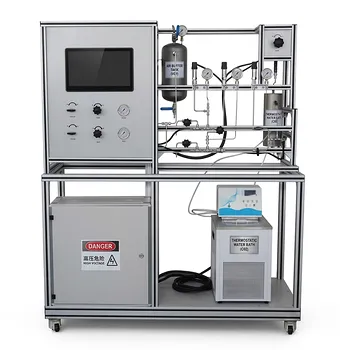
Bridge the gap between thermodynamic theory and real-world practice with LABPARK. We provide state-of-the-art Educational and Vocational Unit Operations Pilot Plants in chemical engineering, bioprocess & biotech, and environmental & water treatment. Designed specifically for universities, research institutes, and enterprises, our physical pilot plants serve as the perfect validation for your digital twins and simulation models.
Ensure your students and researchers work with accurate, safe, and reliable systems. Contact LABPARK today to find the perfect pilot plant solution for your institution!
Related Products
- Throttling Effect Determination Educational Unit Operations Pilot Plant
- Natural Product Extraction Unit Operations Training Pilot Plant
- Thermal Desorption Exhaust Gas and Tail Water Treatment Educational Pilot Plant
- Multi-Reactor Educational Pilot Plant for Reaction Engineering Unit Operations
- Carbon Material Thermal Pretreatment Multiphase Separation Educational Pilot Plant
People Also Ask
- How does kinetic theory explain ideal vs real gas energy differences? Key Pilot Plant Insights
- How are open and closed system boundaries defined when evaluating material balances across educational pilot plant equipment?
- How can selective solvent dissolution and physical property differentials improve pilot-plant recovery?
- How can educational pilot plants be used to teach process safety and risk assessment in chemical engineering curricula?
- Which critical operational criteria should students evaluate when analyzing chemical process units on educational pilot plants? 4 Key Criteria